The Ney Mfg. Co. No. 403 Barn Hay Pulley
SSC MUSEUM COLLECTION
Catalog No. SSC-NEYMFG-PLY-403-001
Barn Hay Pulley | Cast Iron Frame with Wood Sheave | No. 403 | Canton, Ohio
c. 1879–1920 • The Ney Mfg. Co. • Ohio Foundry Corridor

Detail of the manufacturer’s side showing “THE NEY MF’G CO.” cast in raised letters around the upper arc and “CANTON OHIO” around the lower arc of the cast iron cheek plate. The wooden sheave is visible through the four openings in the cross-spoke hub design. The square axle nut at center holds the sheave assembly together.
Before the hay baler. Before the tractor with a front-end loader. Before any of the machinery that modern farmers take for granted, there was a rope, a pulley, and a man standing in a hay wagon with a pitchfork. Moving loose hay from the wagon into the barn loft was one of the most physically demanding tasks on a nineteenth-century farm—and the barn hay pulley was the simple machine that made it possible. A rope ran from the hay fork through this pulley, mounted at the peak of the barn, and back down to a draft horse or team. When the horse pulled, the fork grabbed a load of hay and lifted it to the rafters, where a carrier on a track moved it to the desired position in the loft and released it. The system was elegant, effective, and entirely dependent on cast iron components that could withstand the repeated stress of lifting hundreds of pounds of hay, multiple times a day, for decades.
The Ney Manufacturing Company of Canton, Ohio, was one of the leading producers of this equipment. Founded on a patent by Jacob Ney of North Industry, near Canton, the company built its business on hay elevators, conveyors, carriers, forks, pulleys, and the full range of barn hardware that American agriculture demanded in the era between the Civil War and the mechanization of farming. This No. 403 barn hay pulley is a characteristic Ney product: a cast iron frame with a wooden sheave, designed to be mounted at the peak or gable end of a barn to guide the rope in a hay-hoisting system. It carries the company’s full name—“THE NEY MF’G CO. / CANTON OHIO”—on one side and the patent date—“PAT’D. DEC 16 1879”—on the other. That date corresponds to Jacob Ney’s original patent for his lever hay elevator and conveyor, the invention that launched the company.
The Barn Hay Pulley
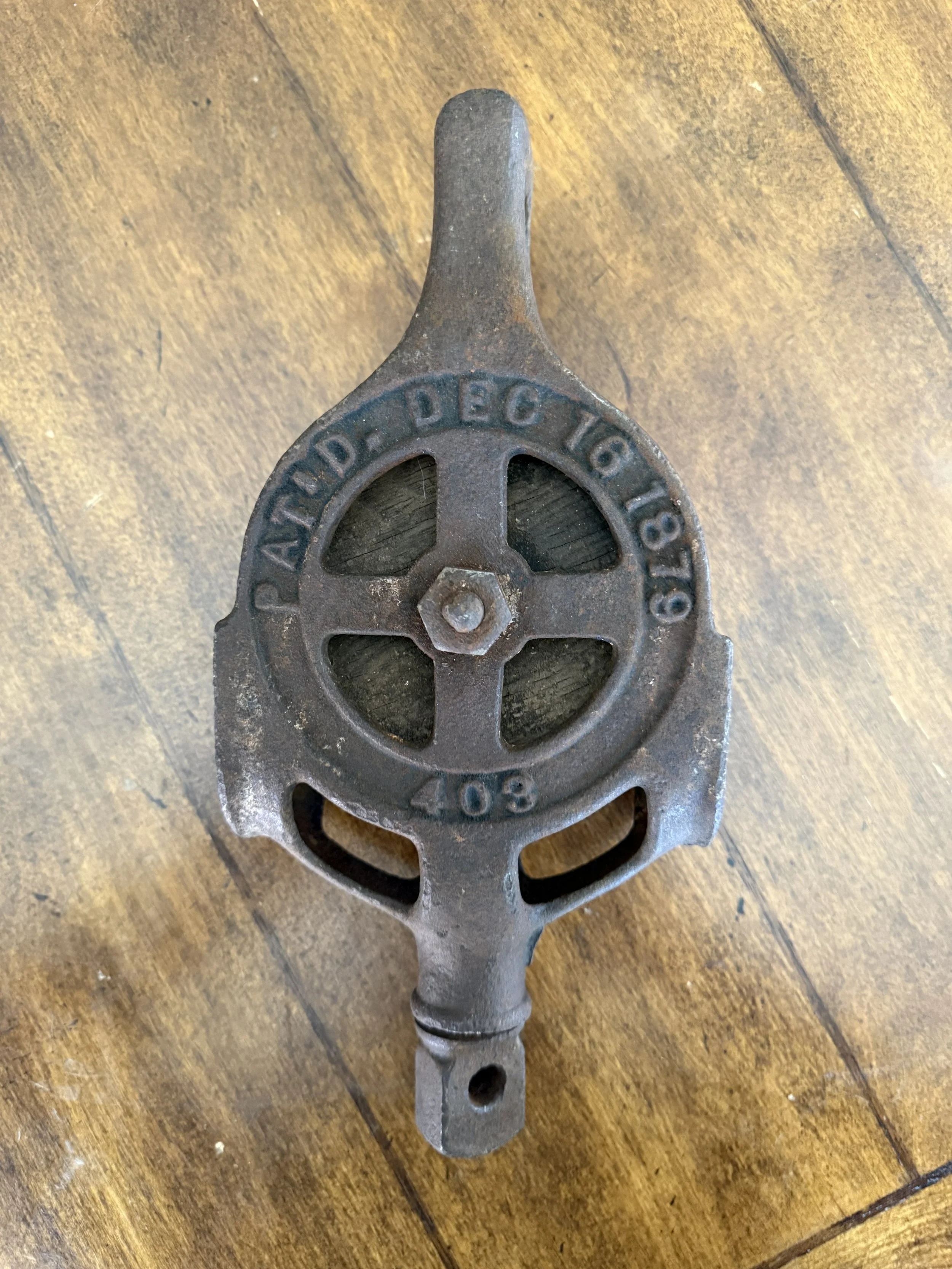
Patent side showing “PAT’D. DEC 16 1879” cast in raised letters around the upper arc and “403” cast below the sheave—the Ney catalog number for this pulley model. The December 16, 1879 patent date corresponds to Jacob Ney’s original patent for his lever hay elevator and conveyor, the foundational invention for the Ney Manufacturing Company.
The design is simple and purpose-built. Two cast iron cheek plates form the frame, connected at top by a hook or mounting loop for attaching to a barn rafter or peak bracket, and at bottom by a clevis-style hook for connecting to the next element in the rope-and-pulley system. Between the cheek plates sits a wooden sheave—a grooved wheel that guides the rope. The wood sheave was standard for hay pulleys of this era: lighter than an all-iron wheel, quieter in operation, and less likely to damage the rope through abrasion. The four-spoke hub design visible through the openings in the cheek plates provided structural rigidity while keeping weight manageable. The hex nut on the axle bolt allowed for servicing and sheave replacement.
The No. 403 designation is a catalog number, not a patent number. Ney Manufacturing produced a wide range of pulleys in different sizes and configurations—single sheave, double sheave, fixed mount, swivel mount—each assigned its own catalog number. The 403 was a standard single-sheave barn pulley, part of a system that included hay forks, carriers, track, floor hooks, hanging hooks, and the various connectors that tied the whole apparatus together. A farmer buying Ney equipment could outfit an entire barn from a single catalog, with every component designed to work together.

Profile view showing the wooden sheave seated between the two cast iron cheek plates. The grooved rim of the sheave guided the rope in the hay-hoisting system. The wood construction was standard for the era: lighter, quieter, and gentler on rope than an all-iron wheel. Age checking is visible in the wood grain—consistent with over a century of barn service.
Piece Details
Manufacturer
The Ney Mfg. Co.
Piece Type
Barn Hay Pulley (single sheave)
Form
Cast iron cheek plates with wooden sheave; hook/mount loop at top; clevis hook at bottom; hex nut axle
Catalog Number
No. 403
Material
Cast iron (frame), wood (sheave), steel (axle hardware)
Marking
“THE NEY MF’G CO. / CANTON OHIO” on one cheek plate; “PAT’D. DEC 16 1879 / 403” on opposite cheek plate
Patent
December 16, 1879 — Jacob Ney’s original patent for lever hay elevator and conveyor
Date of Manufacture
c. 1879–1920
Place of Manufacture
Canton, Stark County, Ohio
Condition
Good — cast iron frame intact with legible markings on both sides; wooden sheave intact with age checking; hex nut and axle present; mounting loop intact; no cracks in casting
Acquisition Date
March 10, 2026
Acquisition Source
eBay — Seller: videoandstuff
eBay Item Number
297915829242
Order Number
22-14330-56956
SSC Catalog Number
SSC-NEYMFG-PLY-403-001
Collection Designation
Ohio Foundry Corridor
The Ney Mfg. Co.: Canton’s Hay Tool Empire
The Ney Manufacturing Company began with a single invention: a hay elevator and conveyor patented by Jacob Ney of North Industry, a community near Canton in Stark County, Ohio. The original patent was issued December 16, 1879—the date cast into this pulley. An 1881 Stark County history described the genesis of the invention: Jacob Ney had spent years building and installing hay elevators, and found that most of those in use did not properly perform their work and failed to satisfy the farmers who used them. He set out to design an elevator that would combine all the advantages and avoid the defects of existing systems. The result was Ney’s Patent Lever Hay Elevator and Conveyor, the foundation upon which the entire Ney manufacturing enterprise was built.
In 1884, Jacob Ney assigned his patent holdings to his father, Valentine Ney, and his brother, Valentine L. Ney. In 1888, the Ney family sold the business to the Miller family, who continued to operate it as The Ney Manufacturing Company from a facility on High Street S.W. in Canton, at the junction of the Fort Wayne and Valley Railways. Under the Millers, the company expanded far beyond the original hay elevator patent, producing a full catalog of barn hay equipment: hay forks, hay carriers and track, hay fork pulleys and associated hooks and hangers, American sickle-edge hay knives, and automatic lawn rakes. They also developed a complete line of dairy barn equipment including stanchions, watering bowls, litter carriers, and ventilating systems.
Meanwhile, Valentine L. Ney—Jacob’s brother, born in Canton in 1854 to Bavarian immigrant parents—went on to form his own competing company. In 1893, he organized the V.L. Ney Manufacturing Company (later the V.L. Ney Hay Tool Co.), operating from 906 Spring Avenue N.E. in Canton. This second Ney company also produced hay forks, carriers, track, pulleys, and hangers. The connection between the two firms was murky even to contemporaries, though both clearly sprang from Jacob Ney’s original 1879 patent. Canton thus had two separate Ney companies, both making hay tools, operating simultaneously in the same small city—a testament to both the Ney family’s inventive legacy and the scale of the American hay equipment market.
Canton itself was a beehive of farm equipment manufacturing during the latter half of the nineteenth century and the first half of the twentieth. Threshers, reapers, plows, tillage tools, hay mowers, rakes, and other agricultural implements were all produced there. The Ney companies were part of a manufacturing ecosystem that made Stark County one of the most concentrated centers of agricultural hardware production in the Midwest.
Corporate Timeline: The Ney Mfg. Co.
1879
Jacob Ney of North Industry, near Canton, Ohio, receives U.S. patent (issued December 16, 1879) for his lever hay elevator and conveyor. This patent becomes the foundation of the Ney Manufacturing Company.
1884
Jacob Ney assigns his patent holdings to his father, Valentine Ney, and brother, Valentine L. Ney.
1888
The Ney family sells the business to the Miller family. The company continues as The Ney Manufacturing Company, located on High Street S.W. in Canton at the junction of the Fort Wayne and Valley Railways.
1893
Valentine L. Ney organizes the V.L. Ney Manufacturing Company (later V.L. Ney Hay Tool Co.) at 906 Spring Avenue N.E., Canton. Two separate Ney companies now operate in the same city.
c. 1890s–1920s
The Ney Mfg. Co. expands its catalog to include hay forks, carriers, track, pulleys, hooks, hangers, sickle-edge hay knives, automatic lawn rakes, children’s hand sleighs, and a full line of dairy barn equipment (stanchions, watering bowls, litter carriers, ventilating systems).
20th c.
Both Ney companies continue to serve the American agricultural market from Canton, Stark County, Ohio, through the transition from horse-powered to mechanized farming.
Canton and the Farm Equipment Corridor
Canton, Ohio, is best known today as the home of the Pro Football Hall of Fame. In the nineteenth and early twentieth centuries, it was known for something very different: farm equipment. Stark County was one of the most concentrated centers of agricultural hardware manufacturing in the Midwest, producing threshers, reapers, plows, tillage tools, hay mowers, rakes, and the full range of implements that American farmers depended on. The Ney companies were part of this ecosystem—specialized manufacturers serving a specific niche within a broader industrial community that touched every aspect of agricultural production.
For the SSC collection, this pulley represents the first piece from Stark County and the first piece from Canton. It also represents the first piece in the collection from the agricultural implements category rather than the household cookware, stove hardware, or foundry promotional categories that dominate the existing collection. The Ney Mfg. Co. was not a cookware foundry. It was a farm equipment foundry that cast iron for a different purpose—but it cast that iron in Ohio, it marked it with its Ohio location, and it serves the SSC mission of documenting the full breadth of Ohio’s foundry heritage. Not every Ohio foundry made skillets. Some made the hardware that kept the farm running, and the Ney barn hay pulley is a perfect example of that broader story.
Why This Piece Matters
The Ney Mfg. Co. No. 403 barn hay pulley matters because it adds Canton and Stark County to the SSC’s Ohio foundry map and expands the collection’s range beyond household cookware into agricultural hardware. The piece carries a patent date of December 16, 1879—Jacob Ney’s original patent, the invention that launched the company—and the full company identification: “THE NEY MF’G CO. / CANTON OHIO.” It is a working piece of farm infrastructure that spent its life in a barn, guiding rope and lifting hay, and it carries the marks of that service in its age-checked wooden sheave and worn iron frame.
The Ney story also illustrates something characteristic of Ohio’s foundry economy: specialization. Just as Madison Foundry in Cleveland specialized in manhole covers, and Dover Manufacturing in Canal Dover specialized in sad irons, the Ney companies in Canton specialized in hay tools. Ohio’s industrial strength was not built on a few giant foundries making everything. It was built on hundreds of specialized manufacturers, each serving a specific market niche, each casting iron for a specific purpose, and each leaving its name and location on the products it shipped across the country. This pulley is one node in that network—a Canton foundry’s answer to the question of how to get hay from the wagon to the loft, cast in iron and built to last.
The iron endures. The markings tell the truth. The story deserves to be told.
Sources & Further Reading
Farm and Dairy — “The Neys Have It: Hay Tools Invented in Canton” (2011): Detailed history of both Ney companies in Canton, Jacob Ney’s 1879 patent, assignment to Valentine and Valentine L. Ney (1884), sale to Miller family (1888), product lines, and catalog descriptions. Quotes from 1881 Stark County history describing the original invention.
Hay Trolley Heaven (haytrolleyheaven.com) — Ney and V.L. Ney manufacturer pages: Catalog of Ney hay carriers, pulleys, and track systems. Biographical entry for Valentine L. Ney from Old Landmarks of Canton and Stark County, Ohio by John Danner (1904).
Smithsonian National Museum of American History — Trade catalogs from Ney Mfg. Co. (Object SILNMAHTL 31897): Product lines including hay forks, carriers, pulleys, track, hooks, hay knives, lawn rakes, children’s sleighs, and dairy barn equipment.
SSC Internal Collection Records.
About Steve’s Seasoned Classics
Steve’s Seasoned Classics is an online museum dedicated to preserving and documenting the heritage of American cast iron, with a focus on Ohio foundry pieces from the 19th and early 20th centuries. The SSC collection features over 130 pieces with detailed provenance, historical research, and photography for each item.
