The A.C. Williams Co. Sad Iron
SSC MUSEUM COLLECTION
Catalog No. SSC-ACWILLIAMS-IRN-1893-001
Solid Sad Iron | Detachable Wood Handle | Cast Iron | Ravenna, Ohio
Circa 1893–1910 • The A.C. Williams Company • Ohio Foundry Corridor

Close-up of the maker’s mark cast into the top of the sad iron, showing “RAVENNA, OHIO” in raised letters around the handle post. The “WILLIAMS CO” marking appears on the opposite side. The text is cast directly into the iron as part of the original pattern. This is a production sad iron from the A.C. Williams Company of Ravenna, Portage County, Ohio—one of the most significant foundry operations in the state’s history, though known today primarily for its cast iron toys and banks rather than for the household hardware that built the business.
Every great company has an origin product—the thing it made before it became famous for something else. For the A.C. Williams Company of Ravenna, Ohio, that product was the sad iron. Before the cast iron banks. Before the toy automobiles and airplanes. Before the horse-drawn rigs sold through Woolworth’s and Kresge’s five-and-dime stores. Before A.C. Williams became the largest manufacturer of cast iron toys in the world—there was a heavy, solid, delta-shaped piece of cast iron with a detachable wooden handle, heated on a stove and used to press clothes. The sad iron is where the A.C. Williams story begins, and it is the product that—through an accident of salesmanship—launched one of America’s most celebrated toy foundries.
This piece is a solid sad iron marked “WILLIAMS CO.” and “RAVENNA, OHIO” in raised letters cast into the top surface, flanking the handle post. It features a detachable wooden handle with a spring-loaded clip mechanism that allowed the user to release the handle from one iron and attach it to a freshly heated replacement—the standard system for sad iron use in the late nineteenth and early twentieth centuries. The marking places this iron in the Ravenna period of the company’s history, meaning it was produced after the 1892 relocation from Chagrin Falls and most likely before the company’s full transition to toys and banks in the early 1900s.
From Plow Points to Pressing Irons: The Williams Family Foundry

View of the “WILLIAMS CO.” marking on the top of the iron, visible in raised letters on the near side of the handle post. The detachable handle mechanism is visible above: a spring-loaded clip that locks onto the iron’s post and releases with a thumb press, allowing the handle to be transferred between heated irons. The handle is original wood, showing the wear and patina of more than a century of age.
The A.C. Williams Company traces its origins to 1844, when John Wesley Williams established a small foundry on the Chagrin River in Chagrin Falls, Cuyahoga County, Ohio. The Williams family had migrated from western New York to Chagrin Falls in 1840, part of the Reverend Benajah Williams’s large clan of eight sons. John Williams started with a one-ton cupola and a single molder, producing chain pump reels, spouts, and plow points. When he had a wagon load finished, he would drive through the countryside trading his products for scrap iron and farm produce—there was almost no cash economy, and most of the business was done by barter.
Over the following decades, the foundry expanded into stoves, wagon boxes, wrought iron axles, and polished flat irons. During the Civil War, John Williams secured a contract for cannon carriages for the Union Army. His son, Adam Clark Williams, joined the business full-time in 1865, and the firm became J.W. Williams & Son. A line of pruning tools was added in 1870. When John Wesley Williams died in 1886 after forty-two years in business, the local tribute said that no single person had done more for the material success of Chagrin Falls.
Adam Clark Williams purchased the business from his father’s estate in 1886 and immediately expanded the product line, adding sad irons with wooden handles. With five molders and a total of fifteen employees, the newly renamed A.C. Williams Company began producing the heavy pressing irons that were a staple of every American household. A narrow-gauge railroad, built by ten leading citizens of Chagrin Falls including Williams himself, provided the transportation link that the growing foundry needed.
Two Fires and a New City: The Move to Ravenna

Side profile of the Williams sad iron with the detachable wooden handle in place. The classic delta shape of the solid sad iron is clearly visible: wide at the rear, tapering to a point at the front for reaching into pleats and gathers. The handle rides high above the body on a cast iron post, keeping the user’s grip away from the heated surface. This is a stove-heated iron—a solid slab of cast iron that absorbed heat from a stove top and retained it long enough to press a batch of clothes before requiring reheating.
In the fall of 1889, while A.C. Williams was attending a show at the Park Theatre in Cleveland, a man came onstage and announced that if A.C. Williams was in the audience, he should report to the box office immediately. There he learned that his foundry in Chagrin Falls was on fire and there was little hope of saving it. He returned home the next morning to find the plant destroyed. With characteristic determination, Williams borrowed from a dozen friends and the local bank, and on a Sunday morning two weeks later, one hundred men showed up to work on rebuilding the plant—without any thought of pay. The foundry was rebuilt and production resumed.
Then, on Thanksgiving night 1892, fire destroyed the plant again. This time, Williams decided to leave Chagrin Falls entirely. The village lacked adequate fire protection and had relatively poor shipping facilities—two problems that had now cost him his factory twice. He visited towns across northeastern Ohio and selected Ravenna, in Portage County, for its railroad access and organized fire department. Construction of the new plant began in the winter of 1892–1893. The Panic of 1893 shut the operation down for several months, but Williams reopened as soon as conditions allowed.
The Sad Iron That Launched a Toy Empire
When A.C. Williams resumed production in Ravenna, he found that the demand for sad irons was diminishing. The electric iron was on the horizon, and the market for stove-heated pressing irons was beginning to soften. Williams finished up his remaining inventory of full-size sad irons, nickel-plating some to make them more attractive, and also produced some small miniature models for his traveling salesmen to carry as samples.
Those miniature sad irons changed everything. The small models—produced as a convenience for the sales force—caught the eye of a buyer in Detroit who suggested they would make excellent toys. Williams recognized the opportunity. Over the next thirty years, the A.C. Williams Company expanded from miniature sad irons into a full line of cast iron toys: horse-drawn rigs, wheeled vehicles, automobiles, tractors, airplanes, and—most famously—cast iron penny banks. By the 1920s, A.C. Williams was recognized as the largest manufacturer of cast iron toys in the world, with products distributed through Woolworth’s, Kresge’s, and other five-and-dime stores across the country.
The company was incorporated as The A.C. Williams Company in 1905, with Williams as President, his son John W. Williams as Vice President, and his son-in-law J.H. Bigalow as Secretary and Treasurer. A.C. Williams sold his interest in the company in 1919 and moved to California. He died on June 15, 1932. The toy and bank lines continued until 1937–1938, when competition from inexpensive plastic and rubber toys and changing consumer demands led the company to transition into a jobbing foundry, casting industrial parts for other manufacturers. During World War II, the Ravenna plant produced bomb plugs, grenades, half-track castings, and aircraft parts in its newly developed magnesium division. The company continued as a precision casting operation and eventually became Lite Metals Company, which still operates in Ravenna today.
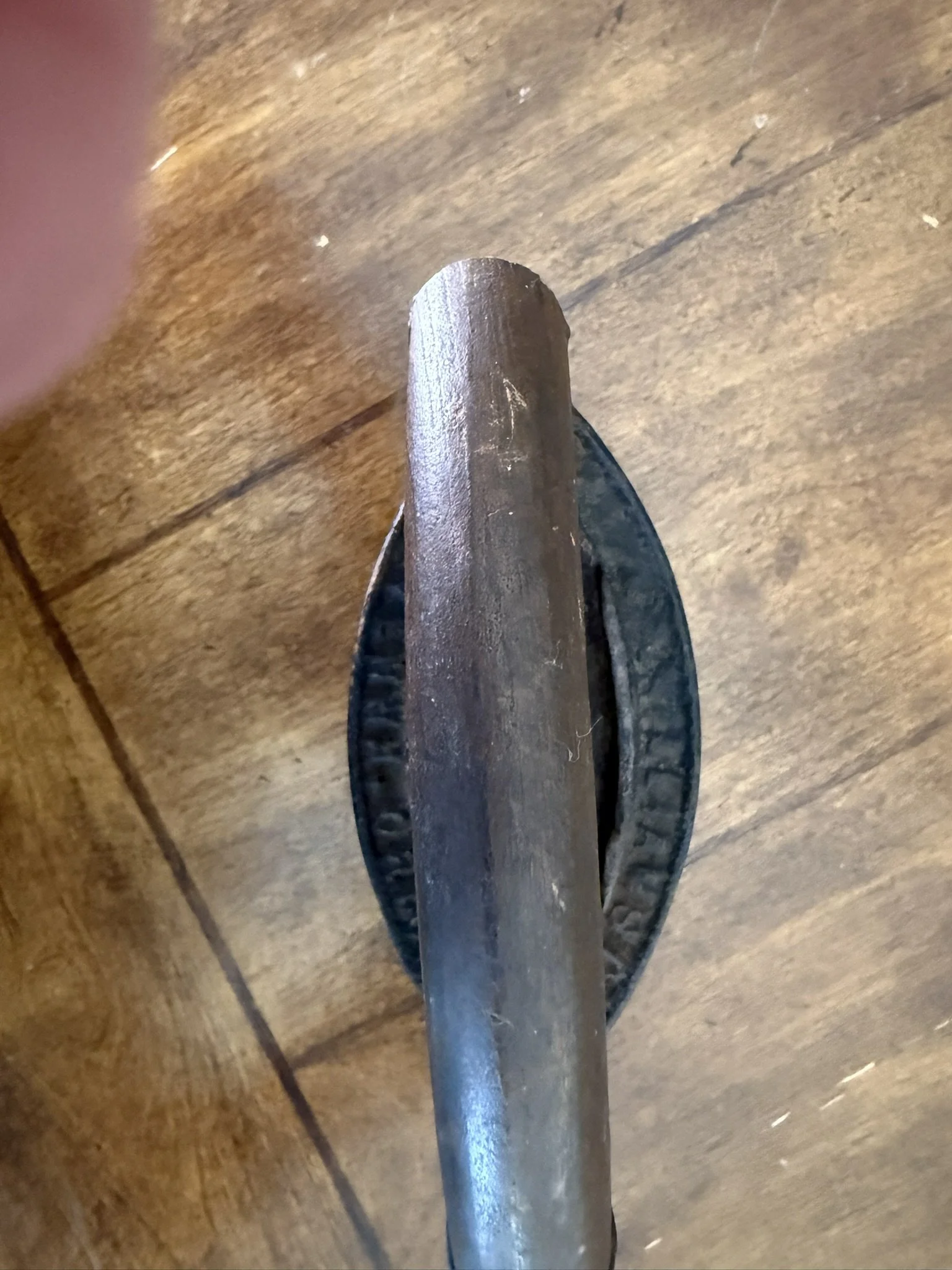
Top-down view showing both halves of the maker’s mark: “WILLIAMS CO.” on the left and “RAVENNA, OHIO” on the right, flanking the central handle post. The spring-loaded clip mechanism of the detachable handle is clearly visible. This handle design allowed a homemaker to keep two or three irons heating on the stove simultaneously and swap the handle between them as each one cooled—a system that kept the pressing process moving without waiting for a single iron to reheat.
Piece Details
Manufacturer
The A.C. Williams Company (founded as J.W. Williams & Son), Ravenna, Ohio
Piece Type
Solid Sad Iron (flat iron) with detachable wooden handle
Form
Delta-shaped solid cast iron body with central post for spring-clip detachable handle; pointed front, flat sole plate
Material
Cast Iron with wooden handle
Marking
“WILLIAMS CO.” and “RAVENNA, OHIO” cast in raised letters on top surface, flanking handle post
Purpose
Household clothes pressing iron, heated on a stove top
Date of Manufacture
Circa 1893–1910
Place of Manufacture
Ravenna, Portage County, Ohio
Condition
Good — legible maker’s mark and city mark; original detachable wooden handle intact and functional; spring clip mechanism operational; sole plate shows normal use wear and surface oxidation consistent with age
Acquisition Date
March 12, 2026
Acquisition Source
Etsy — Seller: stoneridgeattic
Etsy Transaction Number
4999427709
Order Number
3999470792
SSC Catalog Number
SSC-ACWILLIAMS-IRN-1893-001
Collection Designation
Ohio Foundry Corridor
Corporate Timeline: The A.C. Williams Company
1844
John Wesley Williams establishes a foundry on the Chagrin River in Chagrin Falls, Cuyahoga County, Ohio. Products include chain pump reels, spouts, and plow points.
c. 1850s
Foundry expands into the “Empire” wood-burning stove, wagon boxes, wrought iron axles, and polished flat irons.
1861–1865
J.W. Williams secures a Union Army contract for cannon carriages during the Civil War.
1865
Adam Clark Williams (b. 1848) joins the foundry full-time. Firm becomes J.W. Williams & Son. Pruning tools added in 1870.
1886
John W. Williams dies. Adam Clark Williams purchases the business and renames it the A.C. Williams Company. Adds a line of sad irons with wooden handles.
1889
Fire destroys the Chagrin Falls foundry. Plant rebuilt within weeks by community volunteers.
1892
Second fire destroys the plant on Thanksgiving night. Williams decides to relocate to Ravenna, Portage County, Ohio, for railroad access and fire protection.
1892–1893
New plant erected in Ravenna. Panic of 1893 forces temporary shutdown. On resuming, Williams finds sad iron demand diminishing.
c. 1893–1895
Miniature sad iron models produced for traveling salesmen become the genesis of the toy line. A Detroit buyer suggests the models would sell as toys.
1893–1923
A.C. Williams produces cast iron toys: horse-drawn rigs, wheeled vehicles, automobiles, tractors, and airplanes, sold through Woolworth’s and Kresge’s.
1905
Business incorporated as The A.C. Williams Company. Officers: A.C. Williams, President; John W. Williams (son), VP; J.H. Bigalow (son-in-law), Secretary-Treasurer.
1910s–1930s
Cast iron penny banks become a major product line—hundreds of types and styles produced, all now prized collectors’ items.
1919
A.C. Williams sells his interest and moves to California. Company continues under family management.
1932
Adam Clark Williams dies June 15, age 84.
1937–1938
Last toys and hardware items produced. Company transitions to jobbing foundry, casting industrial parts for other manufacturers.
1940s
WWII production: machine tool castings, bomb plugs, grenades, half-track castings, and aircraft parts (magnesium and aluminum divisions).
Present
The company continues operations in Ravenna as Lite Metals Company (magnesium and aluminum castings) and affiliated foundries.
The Sad Iron: America’s Universal Household Tool

Sole plate of the Williams sad iron, showing the smooth pressing surface. The sole plate is the business end of the iron—the surface that made contact with fabric when heated. The delta shape, pointed at the front and wide at the rear, was universal across sad iron manufacturers. The dark patina and surface texture are consistent with a well-used iron of the late nineteenth century. “Sad” in this context derives from the Old English word for “solid”—a sad iron is simply a solid iron, as opposed to a hollow box iron or charcoal iron.
The sad iron was the most common pressing tool in American households from the mid-nineteenth century through the early twentieth century. The form is simple: a heavy, solid slab of cast iron, roughly delta-shaped, with a flat sole plate on the bottom and a handle on top. The iron was placed on a hot stove to absorb heat, then used to press clothes until it cooled, at which point it was returned to the stove and a freshly heated replacement was picked up. The detachable handle—a key innovation of the period—allowed a single wooden grip to serve multiple iron bases, so the user always had a cool handle regardless of which iron was in use.
The word “sad” has nothing to do with emotion. It comes from the Old English “sald,” meaning solid or heavy. A sad iron is simply a solid iron—distinguishing it from hollow charcoal irons, gas-heated irons, and later electric irons. Sad irons were produced by foundries across the country in enormous quantities. They were among the simplest products a foundry could cast—a solid mass of iron with minimal pattern complexity—and they sold in volume to every household in America. For a foundry like A.C. Williams, sad irons were a bread-and-butter product: easy to cast, easy to sell, and reliably profitable.
Why This Piece Matters
The A.C. Williams sad iron matters because it is the origin product of one of Ohio’s most significant foundry operations—the product that the company made before it became famous for something else entirely. The A.C. Williams Company is remembered today as the world’s largest manufacturer of cast iron toys, the maker of hundreds of types of penny banks, and a foundry whose cast iron automobiles and airplanes are prized by collectors who pay hundreds or thousands of dollars for individual pieces. But before any of that, there were sad irons.
The direct connection between the sad iron and the toy line is not metaphorical—it is literal. When demand for full-size sad irons declined in the mid-1890s, Williams produced miniature models for his salesmen to carry as samples. Those miniatures caught a buyer’s eye and became the first A.C. Williams toys. The sad iron is the bridge product: the last item from the old Williams foundry business of stoves, plows, and hardware, and the direct ancestor of the toy business that would make the company famous. Without the sad iron, there are no miniature models. Without the miniature models, there is no toy line. Without the toy line, there is no A.C. Williams as the world knows it.
The Ravenna marking on this iron places it squarely in that transitional period—after the 1892 move from Chagrin Falls and during the years when Williams was still producing sad irons alongside his emerging toy business. It is an artifact of the moment when one of Ohio’s great foundries was about to transform itself, cast in the iron of the product that made the transformation possible.
The iron endures. The markings tell the truth. The story deserves to be told.
Sources & Further Reading
Physical examination of piece: “WILLIAMS CO.” and “RAVENNA, OHIO” cast in raised letters on top surface. Solid sad iron with detachable wooden handle and spring-clip mechanism.
Chagrin Falls Historical Society (chagrinhistorical.org) — “J.W. Williams Co.” history page. Foundry established 1844 on Chagrin River; sad irons added 1886; fires 1889 and 1892; move to Ravenna.
Chagrin Falls Historical Society — “Adam Clark Williams” biographical document (born January 22, 1848; died June 15, 1932). Detailed company history from founding through relocation.
Lite Metals Company (litemetals.com) — “Early History” and “The Move to Ravenna.” Corporate successor to A.C. Williams Company; detailed narrative of the Ravenna plant construction, Panic of 1893 shutdown, transition from sad irons to toys.
WorthPoint Dictionary — “A.C. Williams Toy Company.” Company overview: founded 1844, sad irons added 1886, fires 1889/1892, Ravenna relocation, toy production 1893–1938, largest cast iron toy manufacturer in the world.
AntiqueToys.com — A.C. Williams maker page. Confirms Ravenna relocation, toy line origins from miniature sad iron models, distribution through Woolworth and Kresge’s.
SSC Internal Collection Records — Ohio foundry pieces from Portage County (first entry).
About Steve’s Seasoned Classics
Steve’s Seasoned Classics is an online museum dedicated to preserving and documenting the heritage of American cast iron, with a focus on Ohio foundry pieces from the 19th and early 20th centuries. The SSC collection features over 130 pieces with detailed provenance, historical research, and photography for each item.
