Buckeye Iron & Brass Works 2” Fig. 671 Cleanout Cap
SSC MUSEUM COLLECTION
Catalog No. SSC-BUCKEYE-CAP-1900-001
2” Fig. 671 | Industrial Cleanout Cap | Dayton, Ohio
Circa 1890–1920 • Buckeye Iron & Brass Works • Ohio Foundry Corridor
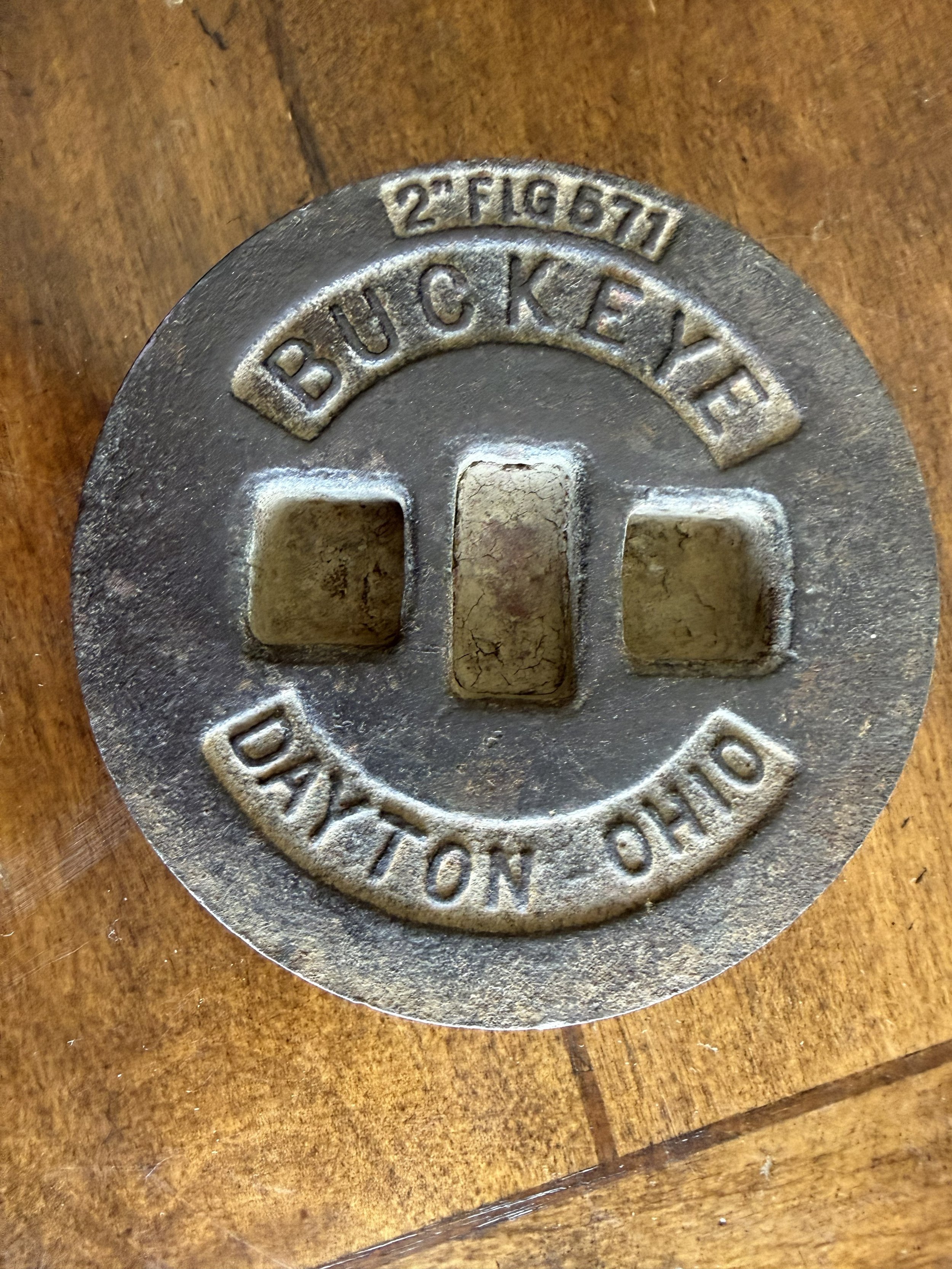
Face marking: “2” FIG 671 / BUCKEYE / DAYTON OHIO” with three rectangular port openings for wrench engagement. The casting retains its original unrestored surface patina—consistent with SSC’s Archival Black™ non-destructive preservation protocol.
This unassuming cast iron cleanout cap carries one of the great untold connections in American industrial history. Marked “BUCKEYE / DAYTON OHIO,” it was produced by the Buckeye Iron & Brass Works—a Dayton foundry whose story stretches from the 1840s to the mid-twentieth century, and whose castings touched industries from cottonseed oil processing to aviation.
The foundry’s most remarkable chapter came at the dawn of the twentieth century. When Orville and Wilbur Wright needed an aluminum crankcase cast for the engine that would power their 1903 Flyer, they turned to their local Dayton foundry: Buckeye Iron & Brass Works. The Smithsonian’s National Air and Space Museum confirms this connection—the crankcase that helped achieve the first powered flight was a Buckeye casting. This SSC piece thus represents the same foundry whose work is preserved in one of the most important artifacts in the Smithsonian’s collection.
By the early twentieth century, Buckeye had become a major supplier of fluid transfer equipment—nozzles, dry-break couplings, valves, and fittings for oil refineries, bulk fuel plants, and service stations. The Smithsonian’s American History Museum holds Buckeye trade catalogs documenting this product line. The “Fig. 671” designation on this piece is a catalog figure number, identifying it as a 2-inch cleanout cap from Buckeye’s standardized industrial offerings.
Piece Details
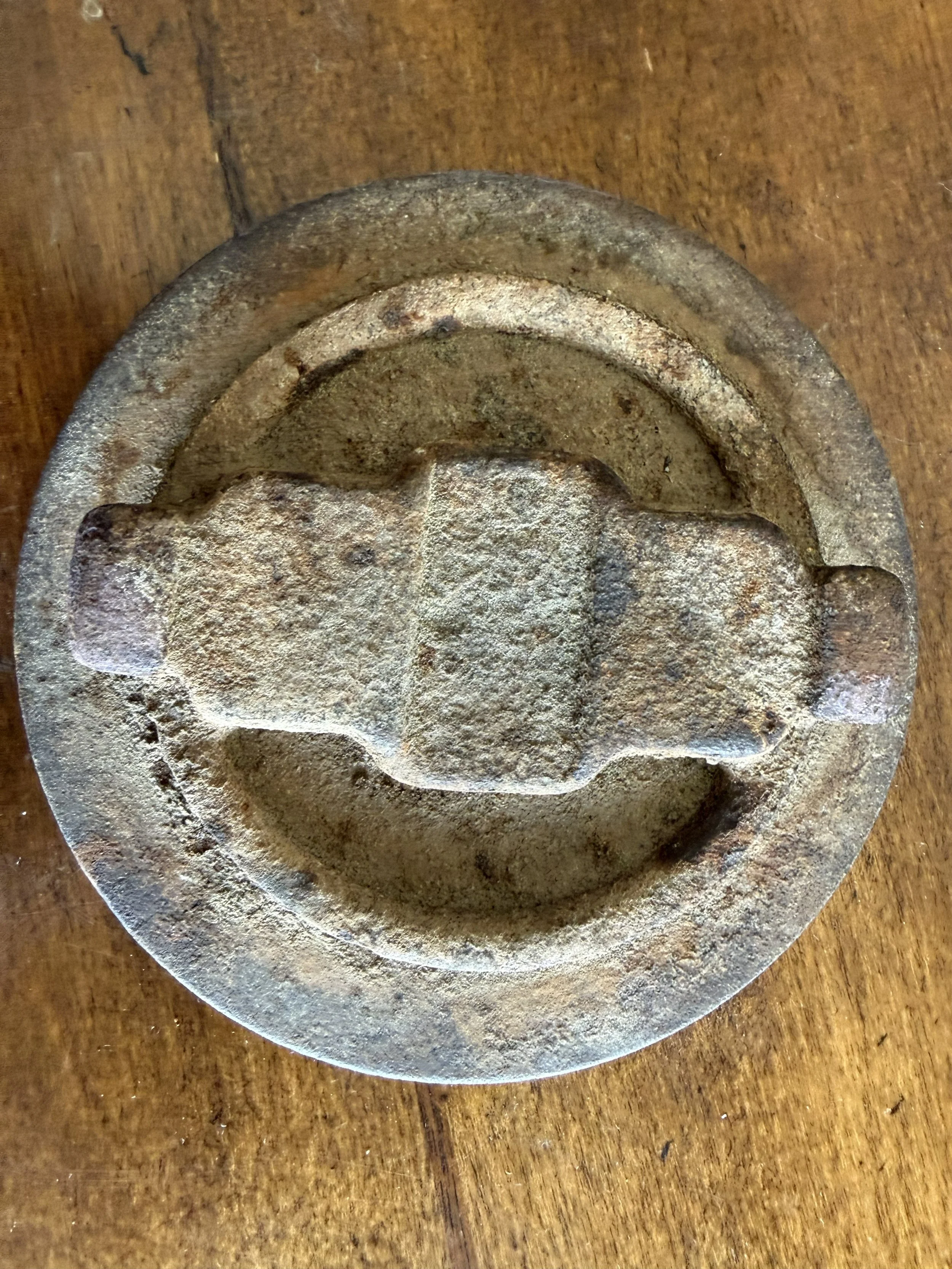
Reverse side showing the raised turnkey lug cast integrally with the disc. This feature provided a grip point for threading the cap into its pipe fitting by hand or with a bar wrench.
Manufacturer
Buckeye Iron & Brass Works
Piece Type
2” Cleanout Cap / Pipe Fitting Cover (Fig. 671)
Material
Cast Iron
Marking (Face)
2” FIG 671 / BUCKEYE / DAYTON OHIO
Marking (Reverse)
Raised turnkey / wrench lug for threaded installation
Date of Manufacture
Circa 1890–1920 (estimated)
Place of Manufacture
Dayton, Montgomery County, Ohio
Condition
Original unrestored surface; intact casting with clear legible markings; no cracks
Acquisition Date
March 6, 2026
Acquisition Source
eBay — Seller: pasthistory67
eBay Item Number
195404883753
Order Number
04-14336-09178
SSC Catalog Number
SSC-BUCKEYE-CAP-1900-001
Collection Designation
Ohio Foundry Corridor
Form and Function: What a Fig. 671 Cleanout Cap Does
The piece is a cast iron cleanout cap—a threaded cover designed to seal access points in plumbing or industrial piping systems. The face features three rectangular openings arranged in a row, which served as tool engagement points for a wrench or bar to thread the cap in and out of its fitting. The reverse shows a raised turnkey lug cast integrally with the disc, providing an alternative grip for installation. The “2”” designation indicates the nominal pipe size of the fitting it sealed.
The casting quality is characteristic of a well-equipped late-nineteenth or early-twentieth-century Ohio foundry: clean lettering, even walls, and functional precision. These were not decorative objects. They were workaday industrial components—the kind of thing that was installed once and forgotten, doing its job in silence for decades. That this one survived with its markings fully legible and its casting intact is a testament to the quality of the Dayton foundry that produced it.
The Foundry That Helped the Wright Brothers Fly
The company’s origins trace to the mid-1840s, when George W. Hoglen and W. H. Pease established a small iron and brass foundry in Dayton. An 1897 biographical record of Montgomery County places the founding as early as 1844. By 1876, the firm was formally incorporated as the Buckeye Iron & Brass Works under Charles E. Pease. Over the following decades, it grew into a significant Dayton manufacturer producing wheel-making machinery, milling machines, cottonseed oil processing equipment, and—most critically for the collection’s narrative—a full range of industrial valves, fittings, nozzles, and pipe components.
The Wright Brothers connection is the headline. When the Wrights needed an aluminum crankcase for the custom engine that would power the 1903 Flyer at Kitty Hawk, they contracted the job to their local Dayton foundry—Buckeye Iron & Brass Works. The Smithsonian’s National Air and Space Museum documents this fact explicitly. The crankcase was a first in aircraft construction: an aluminum casting for an internal combustion engine designed specifically for flight. Buckeye made it. The same foundry that produced this utilitarian cleanout cap also produced the casting that made powered flight possible.
That a single Ohio foundry’s production range could span from a 2-inch pipe fitting to the engine crankcase of the most important aircraft ever built says everything about the versatility and capability of Dayton’s industrial base at the turn of the twentieth century. Buckeye was not a niche operation. It was a full-service foundry that took on whatever work its Dayton neighbors needed done—and its Dayton neighbors happened to include two bicycle mechanics who were trying to fly.
The End of Buckeye
Buckeye Iron & Brass Works operated in Dayton for over a century before being acquired by Emco, Ltd. in 1965. Operations were relocated to Conneaut, Ohio, and the company was briefly known as Emco-Buckeye, Inc. before merging with the A. W. Wheaton Brass Works to form Emco Wheaton Inc. The Dayton foundry that cast aluminum for the Wright Brothers and iron fittings for America’s industrial infrastructure was gone—absorbed into a multinational fluid transfer conglomerate that eventually passed through Syltone plc and Gardner Denver Inc.
Corporate Timeline: Buckeye Iron & Brass Works
c.1844
George W. Hoglen and W. H. Pease establish a small iron and brass foundry in Dayton, Ohio. The earliest known reference appears in an 1897 Montgomery County biographical record.
1876
The firm is formally incorporated as Buckeye Iron & Brass Works under Charles E. Pease. Production expands to include wheel-making machinery, milling machines, and cottonseed oil processing equipment.
1880s–90s
Buckeye develops a full line of industrial valves, fittings, nozzles, and pipe components. The Fig. 671 cleanout cap enters the product catalog during this period. Trade catalogs are produced and later preserved by the Smithsonian.
1903
Orville and Wilbur Wright contract Buckeye to cast the aluminum crankcase for the engine of the 1903 Flyer—the first powered aircraft. The casting is now in the Smithsonian National Air and Space Museum.
1900s–50s
Buckeye continues as a major Dayton manufacturer of fluid transfer equipment: nozzles, dry-break couplings, underwing aircraft refueling couplers, and industrial fittings.
1965
Emco, Ltd. acquires Buckeye Iron & Brass Works. Operations relocate from Dayton to Conneaut, Ohio. The company becomes Emco-Buckeye, Inc. before merging with A. W. Wheaton Brass Works to form Emco Wheaton Inc.
1965–
The Dayton foundry ceases operations permanently. No successor company operates under the Buckeye name. Emco Wheaton passes through Syltone plc (1995) and Gardner Denver Inc. (2004).
Why This Piece Matters
This 2” Fig. 671 cleanout cap is exactly the kind of piece that defines the SSC mission: a legibly marked, well-preserved casting from a defunct Ohio foundry with a story far larger than its physical size. It is not cookware. It is not decorative. It is an industrial fitting—a working component from the infrastructure of American industry—and it carries the name of a foundry that helped the Wright Brothers fly.
Buckeye Iron & Brass Works sits alongside Cleveland’s forgotten foundries and the Ohio Foundry Corridor manufacturers in SSC’s expanding documentation of Ohio’s industrial cast iron heritage. The SSC collection has broadened its mission beyond cookware to include any marked piece from an obscure Ohio foundry—industrial, agricultural, and domestic iron all qualify—and this Buckeye cleanout cap is a powerful example of why that expansion matters. Some of the best stories in American cast iron are not on skillets. They are on the workpieces that built the infrastructure.
The iron endures. The markings tell the truth. The story deserves to be told.
Sources & Further Reading
Smithsonian National Air and Space Museum — “The Wright Engine Aluminum Crankcase”: confirms Buckeye Iron & Brass Works of Dayton cast the 1903 Flyer crankcase.
Smithsonian American History Museum, Trade Catalogs Collection (Record SILNMAHTL_8908): Buckeye Iron & Brass Works catalogs for valves and fittings for the oil industry.
VintageMachinery.org — Buckeye Iron & Brass Works history: founded 1876, manufactured wheel-making machinery, milling machines, and oil processing equipment.
Centennial Portrait and Biographical Record of the City of Dayton and of Montgomery County, Ohio (A. W. Bowen & Co., 1897): John Hoban biography references founding c. 1844 by Hoglen and Pease.
Emco Wheaton corporate history (emcowheaton.com): 1965 acquisition of Buckeye, formation of Emco Wheaton Inc.
About Steve’s Seasoned Classics
Steve’s Seasoned Classics is an online museum dedicated to preserving and documenting the heritage of American cast iron, with a focus on Ohio foundry pieces from the 19th and early 20th centuries. The SSC collection features over 130 pieces with detailed provenance, historical research, and photography for each item.
