Oneta No. 9 Cast Iron Skillet
SSC MUSEUM COLLECTION
Catalog No. SSC-ONETA-SKL-9-1915-001
Wapak Hollow Ware Economy Brand | No. 9 | Wapakoneta, Ohio
Circa 1912–1926 • Wapak Hollow Ware Co. • Ohio Foundry Corridor
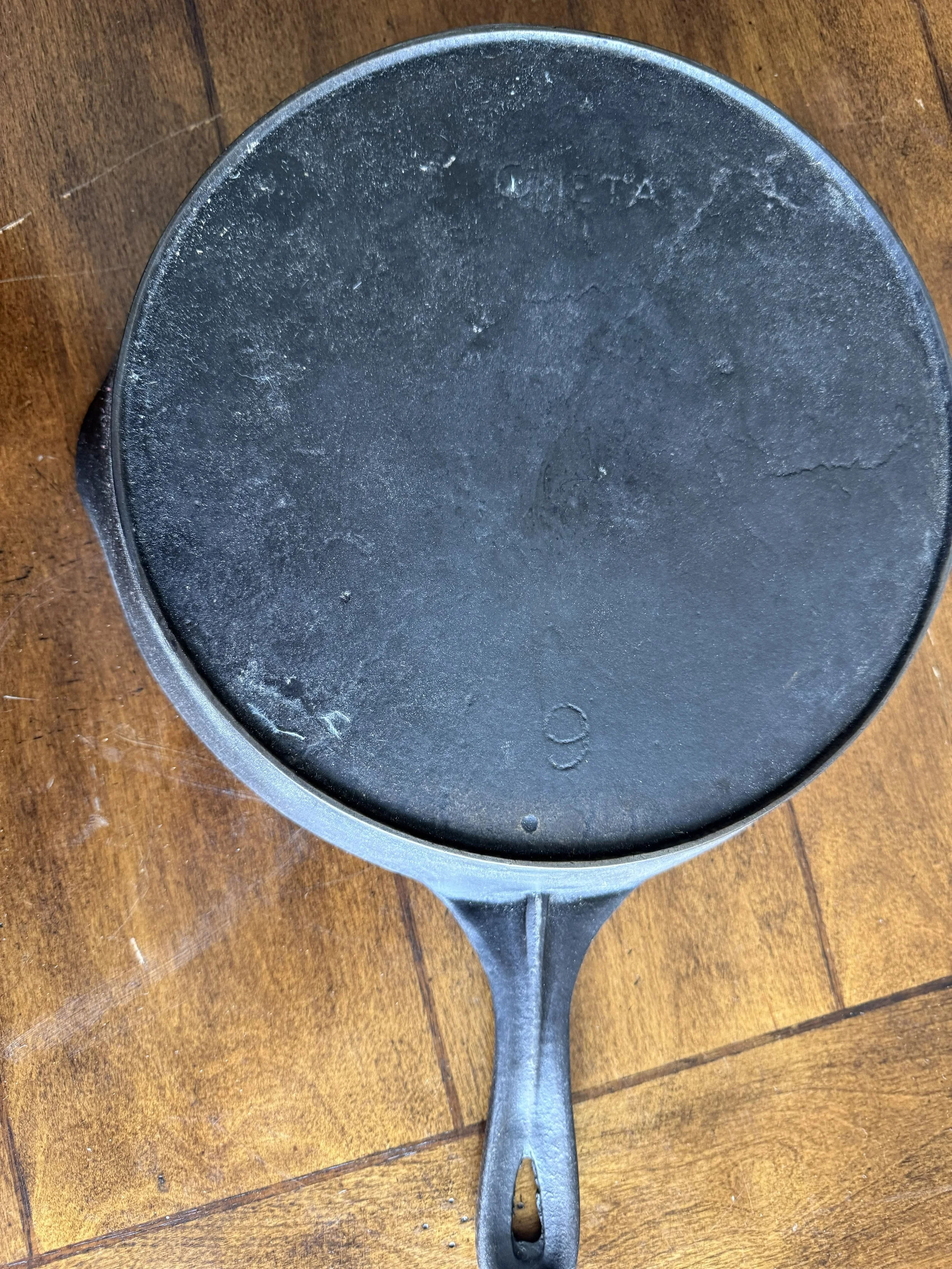
Bottom view showing “ONETA” cast in block letters across the upper portion of the base, with the size numeral “9” below. The Oneta brand was the economy line produced by Wapak Hollow Ware Co. of Wapakoneta, Ohio—a budget-friendly alternative to Wapak’s own branded cookware, itself already positioned as a lighter, more affordable competitor to Wagner and Griswold. The marking is faint but legible under the seasoning, consistent with Wapak’s known tendency toward lighter casting that sometimes resulted in shallower lettering.
Every industry has its price tiers. In the early twentieth century, if you wanted the best cast iron skillet money could buy, you bought Wagner from Sidney or Griswold from Erie. If you wanted something good but more affordable, you bought Wapak from Wapakoneta or Favorite from Piqua. And if you wanted the absolute cheapest new cast iron skillet on the shelf—the one that cost less than everything else in the store—you bought Oneta. You probably did not know that Oneta was made by the same Wapakoneta foundry that made Wapak. The whole point was that you did not need to know. You just needed a skillet you could afford.
Oneta was the economy brand of the Wapak Hollow Ware Company, produced in Wapakoneta, Auglaize County, Ohio from approximately 1912 to 1926. Wapak itself was already the budget competitor in a market dominated by Wagner and Griswold—a scrappy foundry in a small Ohio town trying to sell cast iron against the two biggest names in the industry. Oneta was Wapak’s way of reaching even further down the price ladder: a thinner-walled, lighter-weight skillet with less detailed casting, sold under a separate brand name so that the Wapak name was not associated with the lowest price point.
This No. 9 is one of those budget skillets—and it is now one of the harder-to-find pieces in the cast iron collecting world. The irony of economy brands is that they were made cheaply, bought by people who used them hard, and discarded when they wore out or broke. The expensive skillets—the Wagners and Griswolds—were treated as investments, cared for, passed down through families, and preserved. The cheap skillets were used up and thrown away. The result, a century later, is that Oneta skillets are rarer than the premium brands they competed against. The budget piece outlasted by the premium piece in the marketplace has become the harder find in the collector market.
The Cooking Surface
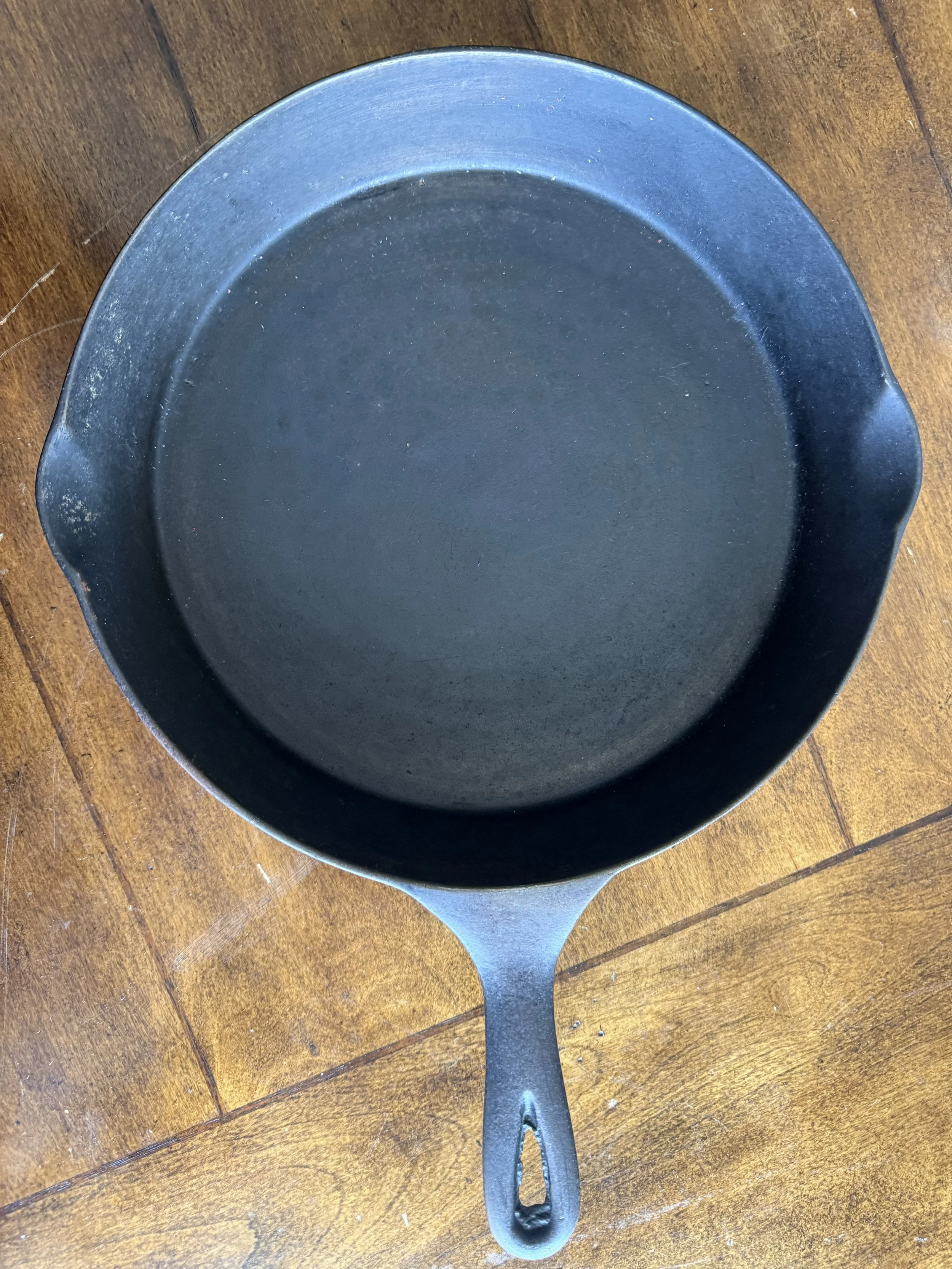
Top view showing the cooking interior with dual pour spouts and flat handle with teardrop hanging loop. The cooking surface is smooth and well-seasoned. Wapak’s “thin wall” lightweight manufacturing technique is evident in the overall feel of the piece—noticeably lighter than a Wagner or Griswold of the same size number.
The top view reveals what made Wapak’s products distinctive in the marketplace: the lightweight construction. Wapak Hollow Ware specialized in “thin wall” cast iron—skillets that were noticeably lighter than their Wagner and Griswold competitors. For a cook who spent hours at the stove, the weight difference mattered. A lighter skillet was easier to lift, easier to maneuver, and easier on the wrist and shoulder during a long cooking session. The tradeoff was in heat retention: a thinner wall holds less thermal mass, which means the skillet cools down faster when cold food hits it. But for everyday cooking—eggs, bacon, pancakes, the daily tasks of a working kitchen—the lighter weight was more feature than flaw.
The Oneta variant pushed this lightweight philosophy even further than standard Wapak production. As the economy brand, Oneta pieces used less iron per unit, resulting in an even thinner casting that kept both material costs and retail prices low. The cooking surface on this No. 9 is smooth and functional—not machine-polished to Wagner’s standard, but adequate for the home cook who was buying on price rather than prestige.
Piece Details
Manufacturer
Wapak Hollow Ware Co. (Oneta economy brand)
Brand
Oneta
Piece Type
No. 9 Skillet
Size Number
No. 9
Base Marking
“ONETA” in block letters / “9” size numeral
Surface Finish
Seasoned cast iron; thin-wall lightweight construction
Bottom Configuration
Smooth base
Pour Spouts
Two opposing spouts at rim
Handle
Flat handle with teardrop hanging loop
Date of Manufacture
Circa 1912–1926 (Oneta production period)
Place of Manufacture
Wapakoneta, Auglaize County, Ohio
Condition
Good — legible ONETA marking; good seasoning; sits flat; no cracks; sandshift character consistent with Wapak production
Acquisition Date
March 2, 2026
Acquisition Source
eBay — Seller: maxstufcomics
eBay Item Number
325895996942
Order Number
15-14301-71595
SSC Catalog Number
SSC-ONETA-SKL-9-1915-001
Collection Designation
Ohio Foundry Corridor
Wapak Hollow Ware Co.: The Underdog of the Ohio Foundry Corridor
Wapak Hollow Ware Company was founded in 1903 in Wapakoneta, Auglaize County, Ohio—a small town in the heart of the same northwestern Ohio corridor that produced Wagner (Sidney, Shelby County), Favorite Stove & Range (Piqua, Miami County), and Columbus Hollow Ware (Columbus, Franklin County). Wapakoneta sits between Sidney and Piqua on the Great Miami River, in the same German Catholic farming communities that the Brandewie family and other immigrants from the Oldenburger Münsterland helped establish in the 1830s. The labor force that built Wapak Hollow Ware came from the same communities whose labor built Wagner.
Wapak’s strategy was to compete on price and weight rather than prestige. Their “thin wall” casting technique produced skillets that were noticeably lighter than Wagner and Griswold products—an advantage for working cooks who valued ergonomics over thermal mass. The company produced several logo variants during its 23-year history, including the block logo, the Z logo, the tapered logo, and the highly sought-after Indian medallion logo. The Oneta brand was introduced around 1912 as a separate economy line, positioned below the Wapak brand itself in price and perceived quality.
Wapak’s casting quality was inconsistent compared to the meticulous standards of Wagner and Griswold. Sand shift during casting—visible as slight ripples or misalignments in the finished piece—is a known Wapak trait. Ghost marks from other manufacturers’ molds (particularly Erie/Griswold) are sometimes found on Wapak pieces, suggesting that Wapak may have purchased or copied molds from competitors. These casting quirks, which were quality shortcomings in their own time, have become identifying features and even selling points for modern collectors who appreciate the character they add to each piece.
Wapak Hollow Ware went bankrupt in 1926 after just 23 years of operation—unable to sustain its price-competitive position against the larger, better-capitalized Wagner and Griswold operations. The foundry closed, the equipment was sold, and the Oneta brand disappeared from store shelves. A century later, Oneta skillets are harder to find than the premium brands they once undercut—because cheap things get used up, and expensive things get saved.
Corporate Timeline: Wapak Hollow Ware Co.
1903
Wapak Hollow Ware Co. founded in Wapakoneta, Auglaize County, Ohio. The company produces lightweight “thin wall” cast iron cookware: skillets, bean pots, Dutch ovens, sad irons, kettles, griddles, and waffle irons.
c.1912
The Oneta economy brand is introduced. Oneta pieces are thinner, lighter, and cheaper than standard Wapak production, targeting the lowest price tier of the cast iron market.
1903–26
Wapak produces seven known logo variants: block logo, Z logo, tapered logo, Indian medallion, and others. Ghost marks from Erie/Griswold molds appear on some pieces. Casting quality is inconsistent but the lightweight construction finds a market niche.
1926
Wapak Hollow Ware Co. goes bankrupt after 23 years of operation. The foundry closes permanently. Both the Wapak and Oneta brands cease production.
Wapakoneta: The Town Between Wagner and Favorite
Wapakoneta occupies a unique geographic position in the Ohio Foundry Corridor. It sits in Auglaize County, between Sidney (Shelby County, home of Wagner) to the south and Piqua (Miami County, home of Favorite Stove & Range) to the southeast. All three towns lie along the Great Miami River valley in northwestern Ohio—the heartland of the German Catholic immigrant communities that settled the region in the 1830s and provided the labor force for the foundries that followed.
The SSC collection now documents cast iron from all three towns in this corridor: Wagner from Sidney, Favorite/Puritan from Piqua, and now Oneta/Wapak from Wapakoneta. Add the Marion Stove Co. (founded in Sidney, moved to Marion, Indiana) and the Foster Stove Co. (Ironton, which acquired Favorite’s patterns), and the collection traces a complete network of interconnected Ohio foundries operating within a day’s wagon ride of each other. These were not isolated operations. They were competitors, suppliers, and sometimes successors to one another—a regional industry cluster that dominated American cast iron production for half a century.
Wapakoneta is also famous as the hometown of Neil Armstrong—the first human to walk on the moon. The SSC collection now holds pieces from the town that produced both the cheapest cast iron skillets in America and the first moonwalker. That is the kind of town Ohio builds.
Why This Piece Matters
The Oneta No. 9 skillet matters because it documents the bottom of the market—the price tier that most collectors overlook and most museums ignore. The SSC collection includes Wagner’s premium nickel-plated pieces and Favorite’s quality Puritan line. This Oneta represents what a family bought when they could not afford Wagner or Favorite: the cheapest new cast iron skillet on the shelf, made in a small Ohio town by a foundry that went bankrupt trying to compete with the big names. It is the underdog’s underdog, and its survival for over a century is an achievement that no one at the Wapak foundry would have predicted.
At $157, this is not a cheap acquisition by modern standards. The economy brand has become the collector’s prize—because the cheap things were used up and thrown away, and the survivors are scarce. The market has inverted: what was once the most affordable skillet in the store is now harder to find and more expensive per piece than the premium brands it once undercut. That inversion is itself a story worth telling, and the SSC collection tells it by placing this Oneta alongside its Wagner and Favorite competitors from the same Ohio corridor.
The iron endures. The markings tell the truth. The story deserves to be told.
Sources & Further Reading
CastIronCollector.com — Wapak Hollow Ware Co.: Wapakoneta, Ohio; founded 1903; bankrupt 1926; Oneta economy brand (c. 1912–1926); seven logo variants documented.
BoonieHicks.com — “Your Complete Guide to Wapak Cast Iron”: Oneta as budget brand, ghost marks, sand shift characteristics, logo identification guide.
Wikipedia — List of American Cast-Iron Cookware Manufacturers: Wapak founded 1903, “thin wall” lightweight manufacture, Wapakoneta, Ohio.
SSC Internal Collection Records — Ohio Foundry Corridor: Wagner (Sidney), Favorite/Puritan (Piqua), Marion Stove (Sidney origins), Foster (Ironton).
About Steve’s Seasoned Classics
Steve’s Seasoned Classics is an online museum dedicated to preserving and documenting the heritage of American cast iron, with a focus on Ohio foundry pieces from the 19th and early 20th centuries. The SSC collection features over 130 pieces with detailed provenance, historical research, and photography for each item.
