Wagner Ware Sidney -O- Bacon and Egg Breakfast Skillet
SSC MUSEUM COLLECTION
Catalog No. SSC-WAGNER-BES-1101A-001
Stylized Logo | Pattern 1101A | Square Divided Pan | Sidney, Ohio
Circa 1924–1959 • Wagner Manufacturing Co. • Wagner Specialty & Variant Collection
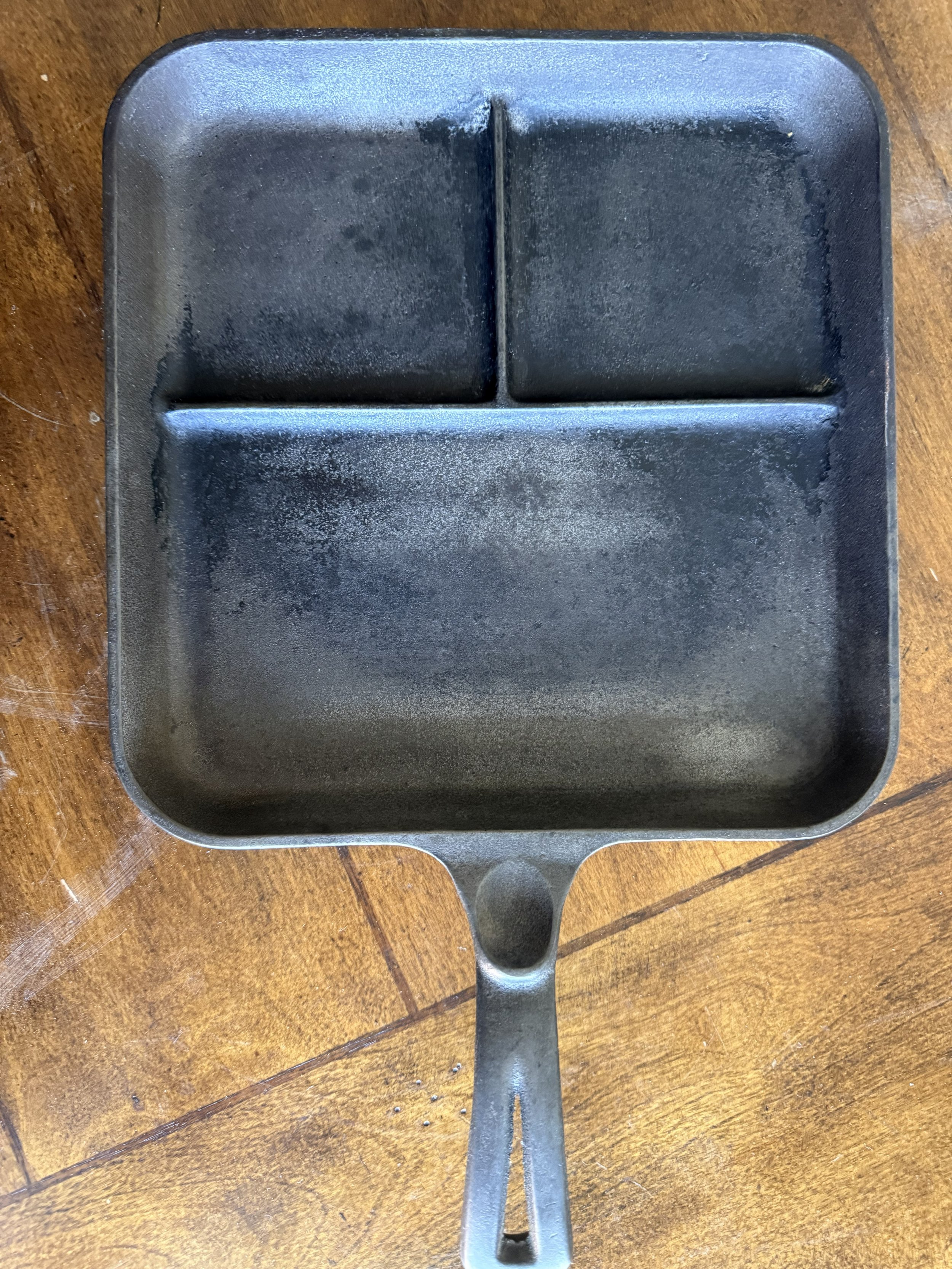
Top view showing the three-compartment divided cooking surface: two smaller square wells for eggs at the top and one large rectangular well for bacon at the bottom. The cast iron dividers are integral to the casting—not welded or added after the fact—and serve both a practical and a visual function: they keep the eggs contained while the bacon grease stays in its own section. The flat handle with hanging loop extends from the bottom edge.
There is a moment in every museum collection when a piece arrives that makes visitors smile before they even read the caption. This is that piece. The Wagner Ware Bacon and Egg Breakfast Skillet is exactly what its name says it is: a square cast iron skillet with built-in dividers that create separate compartments for cooking bacon and eggs simultaneously, in the same pan, on the same burner, without the bacon grease flooding into the eggs or the eggs sliding into the bacon. It is a solution to a problem that every cook who has ever made breakfast has encountered, and Wagner’s answer was to cast the solution directly into the iron.
The design is elegant in its simplicity. The pan is square—approximately 9 inches on a side—with rounded corners and a flat handle extending from one edge. The interior is divided by cast iron walls into three compartments: two smaller squares at the top (the egg side) and one large rectangle at the bottom (the bacon side). The dividers are tall enough to contain liquids and grease but low enough to allow a spatula to reach into each compartment. The whole thing is a single casting—no seams, no joints, no assembled parts. Wagner cast the dividers, the walls, the base, and the handle as one piece of iron, poured from a single mold in the Sidney foundry.
Pattern number 1101A identifies this as a specific catalog item in Wagner’s specialty line—a product category that went beyond standard skillets and Dutch ovens to include purpose-built cooking tools for specific tasks. The Bacon and Egg Breakfast Skillet was not a piece that every household needed. It was a piece that a cook who took breakfast seriously wanted—and it was the kind of clever, function-specific product that defined Wagner’s reputation for innovation alongside quality.
Reading the Bottom
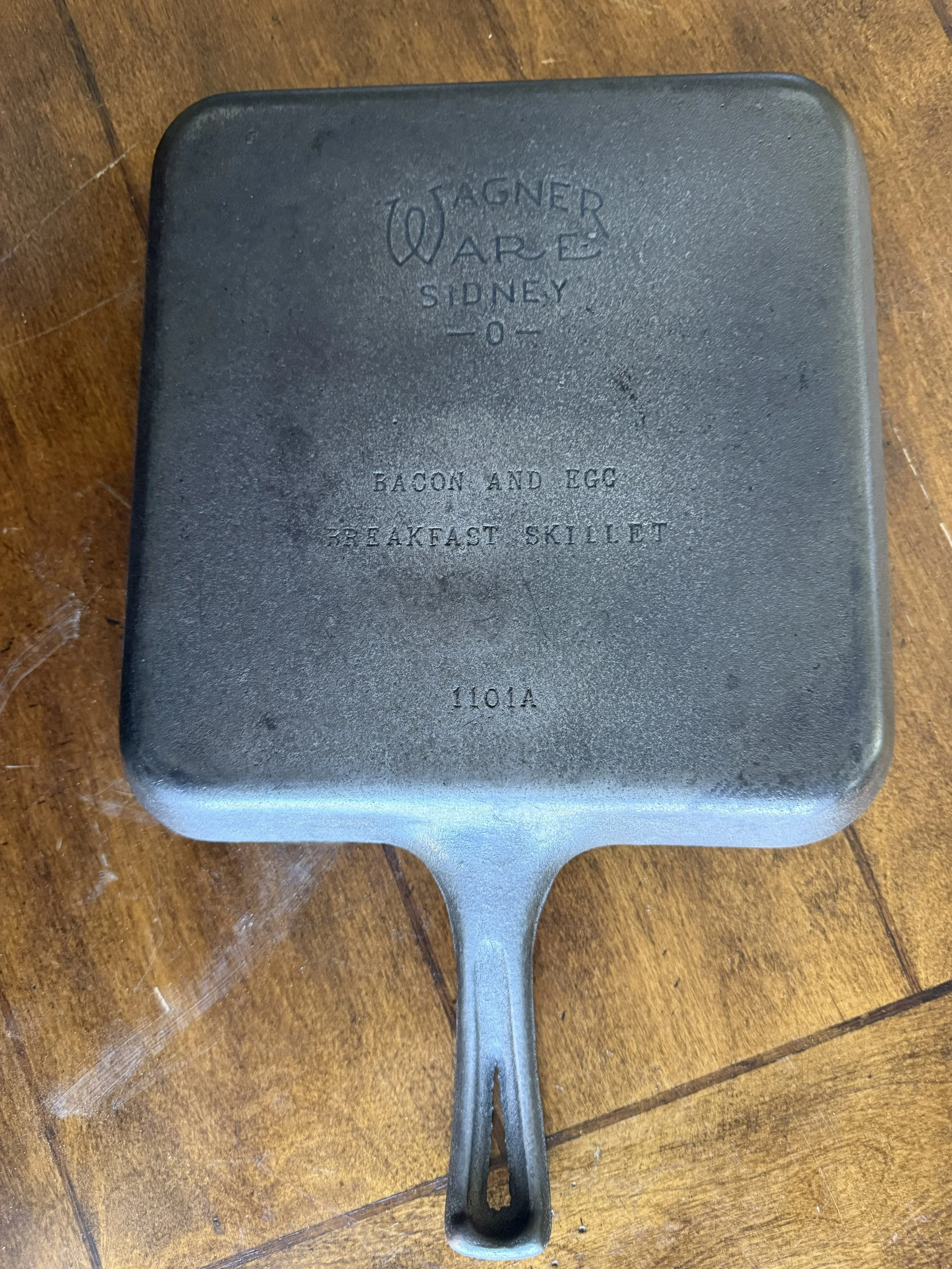
Bottom view showing the full marking suite: the stylized “Wagner Ware Sidney -O-” trademark at the top, the product name “BACON AND EGG / BREAKFAST SKILLET” cast in block letters in the center, and the pattern number “1101A” near the handle. This is one of the most heavily marked pieces in the SSC collection—Wagner wanted every surface of this pan to tell the buyer exactly what it was and who made it.
The bottom of this piece is a study in Wagner’s marketing approach. Most Wagner products carry the trademark and a pattern number—nothing more. The Bacon and Egg Breakfast Skillet adds the full product name cast into the base: “BACON AND EGG / BREAKFAST SKILLET” in two lines of block capital letters. Wagner did not do this with standard skillets or Dutch ovens. They did it with specialty pieces—products whose function was not immediately obvious from their shape alone and which benefited from a built-in explanation. The name cast into the iron served as a permanent label, a selling point, and an instruction all at once: this is what this pan is for.
The “A” suffix on the pattern number 1101 likely indicates a design revision—a minor change to the mold or the casting that distinguished this version from an earlier 1101 pattern. Wagner used letter suffixes across their product line to track mold revisions, and the “A” tells collectors that this piece represents a specific iteration of the breakfast skillet design.
Piece Details
Manufacturer
Wagner Manufacturing Co.
Brand
Wagner Ware
Piece Type
Bacon and Egg Breakfast Skillet (divided square pan)
Pattern Number
1101A
Base Marking
Stylized “Wagner Ware Sidney -O-” / “BACON AND EGG / BREAKFAST SKILLET” / 1101A
Form
Square with rounded corners; three integral cast compartments (two egg wells + one bacon well)
Handle
Flat handle with hanging loop (extends from one edge)
Compartment Layout
Two smaller squares (eggs) at top; one large rectangle (bacon) at bottom
Surface Finish
Seasoned cast iron
Bottom Configuration
Smooth base, no heat ring
Logo Period
Stylized Wagner Ware (c. 1924–1959)
Date of Manufacture
Circa 1924–1959
Place of Manufacture
Sidney, Shelby County, Ohio
Condition
Very Good — legible markings including full product name; good seasoning; sits flat; no cracks; dividers intact
Acquisition Date
December 1, 2025
Acquisition Source
eBay — Seller: doostysmama
eBay Item Number
136789149059
Order Number
01-13921-97348
SSC Catalog Number
SSC-WAGNER-BES-1101A-001
Collection Designation
Wagner Specialty & Variant Collection
The Divided Pan: Engineering a Better Breakfast
The problem the Bacon and Egg Breakfast Skillet solves is one that every cook understands intuitively. Bacon renders fat as it cooks. Eggs are delicate and absorb grease. If you cook them in the same open pan, the eggs end up swimming in bacon fat—which some cooks want but most do not, at least not in uncontrolled quantities. The traditional solution is two pans: one for bacon, one for eggs. But two pans means two burners, two pieces to wash, and two items competing for space on a stove that may only have four burners.
Wagner’s solution was to cast the divider into the pan itself. The large bacon compartment gives the strips room to lay flat and render evenly. The two egg compartments contain the eggs in their own space, keeping them neat and round while allowing just enough grease to seep under the dividers to prevent sticking. The cook uses one burner, one pan, and gets a complete breakfast—bacon and two eggs—in a single coordinated operation. It is a design that respects both the cook’s time and the cook’s stove space.
The square form factor is itself unusual for Wagner, which produced the vast majority of its cookware in round shapes dictated by the circular openings of wood and coal stoves. By the time the Bacon and Egg Breakfast Skillet was in production, gas and electric stoves with flat, rectangular burner grates had made non-round cookware practical—a square pan could sit flat on a gas burner grate just as easily as a round one. The breakfast skillet belongs to the era of modern stove design, and its form reflects that transition.
Wagner’s Specialty Line: Beyond the Skillet
The standard Wagner skillet—round, flat-bottomed, pour-spouted—is what most people think of when they hear the name Wagner Ware. But the Sidney foundry’s catalog extended far beyond the basic skillet into a world of specialty products designed for specific cooking tasks. Divided pans, cornbread molds, waffle irons, tea kettles, Dutch ovens, griddles, muffin pans, and purpose-built items like this Bacon and Egg Breakfast Skillet all carried the Wagner Ware trademark and the same quality of casting that made the standard skillet famous.
The specialty line is what the SSC Wagner Specialty & Variant Collection exists to document. A standard Wagner No. 8 skillet is an important piece of American industrial history, but it is also one of the most common cast iron pieces in existence. The specialty items—the breakfast skillets, the unusual sizes, the nickel-plated variants, the pieces that served a specific function rather than a general one—are where the Wagner story gets interesting. These are the pieces that show what the Sidney foundry was capable of when it went beyond the basics and tried to solve specific kitchen problems with cast iron engineering.
The Bacon and Egg Breakfast Skillet sits alongside the three nickel-plated skillets, the No. 7G sauté skillet, and the No. 7 saucepan in the SSC Wagner Specialty & Variant Collection. Together, they present a Wagner that most casual collectors never see: a foundry that was not just producing skillets but innovating, experimenting, and designing purpose-built tools that made specific cooking tasks easier and better. The breakfast skillet is the most immediately charming example—a piece that makes people smile—but every piece in the specialty collection tells the same story: Wagner was not just a foundry. Wagner was a kitchen engineering company that happened to work in cast iron.
Why This Piece Matters
The Wagner Ware Bacon and Egg Breakfast Skillet matters because it is the most immediately engaging piece in the Wagner Specialty & Variant Collection—the piece that visitors will understand, appreciate, and remember without needing a paragraph of context. Everyone has cooked breakfast. Everyone has dealt with bacon grease flooding into eggs. Everyone can look at this pan and immediately grasp both the problem and the solution. That instant recognition—that moment of “oh, that’s clever”—is a curatorial tool, and this breakfast skillet deploys it perfectly.
But beyond its immediate appeal, the piece matters because it documents a product category that is all but invisible in the modern kitchen. Nobody makes divided breakfast skillets in cast iron anymore. The concept has migrated to thin-gauge nonstick pans sold at discount stores—a pale shadow of what Wagner produced in heavy, heat-retaining cast iron in the Sidney foundry. This 1101A is the original, the real thing, the cast iron breakfast skillet that started a product category and remains the best version of it that was ever made.
The iron endures. The markings tell the truth. The story deserves to be told.
Sources & Further Reading
CastIronCollector.com — Wagner Manufacturing Co.: specialty product line documentation; pattern numbering conventions (1101 series = breakfast/divided skillets).
CastIronCollector.com — Wagner Ware Specialty Items: divided pans, breakfast skillets, and purpose-built cooking tools from the Sidney foundry.
SSC Internal Collection Records — Wagner Specialty & Variant Collection: companion pieces documenting nickel-plated variants, unusual sizes, and specialty forms.
About Steve’s Seasoned Classics
Steve’s Seasoned Classics is an online museum dedicated to preserving and documenting the heritage of American cast iron, with a focus on Ohio foundry pieces from the 19th and early 20th centuries. The SSC collection features over 130 pieces with detailed provenance, historical research, and photography for each item.
