The Kenton Brand Cast Iron Combination Safe Bank
SSC MUSEUM COLLECTION
Catalog No. SSC-KENTON-BNK-1900-001
Still Bank | Combination Safe Form | Ornate Victorian Casting | Kenton, Ohio
Circa 1900–1932 • Kenton Hardware Company • Ohio Foundry Corridor
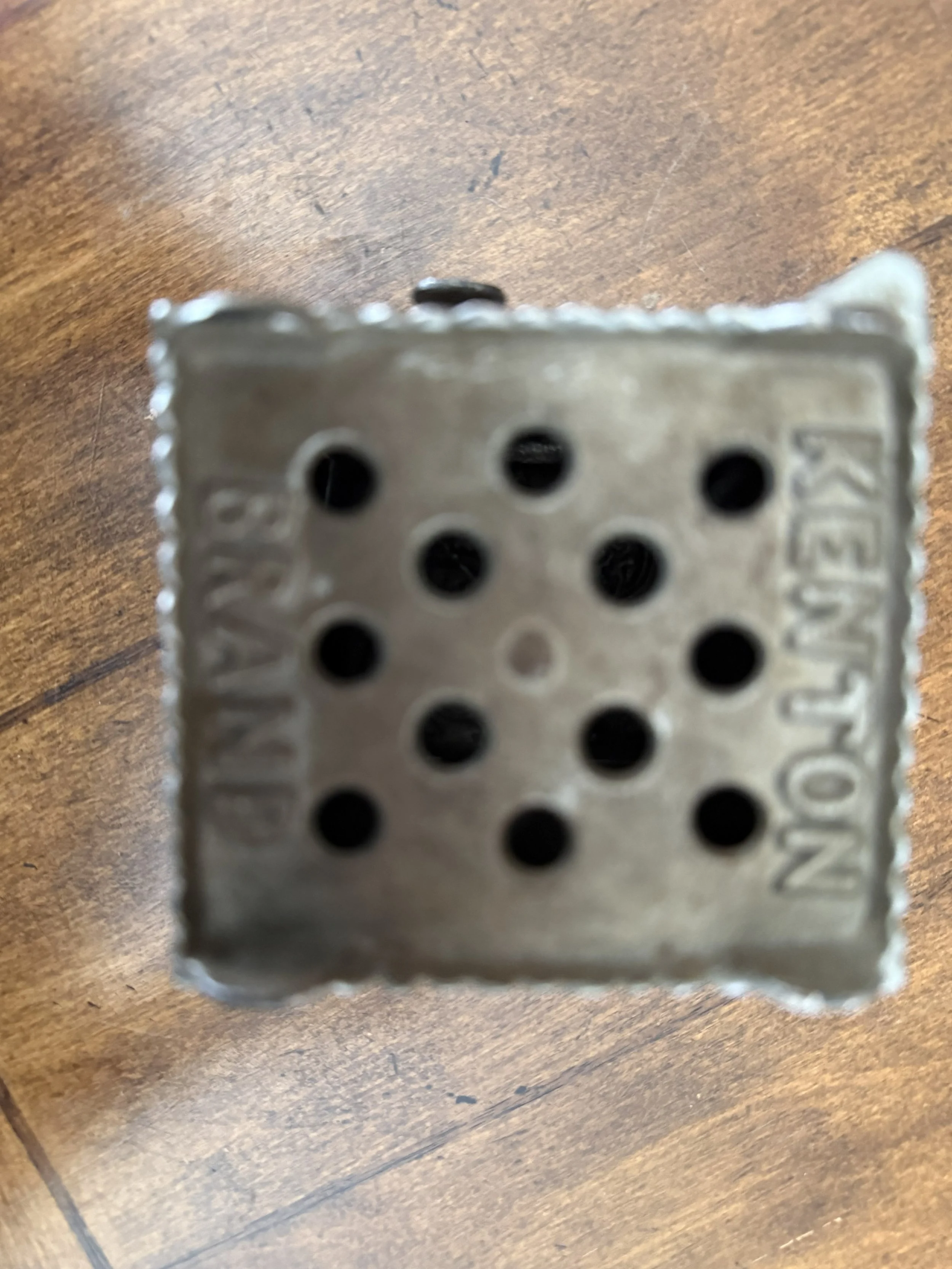
Bottom of the Kenton Brand safe bank, showing the “KENTON BRAND” marking cast in raised letters on the base plate. The base features a grid of circular holes that allowed coins to be sorted or accessed, along with internal divider posts visible through the openings. This marking is the standard identification used by the Kenton Hardware Company of Kenton, Hardin County, Ohio, on its line of cast iron banks produced from the 1890s through the early 1930s. The Kenton safe bank was among the company’s earliest toy products—and the product category that launched one of the world’s largest cast iron toy factories.
In 1893, a small hardware company in the town of Kenton, Ohio produced its first cast iron toy: a bank. That single product decision—to cast iron into a form that children could drop pennies into—set in motion a transformation that would turn a struggling lock manufacturer into one of the world’s largest cast iron toy factories. Over the following six decades, the Kenton Hardware Company would produce horse-drawn fire equipment, toy stoves, trains, circus caravans, automobiles, airplanes, cap pistols, and the iconic Gene Autry cap pistol that sold two million units in its first eighteen months. But before all of that—before the toy trucks distributed through Woolworth’s, before the Smithsonian collected Kenton pieces, before the Ohio Historical Society erected a marker on Espy Street—there were banks. Cast iron banks in the form of miniature safes, designed to teach children the virtue of thrift while demonstrating the casting quality of an Ohio foundry.
This is a Kenton Brand cast iron combination safe bank—a still bank in the form of a miniature safe with ornate Victorian scrollwork, a combination knob on the front door, a coin slot, and a hinged rear panel that opens for coin retrieval. The base is marked “KENTON BRAND” in raised cast letters. It was produced by the Kenton Hardware Company of Kenton, Hardin County, Ohio, during the period from approximately 1900 to 1932, when safe banks were a staple of the company’s product line.
The Combination Safe Bank: A Miniature Vault

Front view of the Kenton safe bank showing the ornate Victorian scrollwork cast into the front panel and the combination knob at center. The scrollwork features flowing acanthus-leaf and arabesque motifs rendered in crisp raised relief—a testament to the pattern-making skill of the Kenton foundry. The combination knob is a decorative element that gives the bank the appearance of a real safe; the actual access to the coin chamber is through the hinged rear panel.
The combination safe bank is one of the most recognizable forms in cast iron bank collecting. Modeled after the full-size floor safes that protected cash, documents, and valuables in businesses and banks across America, the miniature safe bank brought the imagery of financial security into the nursery. The message was simple and direct: your pennies deserve the same protection as a banker’s dollars. The combination knob, the ornate panels, the heavy cast iron construction—all of it told a child that saving money was serious business, and that the bank on their dresser was a vault in miniature.

Top view of the Kenton safe bank showing the elaborate raised scrollwork and filigree pattern cast into the top panel. The detail and depth of the casting are remarkable for a toy—the acanthus scrolls, vine tendrils, and symmetrical arabesque motifs are rendered with the precision of a decorative arts piece. The coin slot is visible at the top edge. This level of ornamental detail was characteristic of Kenton’s best work and reflected an era when even children’s toys were expected to carry aesthetic refinement.
Kenton produced safe banks in multiple sizes and designs, many featuring nickel-plated front doors, combination knobs, and ornamental panels. Some were painted in red, green, or gold. The example in the SSC collection retains its original unpainted cast iron finish with age-appropriate patina. The casting quality is high: the scrollwork on the top and front panels is crisp and detailed, with clean lines and sharp relief. The hinged rear panel opens to allow coin retrieval, and the interior features divider posts and a perforated base plate.
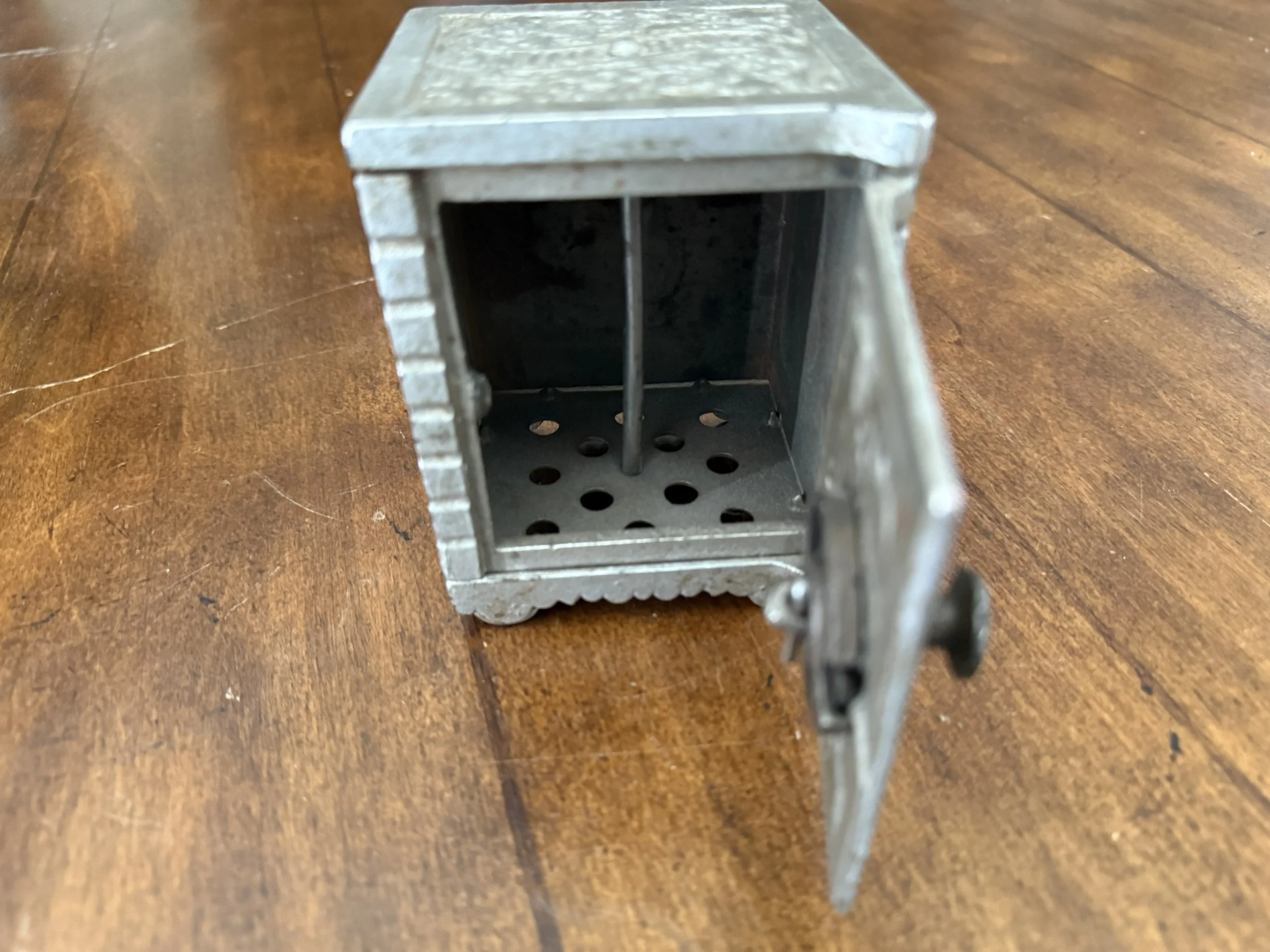
Rear view with the back panel open, showing the interior coin chamber. The divider posts and perforated base plate are visible inside. The hinged back panel swings open for coin retrieval—this is how a child would empty the bank when enough pennies had accumulated. The construction is solid cast iron throughout, with tight seams and well-aligned castings that demonstrate production-quality foundry work.
The Kenton Hardware Company: From Locks to the World’s Largest Cast Iron Toy Factory
The Kenton Hardware Company was founded in May 1890 as the Kenton Lock Manufacturing Company by F.M. Perkins in Kenton, Hardin County, Ohio. Perkins was interested in manufacturing his patented refrigerator locks, and he used temporary quarters at the J. Forbins Scroll Mill in Kenton as his first factory site. The lock business proved unprofitable, and in November 1894 the company changed its name to the Kenton Hardware Manufacturing Company and pivoted to toy production. The first toys included stoves, banks, and horse-drawn fire equipment—all cast in iron at the Kenton foundry.
The safe bank was among the earliest products in this new line. The first known cast iron toy produced in Kenton was the Columbia Bank in 1893. Safe banks, still banks, and mechanical banks became a core product category, and the “KENTON BRAND” marking on the base became the company’s standard identification for its bank line. The banks were affordable, collectible, and served a dual purpose: they were toys that also taught children about saving money. They sold well, and the revenue from banks and toy stoves gave the fledgling toy company the financial foundation to expand into other product lines.
In 1903, fire destroyed the Kenton factory. The company became part of the National Novelty Corporation and continued its toy line under the name Wing Manufacturing Company. After several unsuccessful corporate reorganizations, the company emerged again as the Kenton Hardware Company in 1912, when sales agent L.S. Bixler took over the firm. Under Bixler’s management, which lasted until his death in 1951, Kenton became one of the world’s largest cast iron toy factories. The product line expanded through the 1920s to include horse-drawn vehicles, automotive toys (first produced in 1923), trucks, airplanes, and cap pistols. The company’s most famous product was the Gene Autry cap pistol, introduced in 1938—two million were sold in the first eighteen months of production.
By the late 1930s and 1940s, competition from lighter and more colorful toys made of sheet metal, lithographed tin, rubber, and eventually plastic eroded the market for cast iron toys. Kenton did not adapt to these changes. The company ceased production in 1952 and its assets were sold in 1953. The Littlestown Hardware & Foundry of Pennsylvania acquired many Kenton toy designs and marketed them under the brand “Utexiqual” until Littlestown itself closed in 1982. Today, Kenton toys and banks are highly sought by collectors, and examples are held by the Smithsonian’s National Museum of American History. An Ohio Historical Society marker on Espy Street in Kenton commemorates the factory site.

Side view of the Kenton safe bank showing the combination knob mechanism at top and the overall proportions of the piece. The scalloped decorative edge along the front and the paneled side casting give the bank the appearance of a substantial miniature vault. The quality of the castings—tight seams, crisp edges, well-aligned halves—reflects the production standards of a factory that was casting at industrial scale.
Piece Details
Manufacturer
Kenton Hardware Company (originally Kenton Lock Manufacturing Company), Kenton, Ohio
Piece Type
Cast Iron Combination Safe Still Bank
Form
Miniature safe with ornate Victorian scrollwork panels, combination knob on front door, coin slot, hinged rear access panel, perforated base plate with internal dividers
Material
Cast Iron
Marking
“KENTON BRAND” cast in raised letters on base plate
Purpose
Children’s savings bank / still bank
Date of Manufacture
Circa 1900–1932
Place of Manufacture
Kenton, Hardin County, Ohio
Condition
Good — “KENTON BRAND” marking legible on base; all panels intact; front scrollwork and top filigree crisp and detailed; combination knob present; hinged rear panel functional; coin slot intact; original unpainted cast iron finish with age-appropriate patina; no cracks, breaks, or repairs
Acquisition Date
March 15, 2026
Acquisition Source
eBay — Seller: jpnkoi
eBay Item Number
147192428289
Order Number
03-14379-11522
SSC Catalog Number
SSC-KENTON-BNK-1900-001
Collection Designation
Ohio Foundry Corridor
Corporate Timeline: The Kenton Hardware Company
1890
Kenton Lock Manufacturing Company founded by F.M. Perkins in Kenton, Hardin County, Ohio. Manufactures patented refrigerator locks at the J. Forbins Scroll Mill.
1893
First cast iron toy produced: the Columbia Bank. Marks the beginning of Kenton’s toy manufacturing business.
1894
Company renamed Kenton Hardware Manufacturing Company. Toy production expands to include safe banks, stoves, and horse-drawn fire equipment.
c. 1900–1932
Safe banks with “KENTON BRAND” marking produced as a core product line. Multiple sizes and designs offered, including combination safes and nickel-plated models.
1903
Fire destroys the Kenton factory. Company becomes part of National Novelty Corporation; continues as Wing Manufacturing Company.
1912
L.S. Bixler takes over the firm. Company re-emerges as the Kenton Hardware Company and resumes successful toy production.
1920s
Kenton becomes one of the world’s largest cast iron toy factories. Product line includes horse-drawn vehicles, banks, stoves, trains, and circus caravans.
1923
Automotive toys introduced. Cast iron cars and trucks become a major product line through the 1930s.
1938
Gene Autry cap pistol introduced. Two million sold in the first eighteen months. Kenton’s most famous single product.
1952
Kenton Hardware Company ceases production. Assets sold in 1953.
1953+
Littlestown Hardware & Foundry (PA) acquires many Kenton toy designs; markets them as “Utexiqual” brand until 1982.
1991
Ohio Historical Society erects historical marker at the Kenton factory site on Espy Street, Kenton, Ohio.
Present
Kenton toys and banks are prized collectors’ items worldwide. Examples held by the Smithsonian National Museum of American History.
Why This Piece Matters
The Kenton Brand combination safe bank matters because the cast iron bank is the product that created the Kenton Hardware Company’s identity as a toy manufacturer. Before the banks, Kenton was a failing lock company. After the banks, it was on the path to becoming one of the world’s largest cast iron toy factories. The safe bank is not a minor product in the Kenton catalog—it is the origin product, the category that proved the company could cast toys and sell them profitably. Everything that followed—the fire trucks, the automobiles, the Gene Autry pistol—grew from the foundation that the bank line established.
The piece also matters as a document of casting quality from an Ohio foundry that took pride in its pattern work. The scrollwork on this bank’s top and front panels is not simple or crude—it is detailed, symmetrical, and precisely rendered in raised relief. The acanthus leaves, vine tendrils, and arabesque motifs are the work of a skilled pattern maker producing designs at a foundry that understood aesthetics as well as metallurgy. This was a toy, yes—but it was a toy made by people who cared what it looked like.
And it matters because it cost eighteen dollars. A piece of Ohio foundry history from one of the state’s most significant cast iron manufacturers, with a clear maker’s mark, intact construction, crisp casting detail, and a direct connection to one of the most important product transitions in American toy manufacturing history—for the price of a lunch. That is what the SSC collection is built to find and preserve.
The iron endures. The markings tell the truth. The story deserves to be told.
Sources & Further Reading
Physical examination of piece: “KENTON BRAND” cast in raised letters on base plate. Combination safe still bank form with ornate Victorian scrollwork, combination knob, coin slot, hinged rear panel.
Remarkable Ohio (remarkableohio.org) — Marker 10-33: “Kenton Hardware Company.” Ohio Historical Society marker erected 1991 at Espy Street, Kenton. Documents founding as Kenton Lock Manufacturing Company in 1890; toy production; Gene Autry cap pistol; cessation in 1952.
Smithsonian National Museum of American History (americanhistory.si.edu) — Kenton Hardware Company cast iron toy truck in collection. Confirms first cast iron toy (a bank) in 1893.
Fabtintoys.com — Kenton Hardware Co. maker page. Comprehensive timeline: founding 1890, toy production 1894, fire 1903, National Novelty Corp merger, re-emergence 1912 under L.S. Bixler, cessation 1952, Littlestown acquisition 1953.
Ohio Magazine (ohiomagazine.com) — “Ohio Finds: Kenton Hardware Co. Nite Coach,” May 2021. Company history and Bixler management period.
Safe Bank Collector (safebankcollector.com) — Kenton Hardware Company page. Confirms bank production from 1894 onward; safe bank models cataloged.
Charles M. Jacobs, Kenton Cast Iron Toys (Schiffer Books). Definitive reference on Kenton toy history with catalog illustrations and company archive material.
SSC Internal Collection Records — Kenton Hardware Company listed on Ohio Foundry Checklist. This is the first Kenton piece in the SSC collection.
About Steve’s Seasoned Classics
Steve’s Seasoned Classics is an online museum dedicated to preserving and documenting the heritage of American cast iron, with a focus on Ohio foundry pieces from the 19th and early 20th centuries. The SSC collection features over 130 pieces with detailed provenance, historical research, and photography for each item.
