The Cornerstone: Chamberlain & Co. No. 8 Cast Iron Tea Kettle
SSC MUSEUM COLLECTION
Catalog No. SSC-CHAM-KTL-8-001
No. 8 Tea Kettle | Bail Handle | Menke Patent | June 23, 1863 | Cincinnati, Ohio
Circa 1863–1880s • Chamberlain & Co. • U.S. Patent No. 38,972 (Barney H. Menke) • Menke Patent Network • Ohio Foundry Collection

Top detail of the Chamberlain & Co. No. 8 tea kettle lid showing all markings in raised letters: “CHAMBERLAIN & CO” across the upper arc, “CIN’TI. O.” along the lower arc, and “JUNE 23, 1863” below the city mark. The rectangular steam vent slot is visible at center with a raised knob. The June 23, 1863 date corresponds to U.S. Patent No. 38,972, granted to Barney H. Menke of Cincinnati for an improvement in tea kettles. This is the first patent-to-piece pairing documented in the SSC collection.
Every collection has a piece that changes its direction. For Steve’s Seasoned Classics, this is that piece. The Chamberlain & Co. No. 8 tea kettle did not arrive as the most expensive acquisition in the collection, or the rarest, or the most visually striking. It arrived carrying a date—June 23, 1863—cast into its lid alongside a maker’s name and a city. And that date led to a patent. And that patent led to an inventor named Barney H. Menke. And Menke led to a network of five manufacturers across three states, all casting the same date into their kettles under license from the same Cincinnati inventor. No collector, museum, or published source had previously identified this network. The Chamberlain & Co. kettle is the piece that revealed it. That is why it is called The Cornerstone.
The Kettle: Form and Condition

Profile view of The Cornerstone showing the bulbous kettle body, integral cast spout, bail handle, and fitted lid with raised markings. The piece was received in good overall condition with light seasoning and minimal rust. The “JUNE 23, 1863” date is clearly legible on the lid’s outer rim. Photographed against blue background; Archival Black protocol photography pending.
This is a No. 8 flat-bottom cast iron tea kettle—a stove-top vessel designed to sit on a cookstove plate for boiling water. The body is bulbous with a wide mouth, fitted lid, integral cast spout, and a wire bail handle attached through cast ears on opposite sides. The flat bottom shows a gate mark line running across the center—a hallmark of period casting—with two small nubs consistent with the manufacturing process.
The piece arrived in notably good condition for its age. The casting surfaces show light seasoning rather than the heavy rust typical of most 1860s hollow ware on the secondary market. All markings on the lid are crisp and fully legible. The spout is intact and undamaged. The bail handle is original. The lid fits securely. There are no cracks, holes, chips, or repairs visible anywhere on the piece.

Spout detail showing the integral cast spout in good condition. The casting quality of the spout’s flared opening is clean and sharp.
Reading the Iron
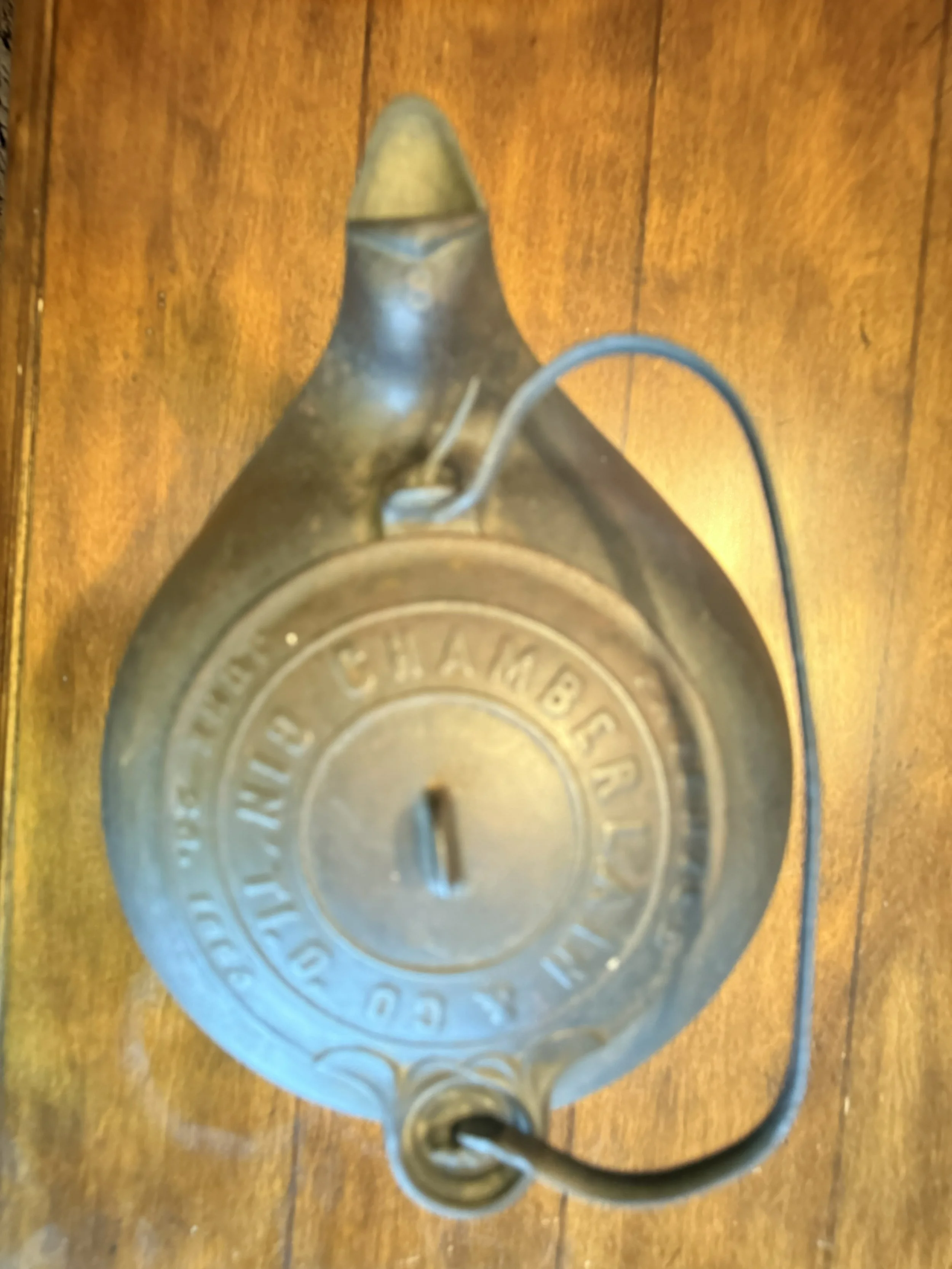
Full top view of the lid showing the complete circular marking arrangement: “CHAMBERLAIN & CO” across the upper arc, “CIN’TI. O.” along the lower arc, and “JUNE 23, 1863” at the base. The bail handle passes over the lid. The rectangular steam vent is visible at center.
The lid carries all of the markings that identify this piece. The text is cast in raised letters in a circular arrangement:
CHAMBERLAIN & CO arcs across the top of the lid. Below that: CIN’TI. O.—the period abbreviation for Cincinnati, Ohio. And below the city mark: JUNE 23, 1863. The size number 8 is also cast into the lid.
Per SSC research protocol, the date was immediately flagged for verification. June 23, 1863 falls during the Civil War—a date that could represent a casting date, a patent date, or a founding date. The absence of a “Pat’d” abbreviation on the lid does not resolve the question, since many Cincinnati foundries omitted the abbreviation while still referencing patent dates. The resolution came through the patent record.
The Menke Patents: Two Inventions, One Kettle
The date June 23, 1863 corresponds to U.S. Letters Patent No. 38,972, granted to Barney H. Menke of Cincinnati, Hamilton County, Ohio, for an “Improvement in Tea-Kettles.” This patent describes a four-piece kettle construction—body, lid, bail, and thimble—designed so that all components can be assembled without filing, screw-cutting, or any other finishing work. The kettle could be packed or shipped in pieces and assembled by anyone in seconds.
But Menke’s connection to Chamberlain & Co. runs deeper. Five months earlier, on January 13, 1863, Menke received U.S. Patent No. 37,423—also titled “Improvement in Tea-Kettles”—which was formally assigned to Chamberlain & Co. This earlier patent describes a swing-lid mechanism with a thimble that fits over the bail-ear, allowing the lid to pivot horizontally for easy access. The assignment clause means Chamberlain & Co. owned the rights to this design outright.
Together, the two Menke patents tell the story of an inventor working in close partnership with a Cincinnati foundry across a single year of the Civil War. The January patent gave Chamberlain & Co. a proprietary lid mechanism. The June patent gave them—and, through licensing, four other manufacturers—a complete kettle design that could be manufactured cheaply and assembled without skilled labor. One witness, Geo. H. Knight, appears on both patents, providing additional evidence of the continuous working relationship.
The Menke Patent Network: Five Manufacturers, Three States
The June 23, 1863 patent date does not appear only on Chamberlain & Co. kettles. SSC’s original research has identified five manufacturers across three states who cast this same date into their tea kettles—evidence of a patent licensing network radiating outward from Menke’s Cincinnati base:
Manufacturer
City
SSC Collection
Patent Connection
1. Chamberlain & Co.
Cincinnati, Ohio
The Cornerstone (SSC-CHAM-KTL-8-001)
Patent No. 37,423 formally assigned to Chamberlain & Co.
2. Shinnick Hattan & Co.
Zanesville, Ohio
The Crown Jewel (SSC collection)
June 23, 1863 date cast into No. 9 tea kettle
3. Sullivan & Herdman
Zanesville, Ohio
Not in SSC collection
June 23, 1863 date documented on kettles
4. Brinkmeyer & Co.
Evansville, Indiana
Not in SSC collection
June 23, 1863 date documented on kettles
5. Baxter Kyle & Co.
Louisville, Kentucky
Not in SSC collection
June 23, 1863 date documented on kettles
This network is an SSC original research discovery. No collector, museum, or published source has previously identified the connection between these five manufacturers through the Menke patent. The discovery that a single Cincinnati inventor’s patent was licensed across the Ohio River valley—from Cincinnati to Zanesville to Evansville to Louisville—reveals a manufacturing and intellectual property infrastructure that has been invisible to the cast iron collecting community.
The Bottom: Gate Mark and Casting Evidence
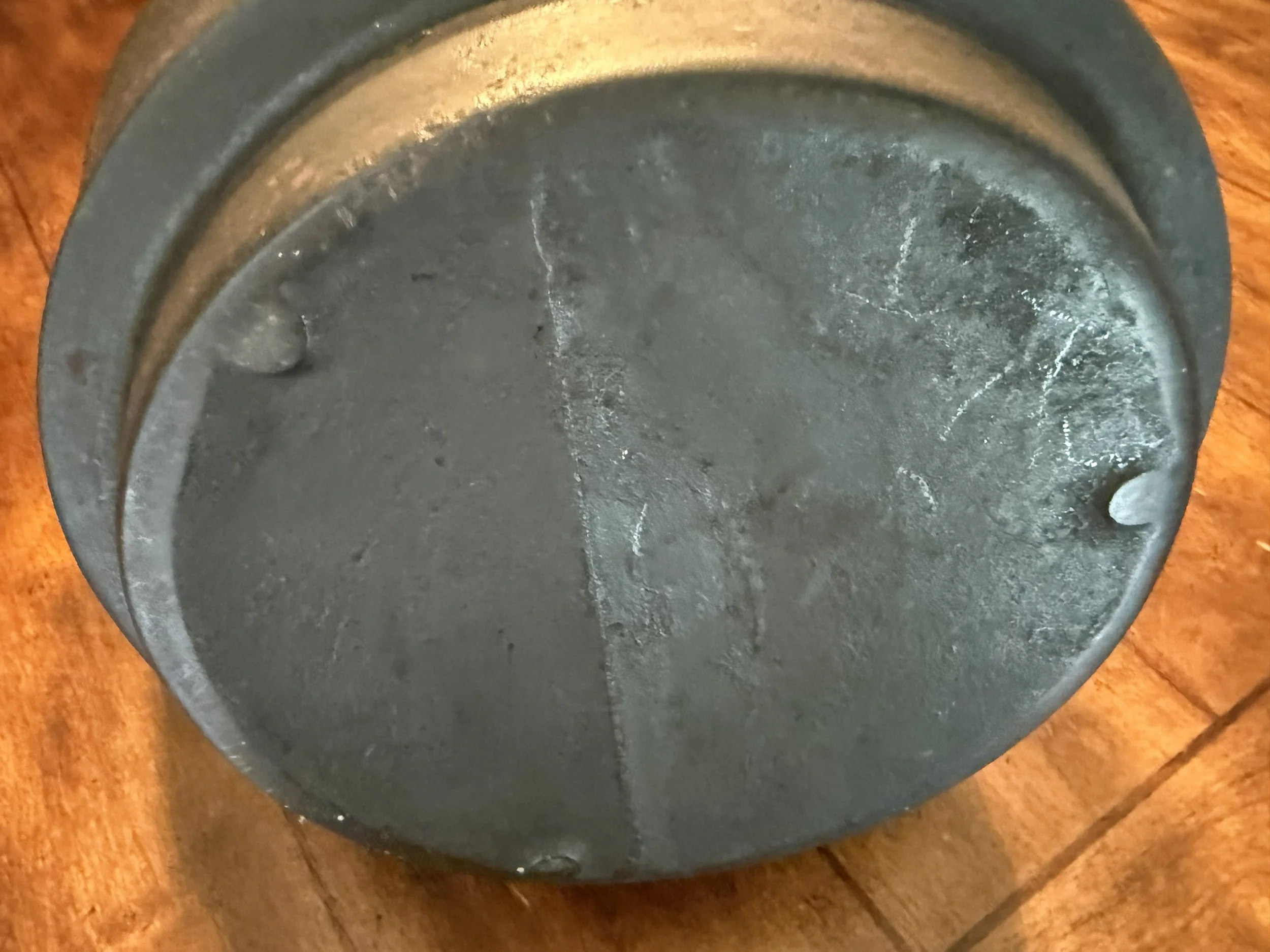
Bottom view showing the flat base with a gate mark line running across the center—evidence of the two-piece sand mold casting process standard for this period. Two small nubs are visible near the rim, consistent with casting artifacts. The bottom is clean and structurally sound with no cracks, warping, or repairs.
The flat bottom and center gate mark are diagnostic features confirming this piece was cast using the standard two-piece flask method of the 1860s. The gate mark runs fully across the diameter, indicating the molten iron was introduced through a channel at the parting line of the mold. This is consistent with the pre-Ziegler casting method—Ziegler’s 1868 patent for routing metal through the feet of footed vessels would not apply to a flat-bottom kettle like this one.

Open view with lid removed, showing the interior of the kettle body and the underside of the lid with markings partially visible. The interior shows light rust consistent with age but no structural damage. The wide mouth accommodates easy cleaning and filling.
Piece Details
Catalog Number
SSC-CHAM-KTL-8-001
Designation
The Cornerstone
Maker
Chamberlain & Co., Cincinnati, Ohio
Piece Type
No. 8 Cast Iron Tea Kettle with Lid, Bail Handle, and Spout
Material
Cast Iron
Markings (Lid)
“CHAMBERLAIN & CO” (top arc), “CIN’TI. O.” (lower arc), “JUNE 23, 1863” (below city mark), “8” (size number)
Bottom
Flat bottom with gate mark line running across center; two small casting nubs visible
Patent (January 1863)
U.S. Patent No. 37,423 — Barney H. Menke, Cincinnati, Ohio — “Improvement in Tea-Kettles” — January 13, 1863 — Formally assigned to Chamberlain & Co.
Patent (June 1863)
U.S. Patent No. 38,972 — Barney H. Menke, Cincinnati, Ohio — “Improvement in Tea-Kettles” — June 23, 1863 — Date cast into the piece
Approximate Date of Manufacture
c. 1863–1880s
Acquisition Date
April 2, 2026
Acquisition Source
eBay — Seller: keensurfer
eBay Item Number
166836223246
Order Number
20-14435-56353
Conservation Plan
Assessment complete; piece received in good condition with light seasoning; Renaissance Wax application pending; Archival Black photography pending
Collection Designation
Ohio Foundry Collection; Pre-1905 Collection; Menke Patent Network
Patent Timeline: Barney H. Menke and Chamberlain & Co.
Jan. 13, 1863
U.S. Patent No. 37,423 is granted to Barney H. Menke of Cincinnati, Ohio, for an “Improvement in Tea-Kettles.” The patent describes a swing-lid mechanism with a thimble that fits over the bail-ear, allowing the lid to pivot horizontally. The patent is formally assigned to Chamberlain & Co. Witnesses: James H. Layman and Charles Smith.
June 23, 1863
U.S. Patent No. 38,972 is granted to Barney H. Menke of Cincinnati, Ohio, for a second “Improvement in Tea-Kettles.” This patent describes a four-piece kettle construction that can be assembled without filing, screw-cutting, or finishing work. Witnesses: James H. Layman and Geo. R. Symonds. This is the date cast into the Chamberlain & Co. No. 8 tea kettle.
1863–1880s
Chamberlain & Co. manufactures tea kettles bearing the June 23, 1863 patent date at their Cincinnati foundry. The same patent date appears on kettles from at least four other manufacturers across three states — the Menke Patent Network.
Post-1880s
Chamberlain & Co.’s operational end date has not been confirmed through available sources. Further research into Cincinnati city directories is ongoing.
Why This Piece Matters
The Chamberlain & Co. No. 8 tea kettle is called The Cornerstone because it is the foundation on which SSC’s patent research methodology was built. It was the first piece in the collection to be matched to a specific U.S. patent through original investigation. It was the first piece to reveal a patent-to-piece connection that no other collector, museum, or published source had previously documented. And it was the piece that led to the discovery of the Menke Patent Network—five manufacturers across three states, all linked by a single Cincinnati inventor’s June 23, 1863 patent.
The Cornerstone connects directly to The Crown Jewel—the Shinnick Hattan & Co. No. 9 tea kettle from Zanesville, Ohio, the emotional anchor of the SSC collection and the inspiration for the book project The Kettle and the War. Both pieces bear the same June 23, 1863 date. Both are linked to the same inventor. Together, they anchor a research narrative that spans the Ohio River valley during the Civil War, connecting Cincinnati to Zanesville to Evansville to Louisville through the iron trade and the patent system.
Two Menke patents are now documented in the SSC archive—the January 1863 patent (No. 37,423, formally assigned to Chamberlain & Co.) and the June 1863 patent (No. 38,972, the date cast into The Cornerstone). Together with the Ziegler patent (No. 83,751, matched to the Greer & King bean pot), SSC now holds three patent-to-piece pairings—a body of original research connecting physical artifacts to federal patent documentation that exists nowhere else.
The iron endures. The markings tell the truth. The story deserves to be told.
Sources & Further Reading
• U.S. Patent No. 37,423 — Barney H. Menke, Cincinnati, Ohio — “Improvement in Tea-Kettles” — January 13, 1863. Assigned to Chamberlain & Co. Witnesses: James H. Layman, Charles Smith. Patent document examined and transcribed by SSC.
• U.S. Patent No. 38,972 — Barney H. Menke, Cincinnati, Ohio — “Improvement in Tea-Kettles” — June 23, 1863. Witnesses: James H. Layman, Geo. R. Symonds. Date cast into The Cornerstone. Patent document examined and transcribed by SSC.
• Physical examination of piece: Chamberlain & Co. Cincinnati Ohio No. 8 cast iron tea kettle. Marked “CHAMBERLAIN & CO / CIN’TI. O. / JUNE 23, 1863 / 8” in raised letters on lid. Flat bottom with gate mark. Bail handle, spout, and lid all present and original.
• SSC Internal Collection Records — The Crown Jewel: Shinnick Hattan & Co. No. 9 tea kettle, Zanesville, Ohio. Same June 23, 1863 Menke patent date. Menke Patent Network documentation.
• SSC Internal Collection Records — Greer & King Mfg. No. 8 bean pot (SSC-GRKING-BPT-8-001), linked to U.S. Patent No. 83,751 (John Ziegler, Dayton, Ohio, 1868). Third patent-to-piece pairing in the SSC collection.
About Steve’s Seasoned Classics
Steve’s Seasoned Classics is an online museum dedicated to preserving and documenting the heritage of American cast iron, with a focus on Ohio foundry pieces from the 19th and early 20th centuries. The SSC collection features over 130 pieces from 50+ confirmed Ohio makers with detailed provenance, historical research, and photography for each item. The museum is dedicated to the memory of Henry J. and Cecilia Brandewei Thaman.
