Hercules Anchor Co. Patented Sad Iron
SSC MUSEUM COLLECTION
Catalog No. SSC-HERC-IRON-001
Patented Pressing Iron | Size 2 | Detachable Handle | Toledo, Ohio
c. 1903–1920s • Hercules Anchor Co. • Toledo, Lucas County, Ohio • Pat. Aug. 4, 1903
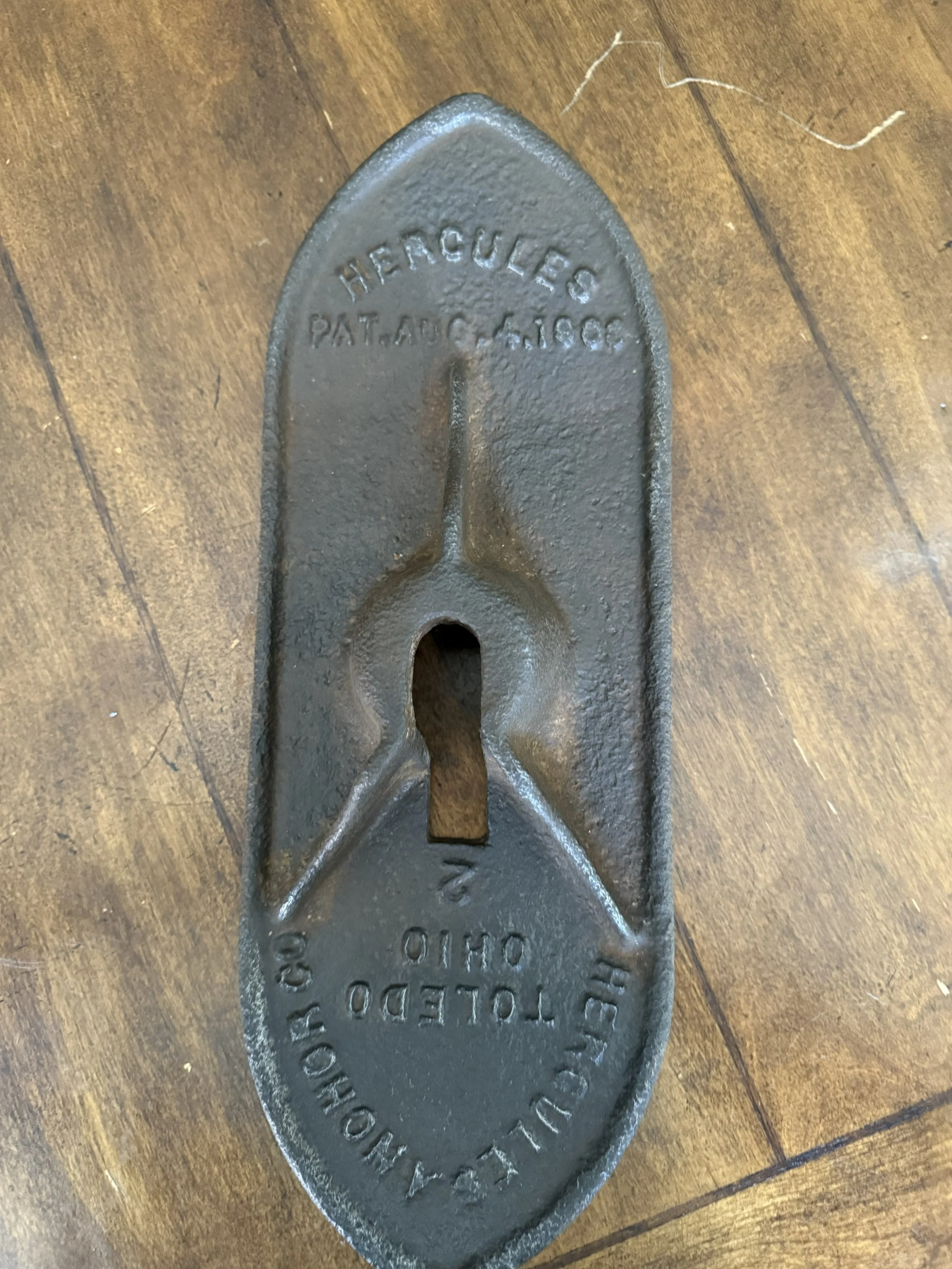
Top view of the Hercules Anchor Co. patented pressing iron, showing the full casting with the central raised spine, the anchor-form locking mechanism for the detachable wooden handle, and the keyhole slot through which the handle engages. The point end carries the patent date Aug. 4, 1903; the heel end carries the Hercules Anchor Co. Toledo Ohio maker cartouche.
The Hercules Anchor Co. of Toledo, Ohio manufactured pressing irons in the early twentieth century. This example — a size 2 patented detachable-handle sad iron bearing the patent date August 4, 1903 — is a product of the same era and the same Ohio manufacturing tradition that produced the hollow ware in the SSC collection, expressed in a different form: not a skillet or a kettle, but a tool for domestic labor, cast from the same gray iron, in the same sand-mold process, by an Ohio foundry whose products were shipped into American households across the Midwest.
A sad iron is a smoothing or pressing iron — the ancestor of the modern electric iron — used for pressing clothes and linens by heating the cast iron body on a wood or coal stove and pressing it across fabric while hot. The name comes from the Old English word ‘sad’ meaning solid or heavy, a reference to the dense cast iron body that retained heat for pressing. Before electric irons became widely available in the 1920s and 1930s, sad irons were standard domestic equipment in virtually every American home.
The Hercules Anchor Co.’s 1903 patent covers the specific mechanism by which this iron’s handle attaches and detaches — a keyhole-slot anchor system in which the wooden handle is inserted through a shaped opening and locked in place by the anchor-form cast iron mechanism visible on the top surface. This detachable handle system, in various forms, was the major pressing iron innovation of the 1870s through 1900s. It allowed the cast iron body to be heated on the stove while the wooden handle remained cool, then the cool handle was attached for pressing and the hot iron used without burning the operator’s hand.
The Detachable Handle System

Close-up detail of the keyhole-slot handle socket and anchor locking mechanism on the top of the Hercules iron. The shaped slot receives the wooden handle, which is locked in place by the cast anchor form. This mechanism is covered by the patent of August 4, 1903.
The detachable handle sad iron was invented in its classic form by Mary Florence Potts of Ottumwa, Iowa, who received a U.S. patent on April 4, 1871. Her design allowed a single wooden handle to serve multiple iron bodies, each heated in rotation on the stove while the cool handle was attached to whichever body was at the right temperature for pressing. This innovation became the dominant sad iron design for the remainder of the nineteenth century and into the early twentieth, producing hundreds of patents from dozens of manufacturers, each claiming improvements on the basic detachable-handle concept.
The Hercules Anchor Co.’s August 4, 1903 patent represents one such improvement — a specific mechanism using an anchor-shaped locking form and keyhole slot that the company evidently believed offered advantages over competing designs in terms of secure attachment, ease of operation, or durability. The company incorporated the word Anchor into its name directly, suggesting the anchor mechanism was the company’s primary selling point and a design feature they considered distinctive enough to brand around.
The wooden handle on this example is original and intact — the period wood survives with appropriate age and patina, fitting securely in the keyhole socket and engaging the anchor mechanism as designed. Original wooden handles on sad irons from this era frequently do not survive — they were subject to cracking from repeated heat exposure, breakage from use, and loss over a century of storage and resale. Their presence on a piece is a meaningful addition to its completeness as a collection object.
Hercules Anchor Co., Toledo, Ohio
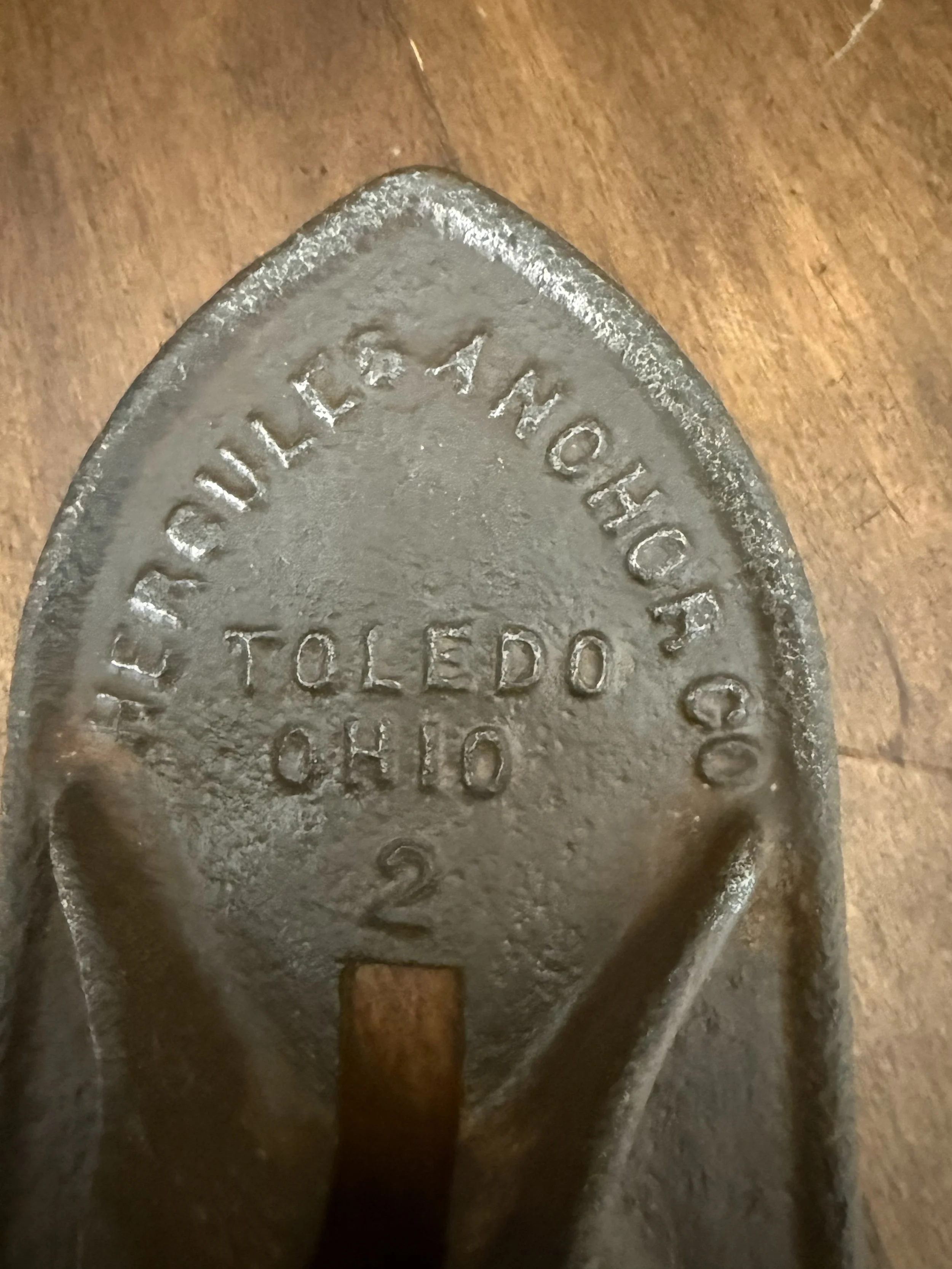
Heel end of the Hercules Anchor Co. pressing iron showing the full maker cartouche: HERCULES ANCHOR CO. / TOLEDO / OHIO / 2. The oval cartouche format is characteristic of early twentieth century Ohio cast iron marking conventions. The '2' designates the weight class of this iron body.
The Hercules Anchor Co. was a Toledo, Ohio manufacturer of patented pressing irons operating in the early twentieth century. Toledo, the seat of Lucas County on the Maumee River at the western end of Lake Erie, was a significant manufacturing center in this period — home to glass manufacturing, automotive supply, and a range of foundry and industrial production that placed it firmly within the Ohio manufacturing tradition that also produced the hollow ware of the SSC collection.
The Hercules Anchor Co. does not appear in the standard references for American cast iron hollow ware, which focus on cookware manufacturers. It was a specialist tools and implements maker rather than a hollow ware producer — a category of Ohio cast iron manufacture that operated alongside the cookware industry but has received less systematic collector attention. Research into the company’s founding date, production history, and closure has not produced documentary records to date, making this piece itself one of the primary physical records of the company’s existence. The patent date of August 4, 1903 establishes the earliest possible production date. The presence of ‘TOLEDO OHIO’ in the cast markings confirms the Ohio origin. The rest of the company’s history is, at present, undocumented.
This is the condition that defines much of the underdocumented Ohio cast iron category: the piece exists, the markings tell us who made it and where, and the patent gives us a date anchor, but the company itself left few surviving records. The iron speaks for itself. That is what the SSC collection preserves and documents.
Patent Date: August 4, 1903

Point (forward) end of the Hercules Anchor Co. pressing iron showing the cast patent marking: HERCULES / PAT. AUG. 4. 1903. The patent date is cast directly into the iron body at the point end. Identification of the specific patent number associated with this date is subject to ongoing research.
The patent date August 4, 1903 is cast directly into the top surface of the iron at the point end. This is a standard practice for patented American consumer goods of the period — rather than listing a patent number, which required the purchaser to look up the number in a federal register, manufacturers cast the date directly, making the patent claim immediately legible to any purchaser or user.
The specific U.S. patent corresponding to August 4, 1903 and assigned to or used by the Hercules Anchor Co. has not been definitively identified in available patent databases at the time of this writing. A comprehensive search of patents granted on or around August 4, 1903 relating to sad irons, pressing irons, and detachable handle mechanisms remains in progress. SSC will update this record if and when the specific patent number is identified. The physical design of the locking mechanism — the keyhole slot and anchor form visible in the photographs — is the embodiment of whatever improvement the 1903 patent claimed over prior art.
What is clear from the patent date is that this iron was in production no earlier than August 4, 1903. The design, materials, and construction are consistent with Ohio foundry production of the 1903–1920s period. Cast iron sad irons of this type were largely displaced by electric irons as household electrification became widespread through the 1920s and into the 1930s, suggesting a production window for this iron type that closed before the mid-1930s in most markets.
The Pressing Iron in American Domestic Life
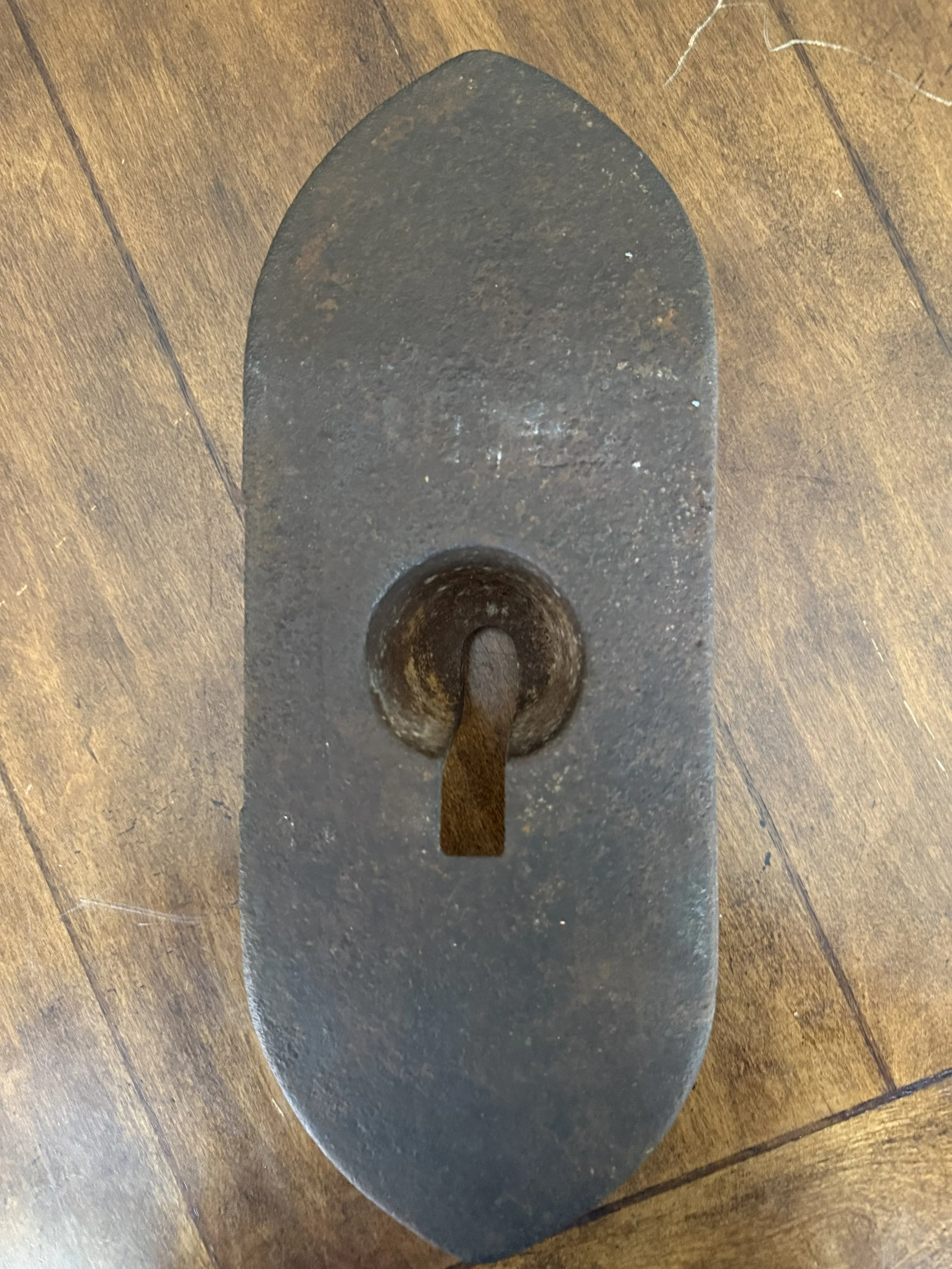
Sole (pressing surface) of the Hercules Anchor Co. pressing iron showing the smooth flat oval bottom designed for contact with fabric. The sole shows appropriate wear and patina consistent with use. The wooden handle stub is visible through the keyhole slot from this angle.
Before the electric iron made its way into American homes — first patented in 1882 by Henry W. Seely of New York, but not widely adopted until household electrification became common in the 1910s and 1920s — the sad iron was the domestic tool by which the enormous labor of ironing was accomplished in every American household. In an era when cotton, linen, and wool required pressing to be presentable, and when most households lacked the machinery to do it differently, the sad iron represented hours of labor per week: heating irons on the stove, testing temperature by holding the iron near the cheek or spitting on the sole to watch the steam, pressing, reheating, pressing again.
The detachable handle system that the Hercules Anchor Co.’s 1903 patent improved was a direct response to one of the most persistent problems of sad iron use: the heat transmitted from the iron body to the handle, making it painful or impossible to hold without a thick cloth pad. By keeping the handle separate from the body during heating — attaching it only when the body was ready to use — the cool-handle system gave users a comfortable grip on an iron hot enough to press effectively. The Hercules design carried this concept with a specific anchor locking mechanism that the company evidently believed was more reliable or more convenient than competing designs.
This pressing iron entered the SSC collection not as a cookware piece but as a piece of Ohio cast iron manufacturing history — an artifact of the domestic tools that Ohio foundries produced alongside their hollow ware, in the same period, for the same American households. The Hercules Anchor Co. of Toledo was one of hundreds of American companies competing in the detachable-handle sad iron market in the decade after Mary Potts’ original patent expired. Their 1903 improvement patent was their attempt to carve out a market position in that competition. This iron is the physical record of that attempt.
Piece Details
Manufacturer
Hercules Anchor Co., Toledo, Lucas County, Ohio
Piece Type
Patented Detachable-Handle Sad Iron (Pressing Iron)
Form
Oval cast iron pressing body with central raised spine and anchor-form locking mechanism for detachable wooden handle; smooth flat sole for pressing; size designation '2'
Material
Cast Iron body with original wooden handle
Markings — Point End
HERCULES / PAT. AUG. 4. 1903 — cast in raised letters at the point (forward) end of the top surface
Markings — Heel End
HERCULES ANCHOR CO. / TOLEDO / OHIO / 2 — cast within an oval cartouche at the heel (rear) end of the top surface
Size Designation
'2' — the number 2 in pressing iron convention refers to the weight class, not a sequential size as in skillet numbering. A size 2 sad iron typically weighs approximately 4–5 lbs.
Patent Date
August 4, 1903 — cast directly on the piece; the specific patent covering the detachable handle locking mechanism of this iron
Handle System
Detachable wooden handle secured via a keyhole-slot anchor mechanism. The wooden handle is inserted through the keyhole slot and locked in place; the iron body is heated on the stove separately while the cool handle is set aside, then reattached for use.
Sole / Pressing Surface
Smooth flat oval sole; shows appropriate wear and patina consistent with period use
Condition
Good — iron body structurally sound; all cast markings legible on both ends; original wooden handle present and intact; patina consistent with age; appropriate surface wear
Place of Manufacture
Toledo, Lucas County, Ohio
Date of Manufacture
c. 1903–1920s — patent date August 4, 1903 establishes the earliest possible production date; manufacture continued for an undetermined period thereafter
Acquisition Date
April 12, 2026
Acquisition Source
eBay — Seller: bbermuda1810
eBay Item Number
287263491575
Order Number
15-14485-74165
SSC Catalog Number
SSC-HERC-IRON-001
Collection Category
Ohio Cast Iron — Tools & Implements
Why This Piece Matters
The Hercules Anchor Co. pressing iron matters as a representative of an Ohio manufacturer whose products survive but whose history has not yet been written. The Hercules Anchor Co. of Toledo, Ohio made cast iron goods in the same foundry tradition as the better-documented hollow ware makers — sand-mold casting, gray iron, Ohio manufacture — but for a different purpose and for a product category that has received less systematic collector research. This piece is evidence that the company existed, what it made, where it was located, and when it began making it.
It matters as documentation of the detachable-handle pressing iron in its Ohio manufacturing context. The SSC collection’s focus on Ohio cast iron extends naturally beyond hollow ware to the full range of cast iron goods produced in the state’s foundries. A Toledo pressing iron with a 1903 patent and original wooden handle is a genuine piece of that broader Ohio cast iron story.
It matters because the original handle survives. A century-old wooden handle intact in its iron socket is not common. The completeness of this piece — iron body and original handle together — makes it a more complete document of the Hercules Anchor Co.’s product than the body alone would be.
The iron endures. The markings tell the truth. The story deserves to be told.
Sources & Further Reading
Physical examination of piece: 'HERCULES / PAT. AUG. 4. 1903' cast at point end; 'HERCULES ANCHOR CO. / TOLEDO / OHIO / 2' cast in oval cartouche at heel end; keyhole-slot handle socket with anchor locking mechanism; smooth flat oval sole; original wooden handle present and intact. Five seller photographs examined prior to acquisition.
U.S. Patent and Trademark Office historical records — Patent search for sad iron / pressing iron patents granted on or near August 4, 1903 ongoing. The specific patent number associated with the 'PAT. AUG. 4. 1903' marking on this piece has not yet been definitively identified. SSC collection record will be updated upon identification.
Smithsonian National Museum of American History — Pressing Iron Collections documentation. General reference for sad iron history, detachable-handle system development, and the Mary Potts patent of April 4, 1871 (U.S. Patent No. 113,448).
AntiqBuyer.com (antiqbuyer.com) — Patented Antiques / Sad Iron Archive. Reference for detachable-handle sad iron taxonomy, maker identification, and dating methodology for early twentieth century pressing irons.
Old and Interesting (oldandinteresting.com) — Early electric irons and sad irons. Historical context for domestic pressing iron use and the transition from sad irons to electric irons in American households 1880s–1930s.
The Cast Iron Collector — Foundry Database. Hercules Anchor Co. not present in standard hollow ware foundry references, confirming classification as a tools and implements maker outside the cookware collector mainstream.
eBay acquisition record — Order No. 15-14485-74165, seller: bbermuda1810, April 12, 2026. Item: Antique blacksmith iron press Hercules Anchor Cast Iron Tool Toledo Ohio vintage.
SSC Internal Collection Records — Ohio Cast Iron / Tools & Implements category. SSC-HERC-IRON-001 is the first Hercules Anchor Co. piece in the SSC collection; patent research ongoing.
About Steve’s Seasoned Classics
Steve’s Seasoned Classics is an online museum dedicated to preserving and documenting the heritage of American cast iron, with a focus on Ohio foundry pieces from the 19th and early 20th centuries. The SSC collection features over 130 pieces with detailed provenance, historical research, and photography for each item.
