Wagner Ware Sidney -O- No. 9 Cast Iron Skillet
SSC MUSEUM COLLECTION
Catalog No. SSC-WGNR-SKL-009
Cast Iron Skillet | No. 9 | Catalog No. 1059 D | Heat Ring | Sidney, Ohio
c. 1924–1935 • Wagner Manufacturing Company • Sidney, Shelby County, Ohio
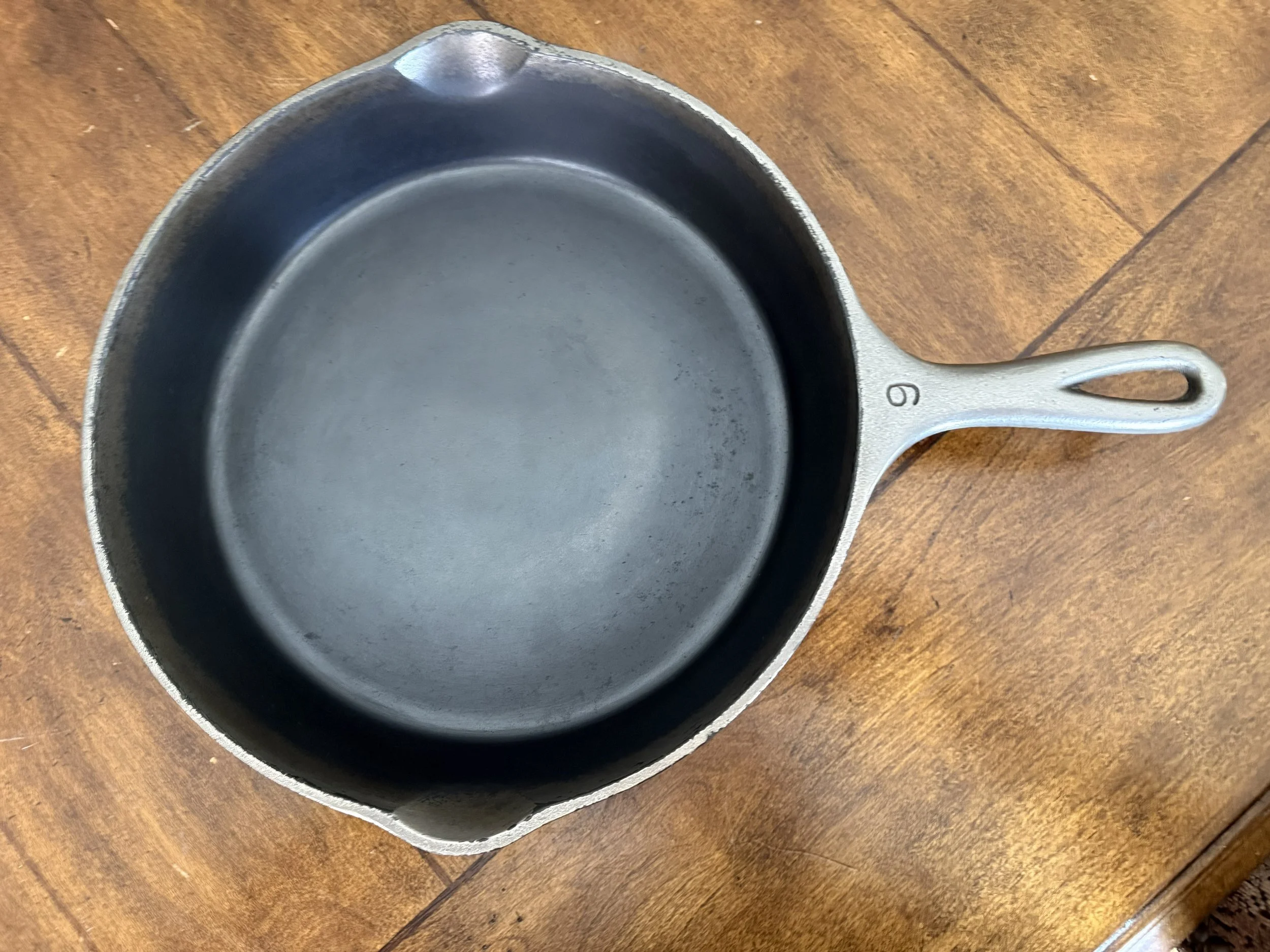
Interior cooking surface of the Wagner Ware Sidney -O- No. 9 skillet, showing the full 9½-inch cooking floor, scalloped pour spouts on the rim, and the size mark '9' at the handle junction. The cooking surface is clean and dark; the exterior reflects the silvery bare iron tone of a recently stripped piece awaiting full re-seasoning.
The Wagner Ware Sidney -O- No. 9 is an uncommonly encountered size — sandwiched between the ubiquitous No. 8 and the more readily found No. 10, it falls into a gap that most collectors working the open market encounter as a genuine search rather than a casual find. This example, catalog number 1059 D, was acquired for the Steve’s Seasoned Classics museum collection in November 2025. It presents in stripped condition — electrolytically cleaned prior to sale, with the cooking surface dark and the exterior base and sidewalls showing the characteristic silvery bare iron tone of recent stripping. The piece lays flat and is structurally sound throughout.
The markings are fully legible and unambiguous: the stylized Wagner Ware Sidney -O- logo at the standard 12 o’clock position, catalog number 1059 D at 6 o’clock, and the size mark ’9’ at the handle junction. The heat ring is present and well-defined, placing this piece in the c. 1924–1935 heat-ring catalog-number era. Pattern letter D designates the fourth mold pattern cut for the No. 9 — the result of the original pattern and its successors wearing out and being recut over the course of the production run.
No MADE IN USA marking is present, confirming pre-1959 manufacture within the collector era. The piece lays flat — a specific characteristic the seller noted in the listing and one worth documenting, as warping is a concern with cast iron of this age that has been subjected to uneven heating or thermal shock. This No. 9 sits level.
The No. 9 Skillet: An Uncommon Size

Profile view of the No. 9 showing the 2-inch sidewalls, the broad cooking floor, and the overall form of the piece. The heat ring is visible as the raised ledge at the base. The silvery exterior tone of the recently stripped iron contrasts with the darker cooking surface interior.
Within the complete Wagner Ware Sidney -O- skillet series, the No. 9 occupies a position that is easy to overlook and difficult to find. The No. 8 was the most produced size in the line — the standard family skillet, the flagship of Wagner’s cookware catalog, the size that appears in every antique market and thrift store in America. The No. 10 is the next step up and was produced in quantity as the large household size. The No. 9, at 11¾ inches across the top rim, sits between them and was produced in smaller numbers than either.
The No. 9 was also used as the base size for Wagner’s dual-logo National / Wagner Ware center-logo pans of the 1920s, where the same base casting received the National brand marking for sale through budget-oriented retail channels. The existence of these dual-logo variants — catalog number 1359 for the National No. 9 — documents that the No. 9 pattern was actively used across multiple product lines simultaneously, which may partly explain why the heat-ring No. 9 in standard stylized logo form is less common in the collector market than its size neighbors.
The No. 9 was produced in both heat-ring and smooth-bottom configurations. This example is the heat-ring version, the earlier of the two, dating from c. 1924 through approximately 1935 when the smooth-bottom transition reached this size. No assist handle was produced on the No. 9 — that feature is exclusive to the No. 13 and No. 14.
Condition: Electrolytically Stripped

Base of the No. 9 skillet showing the stylized Wagner Ware Sidney -O- logo at 12 o'clock and catalog number 1059 D at 6 o'clock. The heat ring is clearly visible as the raised concentric ring separating the cooking floor from the outer base. The silvery gray tone of the base reflects recent electrolytic stripping.
This No. 9 was electrolytically stripped prior to sale — a process in which the pan is submerged in an electrolyte solution and a low electrical current is used to reverse the oxidation process, dissolving rust and accumulated carbon from the surface without mechanical abrasion. The result is visible in the photographs: the exterior base and sidewalls show the light silvery-gray tone of bare iron from which all seasoning, carbon, and oxidation have been removed. The cooking surface is darker, suggesting either a light re-seasoning coat was applied before sale or the interior had been protected enough during the process to retain some existing seasoning.
Electrolytic stripping is considered one of the safest and most thorough methods of cleaning vintage cast iron, as it removes surface contamination without removing iron itself or altering the original casting surface. For a museum collection piece, a stripped pan presents clearly and without ambiguity — the markings are unobscured, the casting surface is readable, and the condition of the iron is fully assessable. SSC will apply appropriate seasoning treatment to stabilize the piece for long-term collection storage and display.
The seller specifically noted that this piece lays flat. Flatness is a meaningful condition attribute for a skillet of this age — it confirms the cooking floor has not warped from uneven heating, overfiring, or thermal shock at some point in its history. A warped No. 9 would rock on a flat surface and be unsuitable for stovetop use. This one does not.
Catalog Number 1059 D: The Fourth Pattern
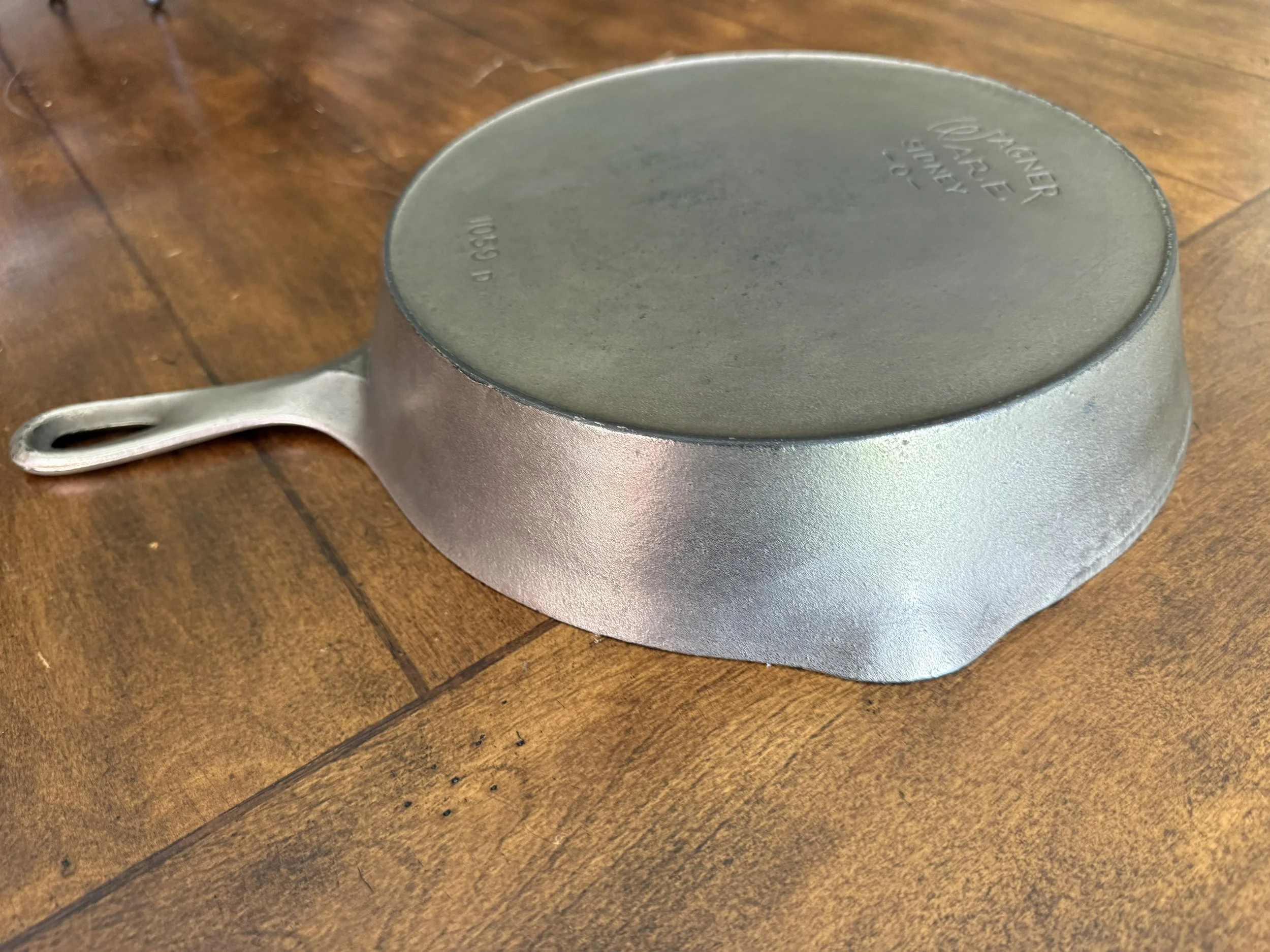
Bottom profile of the No. 9 showing the clearly defined heat ring and 2-inch sidewall depth. The heat ring ledge is well-defined and intact. The even silvery exterior tone of the stripped base and sidewalls is visible throughout.
Catalog number 1059 D identifies this piece precisely within the Wagner production system. The four-digit number 1059 encodes the product type (105x = regular skillet) and the size (x = 9). The letter D is the pattern letter, designating the fourth sand mold pattern cut for the No. 9 size. Wagner adopted this catalog numbering system in 1924; the pattern letter system existed alongside it, tracking the specific mold from which each piece was cast.
Pattern letters are foundry production identifiers, not date codes. The progression from A to D does not necessarily mean this piece was cast later than a 1059 A or 1059 B — multiple patterns for the same size could be in service simultaneously, and the sequence of letter assignment depended on when each new pattern was cut, not when it was used. What the D designation does confirm is that by the time this piece was cast, at least three previous patterns for the No. 9 had been produced and worn sufficiently to require replacement or supplementation. The 1059 D pattern represents mid-production maturity in the heat-ring catalog-number era.
Handle
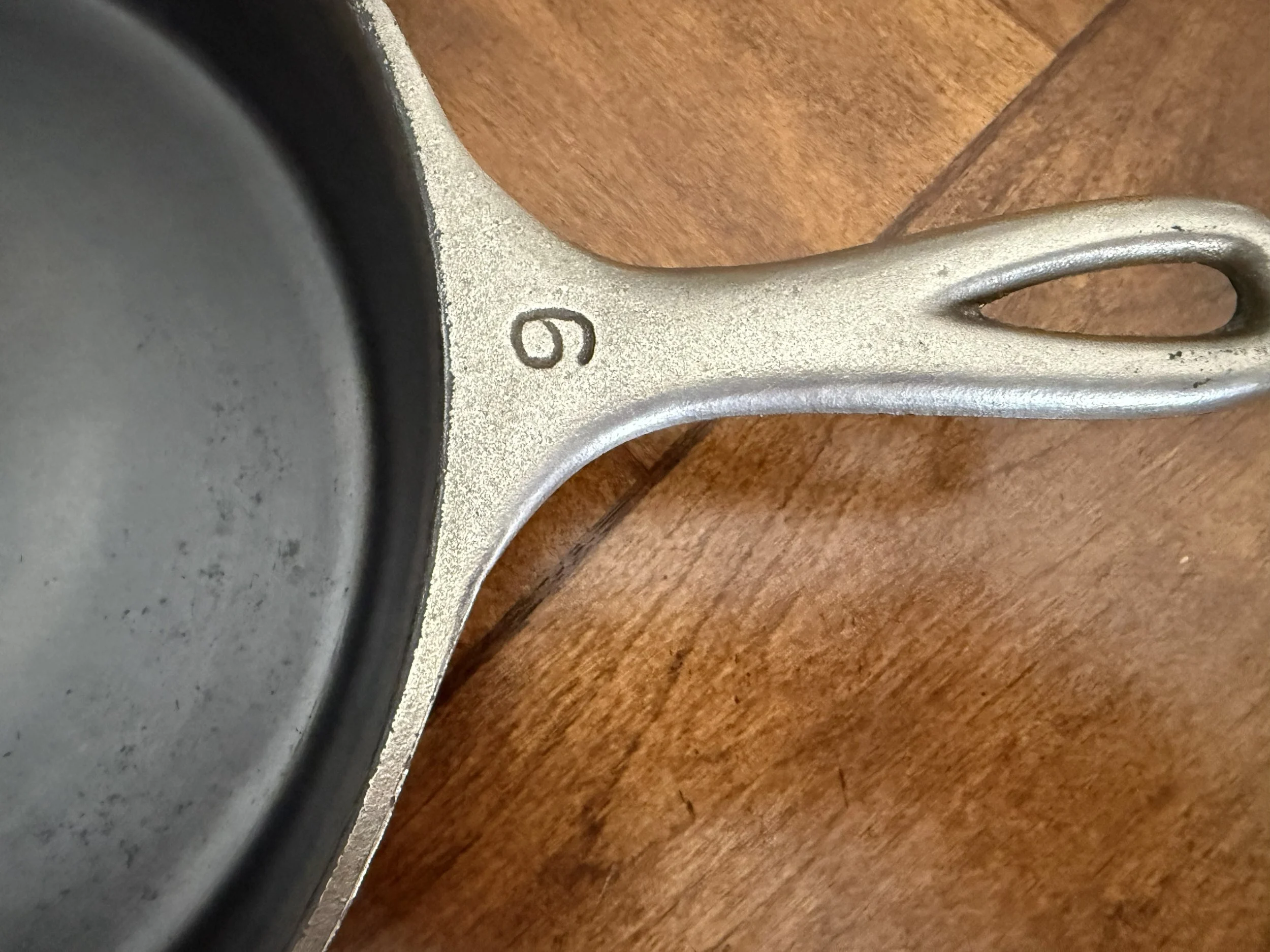
Handle detail of the No. 9. The size mark '9' is incised at the handle junction where the handle meets the pan body. The Wagner teardrop hanging loop at the terminus is intact and well-formed. The handle shows the clean bare iron surface of the stripped piece.
The main handle bears the incised size mark ’9’ at the junction where the handle meets the pan body — clearly legible in the photographs despite the stripped surface. The handle terminates in Wagner’s classic teardrop hanging loop, the open-eye form used across the Sidney -O- skillet line throughout the stylized logo era. The handle is intact with no cracks or losses.
The size mark placement at the handle junction is the standard location for this era of Wagner production, consistent with other heat-ring catalog-number era pieces in the SSC complete set collection.
Piece Details
Manufacturer
Wagner Manufacturing Company, Sidney, Ohio
Piece Type
Cast Iron Skillet
Form
Standard skillet with main handle, heat ring base, scalloped pour spouts. No assist handle — correct for No. 9.
Material
Cast Iron
Markings
Stylized Wagner Ware Sidney -O- logo (looped W) at 12 o'clock; catalog no. 1059 D at 6 o'clock; '9' incised at handle junction
Catalog Number
1059 D — pattern letter D designates the fourth mold pattern cut for the No. 9
Logo Position
12 o'clock — standard high position, consistent with post-1924 production
Size
No. 9 — Top diameter: 11 3/8 in. | Bottom diameter: 9 1/2 in. | Depth: 2 in.
Heat Ring
Yes — present; confirms pre-c.1935 manufacture within the catalog-number era
Made in USA Mark
Absent — confirms pre-1959 collector-era production
Logo Era
Stylized Wagner Ware Sidney -O- — High Position, Heat Ring, Catalog Number (c. 1924–1935)
Date of Manufacture
c. 1924–1935
Place of Manufacture
Sidney, Shelby County, Ohio
Condition
Electrolytically stripped and lightly re-seasoned; cooking surface clean and dark; exterior base and sidewalls show bare iron tone of recent stripping; heat ring intact; no cracks, no repairs; all markings fully legible; lays flat
Acquisition Date
November 11, 2025
Acquisition Source
eBay — Seller: xrc_swiftx
eBay Item Number
205829409912
Order Number
03-13830-95085
SSC Catalog Number
SSC-WGNR-SKL-009
Collection Designation
Wagner Ware Sidney -O- Complete Skillet Set — No. 0 through No. 14
Corporate Timeline: Wagner Manufacturing Company
1891
Wagner Manufacturing Company founded in Sidney, Shelby County, Ohio. Opens with 20 employees; within three months melts 9,200 lbs of iron daily.
1892
Nickel-plated hollow ware introduced.
1894
Wagner becomes one of the first American companies to manufacture cast aluminum cookware.
1897
Wagner acquires Sidney Hollow Ware Company. William H. Wagner joins to run the operation.
1903
Sidney Hollow Ware sold back to original owner Phillip Smith.
c. 1914
'Wagner Ware' branding introduced on hollow ware.
c. 1922
Stylized 'W' logo introduced — the iconic looped letterform shared by 'Wagner' and 'Ware,' positioned above SIDNEY and -O-.
1924
Four-digit catalog numbering system adopted. Regular skillets: 1050 + size number = catalog number. No. 9 = catalog no. 1059. Pattern letter D = fourth mold pattern for this size.
c. 1930–35
Smooth-bottom construction introduced for sizes 4–12. Heat-ring No. 9 examples date from 1924 to approximately 1935.
c. 1930–40
Pie Logo variant — stylized W in wedge-shaped border with 'CAST IRON SKILLET' at 6 o'clock. Most collectible Wagner logo; approximately ten-year production window.
1946–52
Wagner family divests. Company sold to Randall Company of Cincinnati, Ohio.
1957
Randall Wagner division acquires Griswold Manufacturing from McGraw-Edison.
1959
Textron acquires Randall. SIDNEY -O- removed from logo. Last year of collector-era production.
1969
Textron sells Wagner and Griswold lines to General Housewares Corporation (GHC).
1999
Sidney foundry closes permanently after 108 years of production.
2022–23
Wagner Cast Iron relaunches with Wagner family guidance. Former Sidney foundry building demolished June 2023.
Why This Piece Matters
The Wagner Ware Sidney -O- No. 9 matters because it fills a gap in the complete set that is harder to fill than most collectors expect. The No. 8 is everywhere. The No. 10 is common. The No. 9 is neither. Finding a heat-ring No. 9 with fully legible markings, a flat base, and no structural defects requires patience and deliberate searching. This example, catalog number 1059 D, provides that piece for the SSC complete set.
It matters as documentation of the fourth pattern in the No. 9 production sequence. Pattern letter D is not glamorous in the way that a center logo or a pie logo is glamorous, but it is information — it tells the story of a production line that wore through at least three mold patterns before this one was cut, that was busy enough to require repeated pattern replacement, that was making No. 9 skillets in sufficient volume to justify the ongoing investment in new patterns. The D is a mark of working production, not rarity.
It matters because it lays flat. That is not a small thing for a pan that is ninety years old. It has been through decades of heat, of use, of storage, of whatever history brought it to the market. And it lays flat. The iron held. The casting held. The geometry of the Sidney foundry held against everything that came after. That is worth documenting and worth preserving.
The iron endures. The markings tell the truth. The story deserves to be told.
Sources & Further Reading
Physical examination of piece: stylized Wagner Ware Sidney -O- logo at 12 o'clock; catalog no. 1059 D at 6 o'clock; size mark '9' at handle junction; heat ring present; no MADE IN USA marking; lays flat. Five seller photographs examined prior to acquisition.
The Cast Iron Collector (castironcollector.com) — Evolution of the Wagner Trademark; Numbers & Letters; Wagner Manufacturing Co. page. Primary reference for logo dating, catalog number system, pattern letter explanation, heat-ring/smooth-bottom transition, and No. 9 dual-logo National variant documentation.
Wagner Cast Iron (wagnercastiron.com/pages/story) — Official Wagner family history. Foundry founding, innovations, corporate ownership chain, foundry demolition 2023.
Wagner Cast Iron FAQ (wagnercastiron.com/pages/faq) — Catalog number formula: 1050 + size = catalog number for regular skillets.
Panman.com — Cast Iron Size and Capacity Charts (David G. Smith). No. 9 standard dimensions: top diameter 11 3/8 in., bottom 9 1/2 in., depth 2 in.
Cast Iron Collector Forums (castironcollector.com/forum) — Wagner Ware collecting thread; Smooth Bottom 1935–1959 questions thread. No. 9 heat-ring and smooth-bottom configurations confirmed; National dual-logo No. 9 (catalog no. 1359) documented.
The Book of Griswold & Wagner (Wallaces-Homestead / Krause Publications) — Standard collector reference volume.
eBay acquisition record — Order No. 03-13830-95085, seller: xrc_swiftx, November 11, 2025. Item: Vtg WAGNER WARE 9 1059 D Cast Iron Cooking Skillet w Heat Ring, Lays Flat/Level.
SSC Internal Collection Records — Wagner Ware Sidney -O- Complete Skillet Set documentation. SSC-WGNR-SKL-009 acquired in stripped condition; seasoning treatment pending.
About Steve’s Seasoned Classics
Steve’s Seasoned Classics is an online museum dedicated to preserving and documenting the heritage of American cast iron, with a focus on Ohio foundry pieces from the 19th and early 20th centuries. The SSC collection features over 130 pieces with detailed provenance, historical research, and photography for each item.
