Wagner Ware Sidney -O- No. 5 Cast Iron Skillet
SSC MUSEUM COLLECTION
Catalog No. SSC-WGNR-SKL-005
Cast Iron Skillet | No. 5 | Catalog No. 1055 H | Heat Ring | Sidney, Ohio
c. 1924–1935 • Wagner Manufacturing Company • Sidney, Shelby County, Ohio
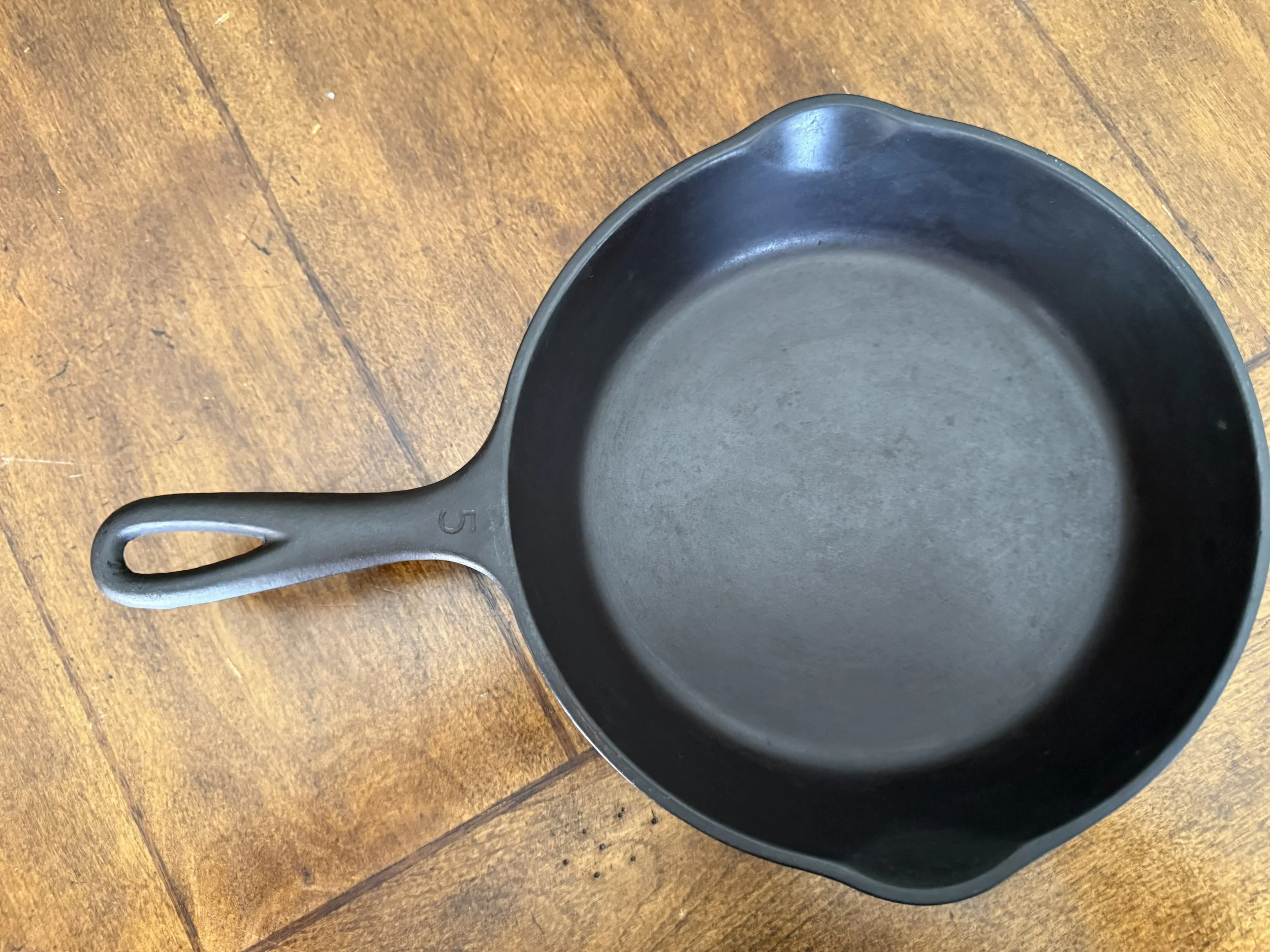
Interior cooking surface of the Wagner Ware Sidney -O- No. 5 skillet, showing the full 6¾-inch cooking floor, scalloped pour spouts on the rim, and the size mark '5' at the handle junction. The deep even seasoning is consistent throughout the cooking surface.
The Wagner Ware Sidney -O- No. 5 sits at the smaller end of the everyday domestic skillet range — compact enough for a single serving or a small side dish, capable enough to handle sautéed vegetables, a pair of eggs, or a small portion of meat without difficulty. At 8 inches across the top rim it fits squarely on a single stove burner. It was never a specialty size or a commercial tool. It was household cookware, produced across the full span of the collector era in both heat-ring and smooth-bottom configurations.
This example, catalog number 1055 H, was acquired for the Steve’s Seasoned Classics museum collection in August 2025. It carries the stylized Wagner Ware Sidney -O- logo at the standard 12 o’clock position, catalog number 1055 H at 6 o’clock, the heat ring on the base, and the size mark ‘5’ on the handle top — placing it in the c. 1924–1935 heat-ring catalog-number era. No MADE IN USA marking is present, confirming pre-1959 manufacture. The piece presents in excellent condition with deep even seasoning throughout and a clean cooking surface.
Pattern letter H — the eighth pattern designation for the No. 5 — confirms that this smaller size saw sustained production volume across the catalog-number era. Eight patterns worn through before this one was cut speaks to continuous domestic demand for a compact, practical everyday skillet across the decade between 1924 and approximately 1935.
The No. 5 Skillet: Compact and Practical
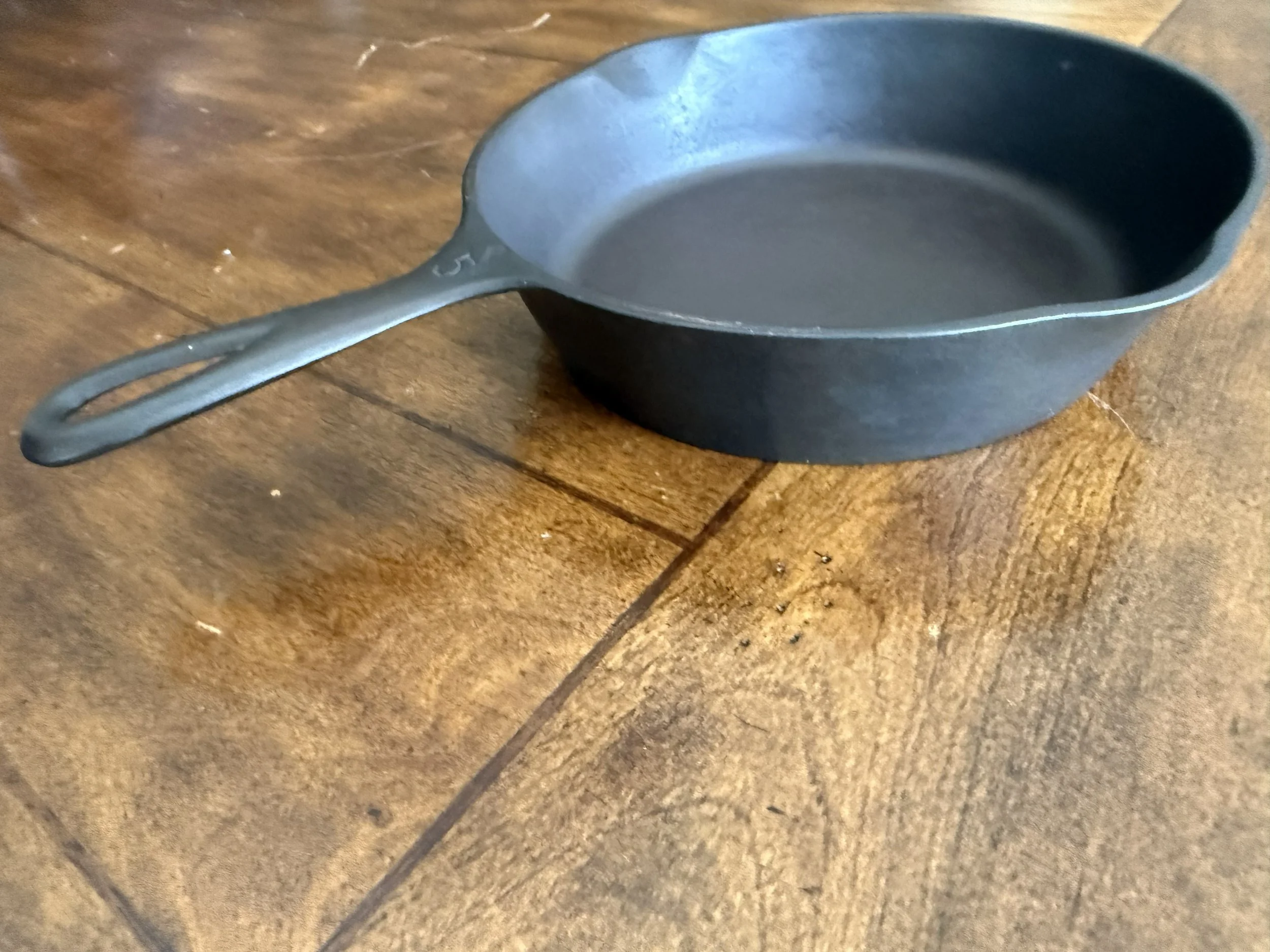
Profile view of the No. 5 showing the 1¾-inch sidewalls and the compact overall form. The heat ring is visible as the raised ledge at the base perimeter. The deep even seasoning extends across the exterior sidewall throughout.
At 8 inches across the top rim and 6¾ inches at the cooking floor, the No. 5 is one of the smaller sizes in the Wagner Ware Sidney -O- standard skillet line. It was produced in both heat-ring and smooth-bottom configurations throughout the Sidney collector era. The heat-ring version — this piece — is the earlier of the two, from the decade between the adoption of the catalog numbering system in 1924 and the smooth-bottom transition of approximately 1930–1935. It is the No. 5 from the wood-stove era, when the heat ring that seats the pan on a stove eye was still a functional necessity in most American kitchens.
The No. 5 also continued in production through the smooth-bottom era and into the 1950s as Wagner’s production range was contracted. By the early 1950s the standard line had been pared down to a smaller selection of sizes — No. 3, No. 5, No. 6, No. 8, No. 10, and No. 12 appear in references to late-period production — confirming the No. 5 as one of the sizes Wagner retained through the end of the collector era. The heat-ring example in this collection represents the earlier chapter of that sustained run.
Markings Analysis
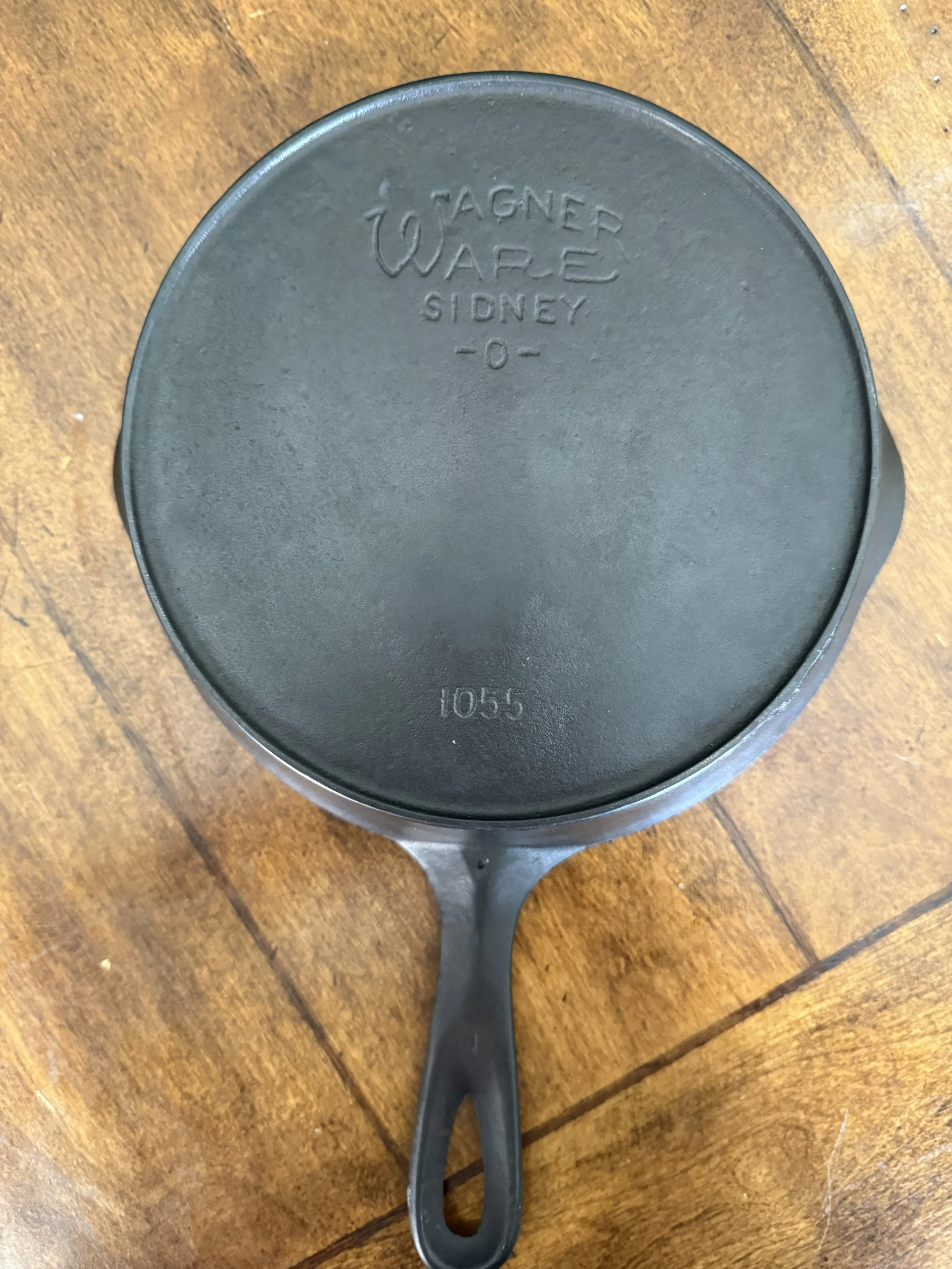
Base of the No. 5 skillet showing the stylized Wagner Ware Sidney -O- logo at 12 o'clock and catalog number 1055 H at 6 o'clock. The heat ring — the raised concentric ring separating the cooking floor from the outer base — is clearly present, confirming c. 1924–1935 manufacture.
The stylized Wagner Ware Sidney -O- logo appears at the standard 12 o’clock position. Catalog number 1055 H appears at the 6 o’clock position — No. 5 = 1055 under the 1050+size formula adopted in 1924. Pattern letter H is the eighth mold pattern cut for the No. 5. The heat ring is present and intact. No MADE IN USA marking is present, confirming pre-1959 manufacture. All evidence — stylized logo at 12 o’clock, catalog number present, heat ring present — converges on c. 1924–1935.
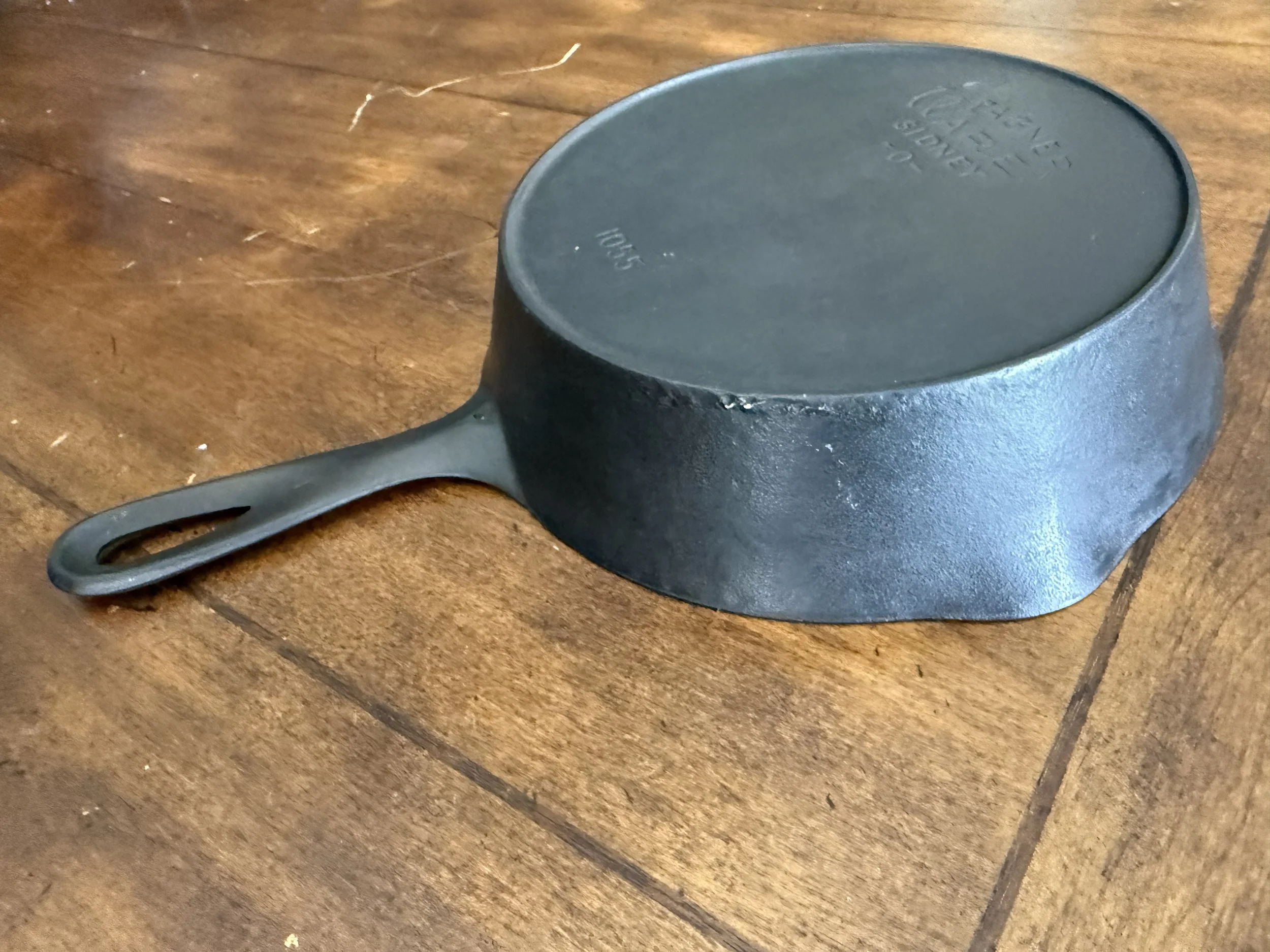
Bottom profile of the No. 5 showing the heat ring and 1¾-inch sidewall depth. The heat ring ledge is well-defined and intact. The compact proportions of the No. 5 are clearly visible in this profile view.
The heat ring on this No. 5 is well-defined and consistent with the overall quality of the piece. The ring was designed to seat the pan securely over a wood or coal stove eye, holding it in place during cooking. As gas and electric ranges replaced wood stoves through the 1930s, the practical need for the ring disappeared — and around 1930–1935 Wagner transitioned the No. 5 to smooth-bottom construction. This heat-ring example predates that transition, placing it in the earlier portion of the catalog-number era.
Pattern Letter H: The Eighth Pattern
Catalog number 1055 H identifies this piece precisely. The four-digit number 1055 encodes the product type (regular skillet) and the size (5). The letter H is the pattern letter — the eighth sand mold pattern cut for the No. 5. For a smaller size like the No. 5, reaching pattern letter H within the approximately eleven-year heat-ring catalog-number window (1924–1935) reflects steady, continuous domestic demand. The No. 5 pattern was worn through and replaced seven times before this piece was cast, because the No. 5 kept being made, because it kept being bought, because it kept being used in American kitchens.
Handle
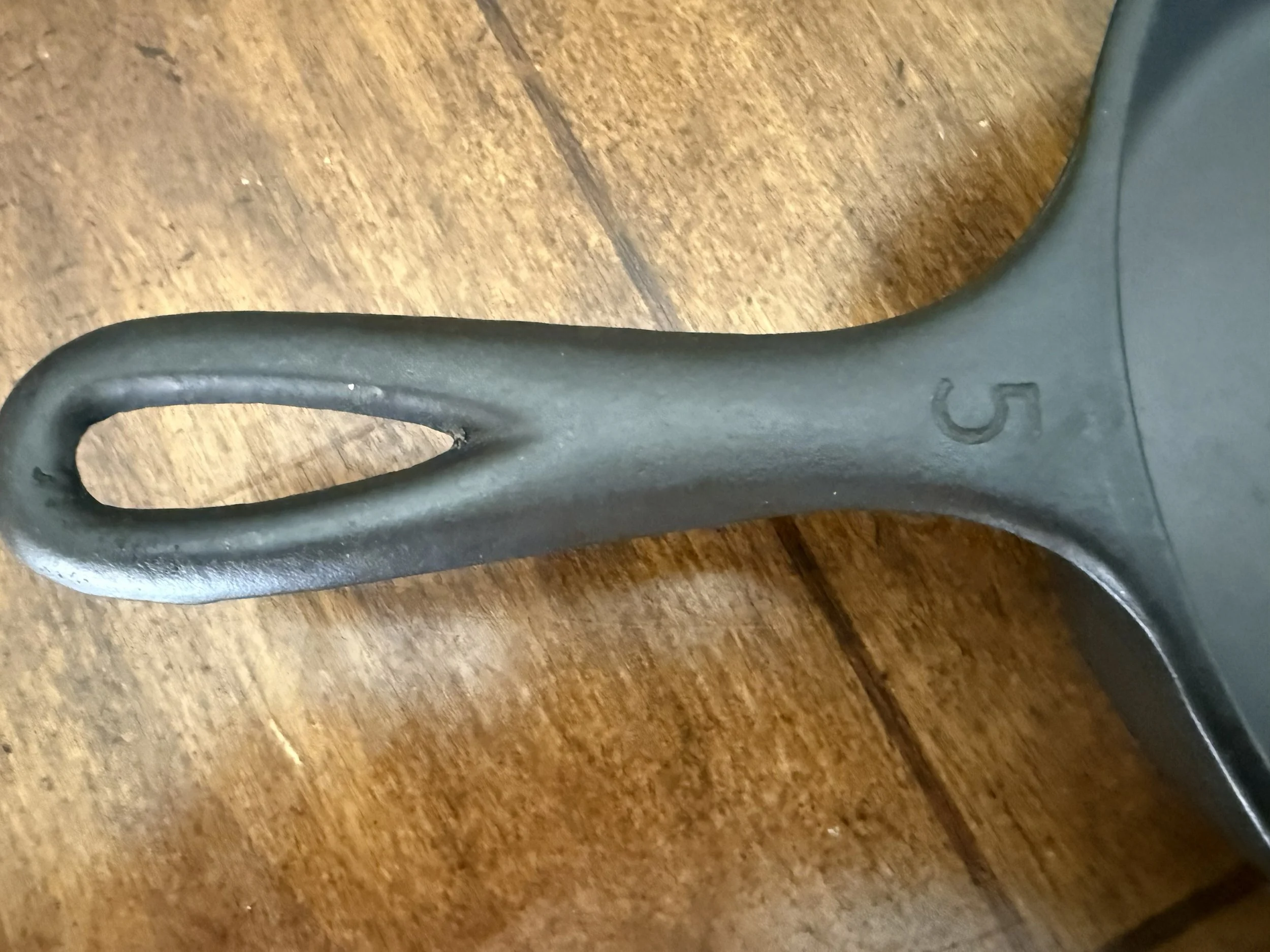
Handle detail of the No. 5. The size mark '5' is incised on the handle top near the junction with the pan body. The Wagner teardrop hanging loop at the terminus is intact and well-formed. The deep consistent seasoning is visible throughout the handle.
The main handle bears the incised size mark ‘5’ on the handle top near the junction with the pan body. The handle terminates in Wagner’s classic teardrop hanging loop — the open-eye form used across the Sidney -O- skillet line throughout the stylized logo era. The handle is intact with no cracks or losses.
Piece Details
Manufacturer
Wagner Manufacturing Company, Sidney, Ohio
Piece Type
Cast Iron Skillet
Form
Standard skillet with main handle, heat ring base, scalloped pour spouts. No assist handle — correct for No. 5.
Material
Cast Iron
Markings
Stylized Wagner Ware Sidney -O- logo (looped W) at 12 o'clock; catalog no. 1055 H at 6 o'clock; '5' incised on handle top near junction
Catalog Number
1055 H — pattern letter H designates the eighth mold pattern cut for the No. 5; confirms sustained production volume for this size
Logo Position
12 o'clock — standard high position, consistent with post-1924 production
Size
No. 5 — Top diameter: 8 in. | Bottom diameter: 6 3/4 in. | Depth: 1 3/4 in.
Heat Ring
Yes — present; confirms pre-c.1935 manufacture within the catalog-number era
Made in USA Mark
Absent — confirms pre-1959 collector-era production
Logo Era
Stylized Wagner Ware Sidney -O- — High Position, Heat Ring, Catalog Number (c. 1924–1935)
Date of Manufacture
c. 1924–1935
Place of Manufacture
Sidney, Shelby County, Ohio
Condition
Excellent — deep even seasoning throughout; cooking surface clean; heat ring intact; no cracks, no repairs; all markings legible
Acquisition Date
August 19, 2025
Acquisition Source
eBay — Seller: 99buckeyes99
eBay Item Number
156808418839
Order Number
19-13458-77265
SSC Catalog Number
SSC-WGNR-SKL-005
Collection Designation
Wagner Ware Sidney -O- Complete Skillet Set — No. 0 through No. 14
Corporate Timeline: Wagner Manufacturing Company
1891
Wagner Manufacturing Company founded in Sidney, Shelby County, Ohio. The No. 5 is among the sizes in production from the foundry's earliest years.
c. 1914
'Wagner Ware' branding introduced on hollow ware.
c. 1922
Stylized 'W' logo introduced.
1924
Four-digit catalog numbering system adopted. No. 5 = catalog no. 1055. Pattern letter H = eighth mold pattern for this size, documenting sustained production volume.
c. 1930–35
Smooth-bottom construction introduced for sizes 4–12. Heat-ring No. 5 examples (this piece) date from c. 1924 to approximately 1935.
c. 1930–40
Pie Logo variant produced — stylized W in wedge-shaped border with 'CAST IRON SKILLET' at 6 o'clock. Most collectible Wagner logo; approximately ten-year window.
1934
Magnalite cast aluminum line introduced.
1946–52
Wagner family divests. Company sold to Randall Company of Cincinnati, Ohio.
1957
Randall Wagner division acquires Griswold Manufacturing from McGraw-Edison.
1959
Textron acquires Randall. SIDNEY -O- removed from logo. Last year of collector-era production.
1999
Sidney foundry closes permanently after 108 years of production.
2022–23
Wagner Cast Iron relaunches with Wagner family guidance. Former Sidney foundry building demolished June 2023.
Why This Piece Matters
The Wagner Ware Sidney -O- No. 5 matters in a complete set because every size matters in a complete set. This is the premise of the collection: that the full progression from No. 0 to No. 14, each piece documented with the same care given to the rarest sizes, represents something that no selection of highlights can represent — the actual range of what Wagner made and the actual spectrum of domestic cooking need that the Sidney foundry served across its history.
The heat-ring No. 5 is the earlier of the two No. 5 configurations in the Wagner line. It is the No. 5 from the wood-stove decade, from the years when American kitchens still depended on the ring to hold the pan steady on an eye. Pattern letter H documents eight generations of mold production within that era — eight times the foundry made a new pattern for this size, wore it through production, and replaced it. That is a quiet but real record of sustained manufacture, of a product that kept selling because it kept being needed.
It matters because the No. 5 is where the set transitions into the smaller everyday sizes. In a wall display, the progression from No. 5 to No. 4 to No. 3 to No. 2 to No. 0 tells a story about how cast iron cooking scaled down to individual servings and specialty uses. The No. 5 holds its place at the top of that smaller range honestly, as the heat-ring representative of a size that cooked daily in American households across the 1920s and into the mid-1930s.
The iron endures. The markings tell the truth. The story deserves to be told.
Sources & Further Reading
Physical examination of piece: stylized Wagner Ware Sidney -O- logo at 12 o'clock; catalog no. 1055 H at 6 o'clock; size mark '5' on handle top; heat ring present; no MADE IN USA marking. Five seller photographs examined prior to acquisition.
The Cast Iron Collector (castironcollector.com) — Evolution of the Wagner Trademark; Numbers & Letters; Wagner Manufacturing Co. page. Primary reference for logo dating, catalog number system, pattern letter explanation, heat-ring/smooth-bottom transition, and late-period production range documentation.
Wagner Cast Iron (wagnercastiron.com/pages/story) — Official Wagner family history. Foundry founding, innovations, corporate ownership chain, foundry demolition 2023.
Wagner Cast Iron FAQ (wagnercastiron.com/pages/faq) — Catalog number formula: 1050 + size = catalog number for regular skillets.
Panman.com — Cast Iron Size and Capacity Charts (David G. Smith). No. 5 standard dimensions: top diameter 8 in., bottom 6 3/4 in., depth 1 3/4 in.
Cast Iron Collector Forums (castironcollector.com/forum) — Wagner Ware collecting thread; Smooth Bottom 1935–1959 questions thread. No. 5 heat-ring and smooth-bottom configurations confirmed.
The Book of Griswold & Wagner (Wallaces-Homestead / Krause Publications) — Standard collector reference volume.
eBay acquisition record — Order No. 19-13458-77265, seller: 99buckeyes99, August 19, 2025. Item: #5 WAGNER WARE, cast iron skillet, cn # 1055H.
SSC Internal Collection Records — Wagner Ware Sidney -O- Complete Skillet Set documentation. SSC-WGNR-SKL-005 is the heat-ring No. 5 representative in the full-run No. 0 through No. 14 display set.
About Steve’s Seasoned Classics
Steve’s Seasoned Classics is an online museum dedicated to preserving and documenting the heritage of American cast iron, with a focus on Ohio foundry pieces from the 19th and early 20th centuries. The SSC collection features over 130 pieces with detailed provenance, historical research, and photography for each item.
