Wagner Ware Sidney -O- No. 14 Cast Iron Skillet
SSC MUSEUM COLLECTION
Catalog No. SSC-WGNR-SKL-014
Cast Iron Skillet | No. 14 | Catalog No. 1064 | Sidney, Ohio
c. 1924–early 1940s • Wagner Manufacturing Company • Sidney, Shelby County, Ohio
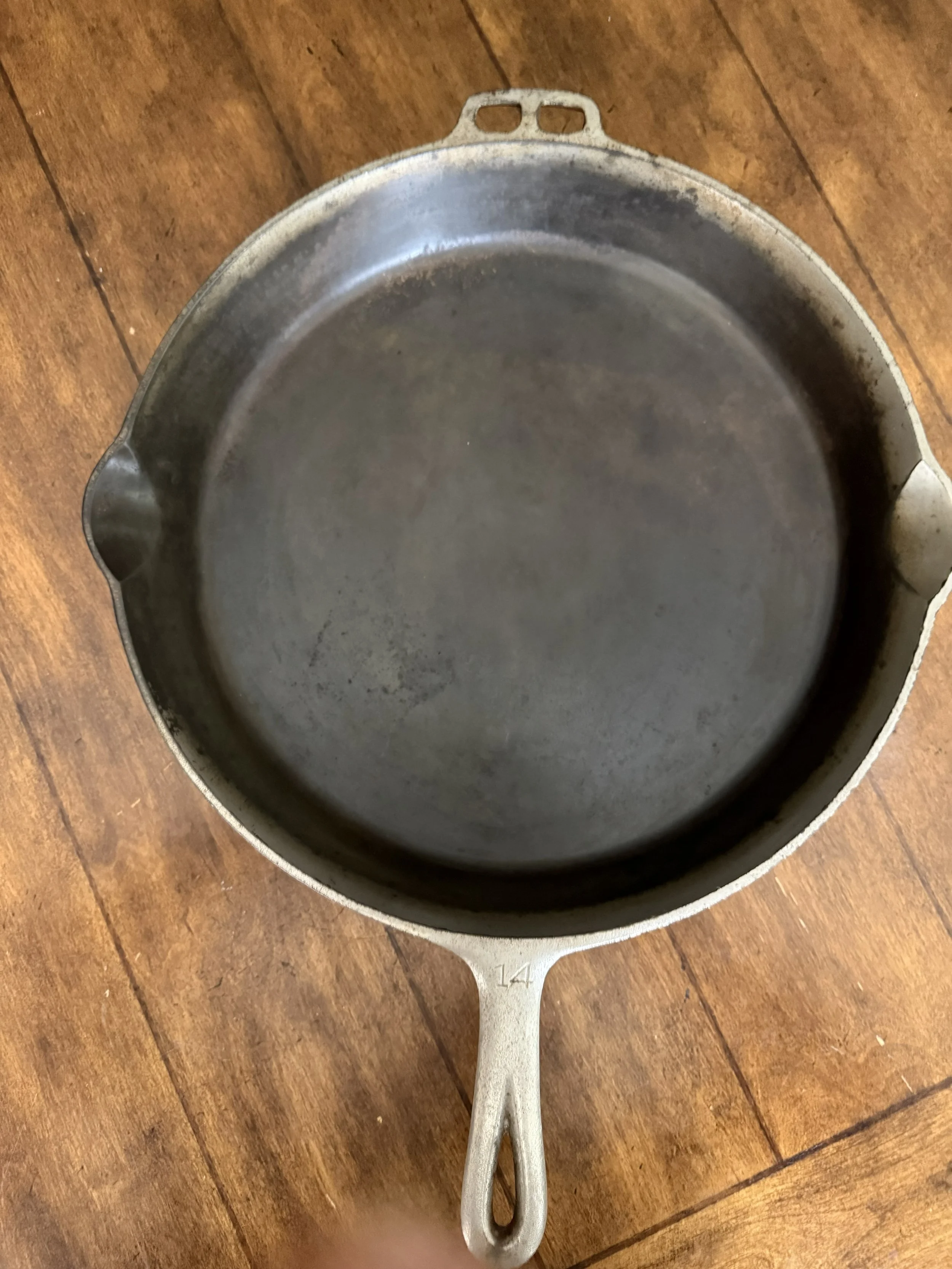
Interior cooking surface of the Wagner Ware Sidney -O- No. 14 skillet, showing the full 13½-inch cooking floor, the double-loop assist handle at 12 o’clock, and the main handle with Wagner’s classic teardrop hanging loop. The skillet is the largest standard size in the Wagner line.
At 15¼ inches across the top rim and 13½ inches at the cooking floor, the Wagner Ware Sidney -O- No. 14 is the largest standard skillet the Wagner Manufacturing Company of Sidney, Ohio ever produced. It is also one of the rarest. This piece was acquired for the Steve’s Seasoned Classics museum collection in January 2026, where it anchors the full-run No. 0 through No. 14 complete skillet display on the Wagner Donation Page.
The No. 14 was not a pan for the household stove. It was built for the boarding house, the logging camp cookhouse, the railroad commissary, the farm kitchen feeding a harvest crew. Anywhere a cook needed to work at volume, at heat, in iron. At 15¼ inches, it would have covered two burners simultaneously. Its double-loop assist handle — cast opposite the main handle and clearly visible in the photographs — made two-handed control possible at a weight no single grip could safely manage.
This example carries the stylized Wagner Ware Sidney -O- logo on its base, catalog number 1064, the size number ‘14’ on the handle top, and a heat ring on the base — the correct and expected configuration for a No. 14. Wagner never produced this size in smooth-bottom form. The absence of any MADE IN USA marking places it firmly in the pre-1959 collector era.
The No. 14 Skillet: The Outer Limit of the Wagner Line
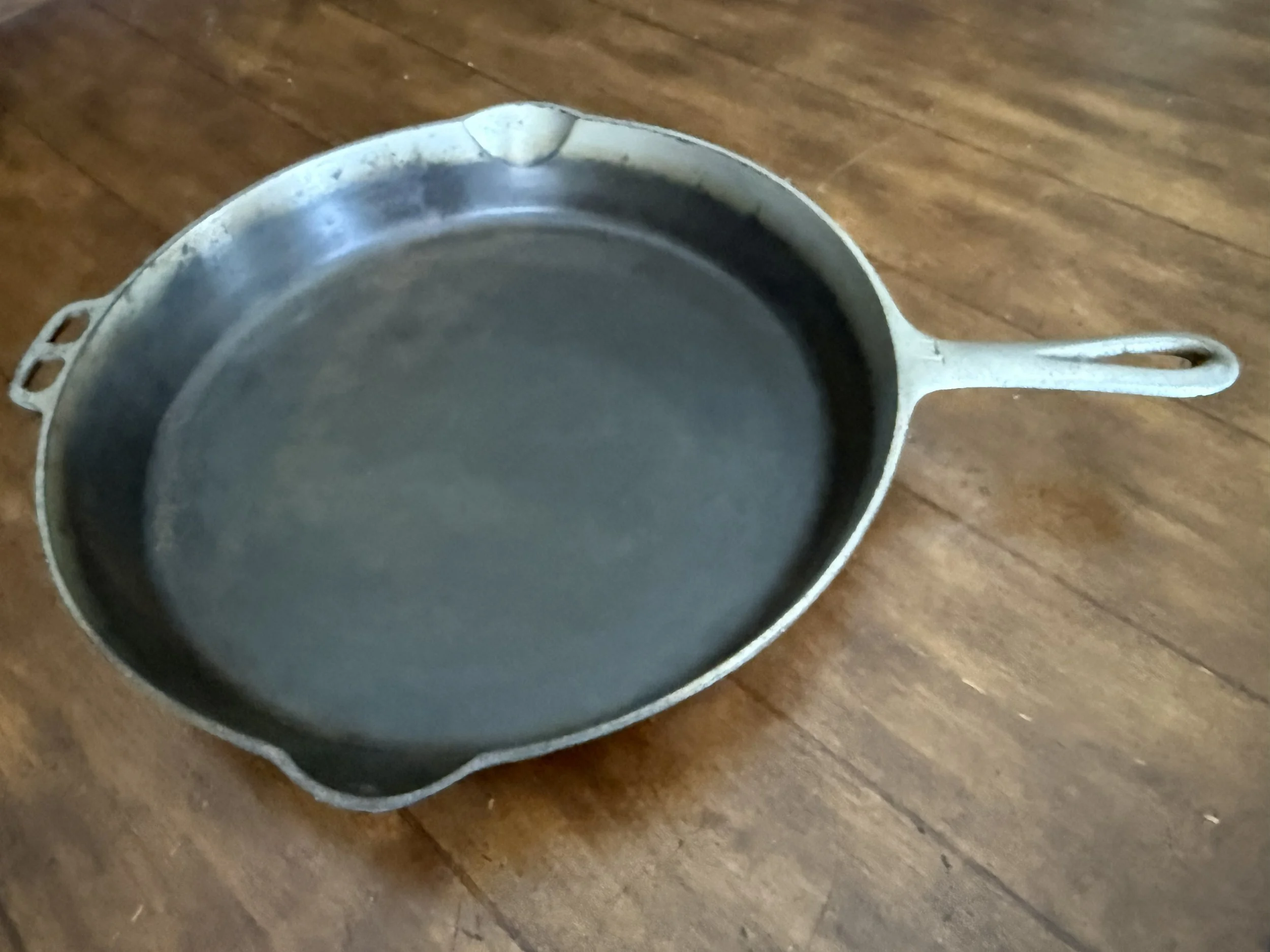
Profile view of the No. 14 showing the deep 2¼-inch sidewalls, the broad cooking floor, and the teardrop hanging loop on the main handle. The assist handle is visible at left.
The standard Wagner Ware Sidney -O- skillet line ran from No. 0 to No. 14, with No. 1 never having existed. The progression was built around the stove-eye sizing conventions of the wood and coal range era: each number corresponded to a specific cooking diameter, and a cook could specify a size that fit their stove’s eyes without guesswork. For most domestic users, the practical range ended at No. 10 or No. 12. The No. 13 and No. 14 were commercial sizes — ordered by institutions, not households.
The practical consequence of that commercial orientation is rarity. Production of the No. 13 and No. 14 was lower in volume relative to the everyday sizes. The environments in which these pans were used — heavy commercial kitchens, camps, boarding houses — were hard on cast iron. Pans cracked, handles broke, pieces were discarded rather than preserved. The No. 6 and No. 8 appear constantly in the antique market because they were made in enormous quantities and kept in domestic kitchens that preserved them. The No. 14 surfaces rarely, and rarely in clean condition.
Wagner Manufacturing Company: Sidney, Ohio and the Making of an American Foundry
The Wagner Manufacturing Company was founded in June 1891 by brothers Milton M. and Bernard P. Wagner in Sidney, Shelby County, Ohio. The foundry opened with twenty employees and within three months was melting approximately 9,200 pounds of iron daily. Architect Joseph Altenbach, a family friend, had begun construction of the manufacturing complex the prior year. The facility would expand repeatedly over the following decades as Wagner grew into a dominant force in American cast iron hollow ware.
Wagner’s early advantages were competitive from the start. R.O. Bingham, a veteran of the Marion Stove Works and the Sidney Manufacturing Company, joined as plant superintendent and proved to be a prolific designer. The company was an early adopter of nickel plating (1892) and cast aluminum cookware (1894) — at the time a genuinely exotic material. By the early twentieth century the Sidney plant had grown to 160,000 square feet with a staff of 300. The Sidney Daily News called it “the largest Holloware Plant in the World.” Wagner held, at its peak, approximately 60% of the American domestic cast iron cookware market.
In 1897, Wagner acquired the Sidney Hollow Ware Company — a local competitor founded by Phillip Smith in 1886 that had earned a reputation for exceptionally thin-walled, finely finished cast iron. William H. Wagner joined the family business to run the acquired foundry. In 1903 it was sold back to Smith. Collectors today encounter both the pre-Wagner Sidney Hollow Ware pieces (1886–1897) and the far more numerous Wagner-made pieces bearing Sidney markings — an important attribution distinction for serious students of Ohio hollow ware.
About 1914, Wagner began marketing its products under the combined ‘Wagner Ware’ brand name. Around 1922, the company introduced the stylized W — the iconic looped letterform that served double duty as the first letter of both ‘Wagner’ and ‘Ware’ — positioned above SIDNEY and -O- on every piece. In 1924, a four-digit catalog numbering system was adopted. For regular skillets: 1050 plus the size number equals the catalog number. The No. 14 became catalog number 1064.
The original Wagner family gradually divested between 1946 and 1952, selling to the Randall Company of Cincinnati. In 1957 Wagner’s Randall division acquired Griswold Manufacturing. In 1959 Textron acquired Randall, and with it the Wagner and Griswold lines. The year 1959 is the accepted boundary of the collector era: it was the year SIDNEY -O- was removed from the logo, reflecting that casting operations had moved away from the historic Sidney plant. In 1969 Textron sold to General Housewares Corporation. The Sidney foundry closed permanently in July 1999 after 108 years of operation. The factory building stood derelict for more than two decades before its demolition in June 2023.
Markings Analysis

Base of the No. 14 skillet. The stylized Wagner Ware Sidney -O- logo is visible at the 12 o’clock position. Catalog number 1064 appears at the 6 o’clock position opposite the handle. The heat ring — raised concentric ring separating the cooking floor from the outer base — is clearly present.
The stylized Wagner Ware Sidney -O- logo on this piece — the large looped W above SIDNEY and -O- — was introduced around 1922 and remained in continuous use through 1959. It is the most recognizable mark in Wagner’s history and the signature of the company’s peak production era. The logo appears at the 12 o’clock position on the base, consistent with the standard placement for stylized logo pieces.
Catalog number 1064 appears at the 6 o’clock position, opposite the handle. Wagner adopted catalog numbers in 1924. The formula for the regular skillet line was 1050 plus the size number: No. 6 = 1056, No. 8 = 1058, No. 14 = 1064. The presence of a catalog number establishes a firm post-1924 date for this piece.
The handle top bears the incised numeral ‘14’ — the size mark. This is consistent with Wagner’s standard practice for larger skillet sizes.
No MADE IN USA marking is present. That text was added to Wagner’s logo after 1959, when SIDNEY -O- was removed and production was no longer confined to Sidney. Its absence is a positive indicator of pre-1959 manufacture. No pattern letter is resolved in the seller photographs; electrolytic cleaning may reveal one.

Bottom profile of the No. 14 showing the heat ring and 2¼-inch sidewall depth. The heat ring is the raised concentric ring on the base, designed to fit over a stove eye. The No. 14 was never produced without it.
The heat ring is present and correct. Wagner’s transition from heat-ring to smooth-bottom construction, which occurred around 1930–1935, applied only to sizes 4 through 12. Sizes 2 and 3 were never made with heat rings at all; sizes 13 and 14 were never made without them. A smooth-bottom No. 14 would be an extraordinary find requiring careful authentication. The heat ring on this piece is not a mark against it — it is the only configuration in which a No. 14 was ever made.
Handle and Assist Handle
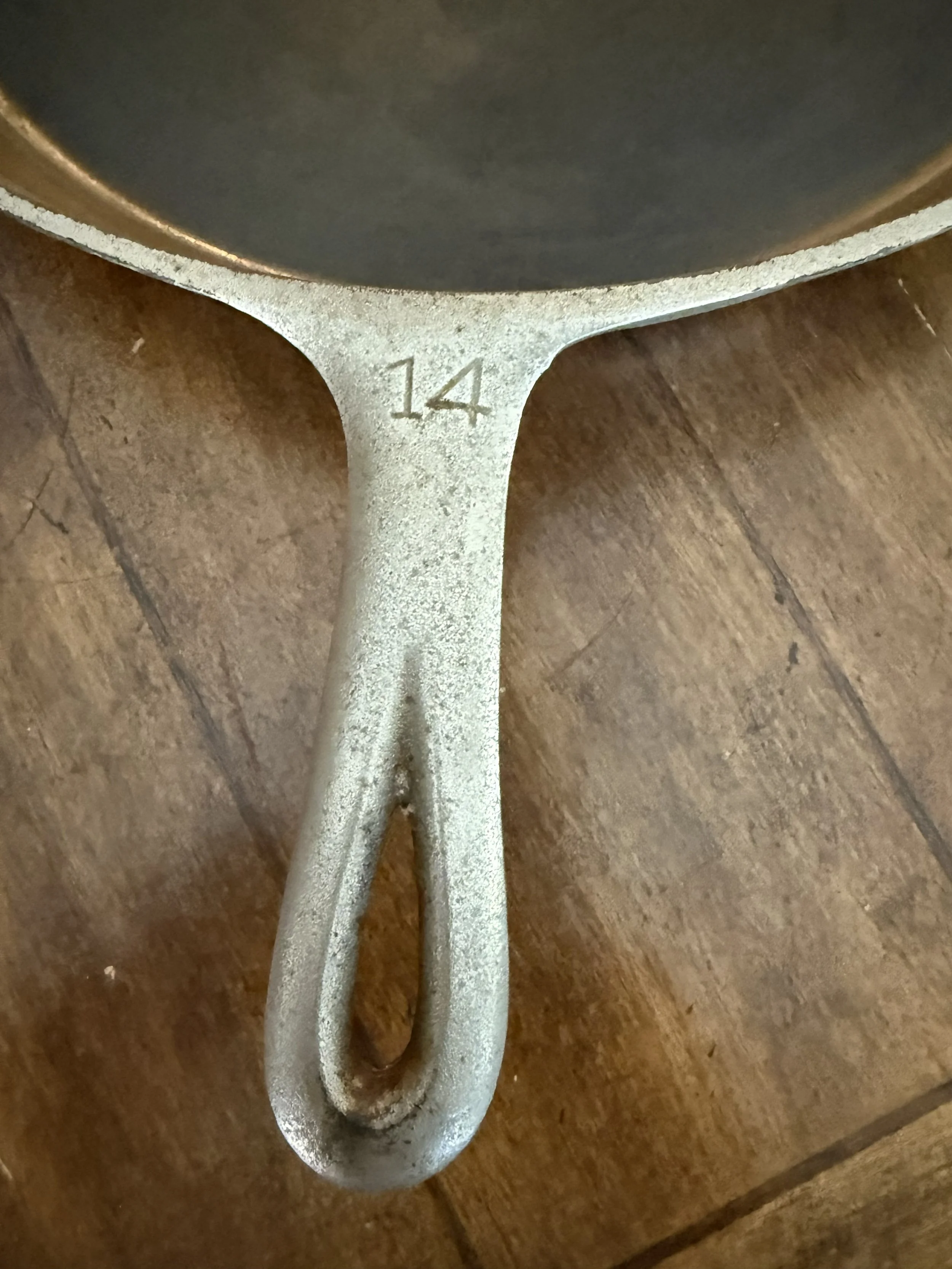
Handle detail of the No. 14. The incised size number ‘14’ is clearly legible on the handle top. The Wagner teardrop hanging loop at the terminus is intact and well-formed, showing the characteristic open-eye design used across the Sidney -O- skillet line.
The main handle bears the incised size mark ‘14’ and terminates in Wagner’s classic teardrop hanging loop — the open-eye form used throughout the stylized logo era. The handle is intact with no cracks or losses.
The double-loop assist handle — cast into the skillet body at the 12 o’clock position, opposite the main handle — is a defining feature of the No. 14. At the No. 14’s size and weight, a single main handle would have made the pan dangerous to maneuver over a hot fire. The assist handle allowed a second grip point, distributing the load between two hands. This design detail reflects the reality that the No. 14 was working equipment, not domestic tableware, and that Wagner engineered it accordingly.
Piece Details
Manufacturer
Wagner Manufacturing Company, Sidney, Ohio
Piece Type
Cast Iron Skillet
Form
Standard skillet with main handle, double-loop assist handle opposite, heat ring base
Material
Cast Iron
Markings
Stylized Wagner Ware Sidney -O- logo (looped W) at 12 o'clock; catalog no. 1064 at 6 o'clock; '14' incised on handle top
Catalog Number
1064
Size
No. 14 — Top diameter: 15 1/4 in. | Bottom diameter: 13 1/2 in. | Depth: 2 1/4 in.
Heat Ring
Yes — present and correct; No. 14 was never produced in smooth-bottom form
Made in USA Mark
Absent — confirms pre-1959 collector-era production
Logo Era
Stylized Wagner Ware Sidney -O- (post-1922, catalog number present = post-1924)
Date of Manufacture
c. 1924–early 1940s
Place of Manufacture
Sidney, Shelby County, Ohio
Condition
Collection-grade — no cracks, no repairs; legible markings; cooking surface and assist handle intact; surface oxidation consistent with age
Acquisition Date
January 19, 2026
Acquisition Source
eBay — Seller: chrisddavis
eBay Item Number
206006726124
Order Number
25-14102-72894
SSC Catalog Number
SSC-WGNR-SKL-014
Collection Designation
Wagner Ware Sidney -O- Complete Skillet Set — No. 0 through No. 14
Corporate Timeline: Wagner Manufacturing Company
1881
Milton M. and Bernard P. Wagner begin producing light metal hardware castings in Sidney, Ohio — the foundry's pre-history before formal incorporation.
1891
Wagner Manufacturing Company formally founded in Sidney, Shelby County, Ohio by brothers Milton M. and Bernard P. Wagner. Opens with 20 employees; within three months melts 9,200 lbs of iron daily. R.O. Bingham joins as plant superintendent.
1892
Nickel-plated hollow ware introduced — one of the first such lines in American cast iron manufacturing.
1894
Wagner becomes one of the first American companies to manufacture cast aluminum cookware. A new building — the second addition — is completed.
1897
Wagner Manufacturing acquires Sidney Hollow Ware Company from founder Phillip Smith. William H. Wagner joins to oversee the Sidney foundry operation.
1903
Sidney Hollow Ware Company sold back to Phillip Smith. Wagner continues expanding its primary Sidney plant.
c. 1914
'Wagner Ware' branding introduced — the combined brand name first appears on hollow ware.
c. 1922
Stylized 'W' logo introduced — the iconic looped letterform shared by 'Wagner' and 'Ware,' with SIDNEY and -O- below. Wagner's most recognized mark.
1924
Four-digit catalog numbering system adopted. Regular skillets: 1050 + size number = catalog number. No. 14 = catalog no. 1064.
c. 1930–35
Smooth-bottom construction introduced for regular skillet sizes 4–12. Sizes 2 and 3 were never heat-ring; sizes 13 and 14 retain heat ring throughout production.
1934
Magnalite brand cast magnesium-aluminum alloy cookware introduced.
c. 1930–40
Pie Logo variant produced — stylized W enclosed in wedge-shaped border with 'CAST IRON SKILLET' at 6 o'clock. Approximately ten-year production window. Most collectible Wagner logo.
1913
International distribution of Wagner products established. Brand reaches Europe.
1946–52
Original Wagner family gradually divests. Company sold to Randall Company of Cincinnati, Ohio in late 1952.
1957
Randall Wagner division acquires Griswold Manufacturing from McGraw-Edison.
1959
Textron, Inc. acquires Randall. SIDNEY -O- removed from logo. Last year of collector-era Wagner production.
1969
Textron sells Wagner and Griswold lines to General Housewares Corporation (GHC). Quality declines under GHC.
1996
GHC sells Wagner and Griswold rights to Slyman Group. Wagner plant enters receivership.
1999
Sidney foundry closes permanently in July. End of 108 years of production in Sidney.
2000
American Culinary Corporation of Willoughby, Ohio acquires Wagner and Griswold trademarks. No cast iron produced thereafter at Sidney.
2022–23
Wagner Cast Iron relaunches with guidance from Wagner family descendants, producing reissues of historic designs. Former Sidney foundry building demolished June 2023.
Why This Piece Matters
The Wagner Ware Sidney -O- No. 14 matters because it is the end of the line — literally the largest standard skillet Wagner Manufacturing Company ever cast in Sidney, Ohio. A full-run set from No. 0 to No. 14 is the complete statement of what Wagner made. This piece completes that statement for the Steve’s Seasoned Classics collection.
It matters as a document of purpose. The No. 14 was never a domestic pan. It was an institutional tool built for the conditions of commercial cooking: high heat, heavy loads, constant use, minimal care. That it survives intact — no cracks, no repairs, markings legible, handle and assist handle whole — is a testament to the quality of Wagner’s casting at the Sidney plant in its peak production decades.
It matters as a record of the foundry’s reach. Sidney, Ohio — a city of modest size in west-central Ohio — was once the site of what the local newspaper described as the largest hollow ware plant in the world. The ‘-O-’ in Wagner Ware Sidney -O- stood for Ohio, and it was cast into every piece as a mark of origin and pride. After 1959 it was gone from the logo. After 1999 the foundry was gone. After 2023 the building itself was gone. What remains is the iron.
The iron endures. The markings tell the truth. The story deserves to be told.
Sources & Further Reading
Physical examination of piece: stylized Wagner Ware Sidney -O- logo (looped W), catalog no. 1064, size mark '14' on handle top, heat ring present, no MADE IN USA marking. Five photographs from seller prior to shipment.
The Cast Iron Collector (castironcollector.com) — Wagner Manufacturing Co. page; Evolution of the Wagner Trademark; Numbers & Letters. Primary reference for logo dating, catalog number system, and production timeline.
Wagner Cast Iron (wagnercastiron.com/pages/story) — Official Wagner family history. Foundry founding, innovations, corporate ownership chain, foundry demolition 2023.
Wagner Cast Iron FAQ (wagnercastiron.com/pages/faq) — Catalog number formula confirmation: 1050 + size = catalog number for regular skillets.
Panman.com — Cast Iron Size and Capacity Charts (David G. Smith). Standard skillet dimension reference: No. 14 top diameter 15 1/4 in., bottom 13 1/2 in., depth 2 1/4 in.
Wikipedia — Wagner Manufacturing Company. Corporate history, ownership chain, Griswold acquisition, GHC era, Sidney closure 1999.
Atlas Obscura — Abandoned Wagner Ware Factory, Sidney, Ohio. Foundry site documentation; factory demolished June 2023.
Cast Iron Collector Forums (castironcollector.com/forum) — Wagner Ware collecting thread; Smooth Bottom 1935–1959 questions thread. Confirmation that No. 13 and No. 14 were never produced in smooth-bottom form.
The Book of Griswold & Wagner (Wallaces-Homestead / Krause Publications) — Standard collector reference volume.
eBay acquisition record — Order No. 25-14102-72894, seller: chrisddavis, January 19, 2026. Item: Rare Vintage Wagner Ware Sidney -O- No. 14 Cast Iron Skillet #1064.
SSC Internal Collection Records — Wagner Ware Sidney -O- Complete Skillet Set documentation. SSC-WGNR-SKL-014 is the largest piece in the set and completes the No. 0 through No. 14 run.
About Steve’s Seasoned Classics
Steve’s Seasoned Classics is an online museum dedicated to preserving and documenting the heritage of American cast iron, with a focus on Ohio foundry pieces from the 19th and early 20th centuries. The SSC collection features over 130 pieces with detailed provenance, historical research, and photography for each item.
