Wagner Ware Sidney -O- No. 11 Cast Iron Skillet
SSC MUSEUM COLLECTION
Catalog No. SSC-WGNR-SKL-011
Cast Iron Skillet | No. 11 | Catalog No. 1061A | Sidney, Ohio
c. 1924–1935 • Wagner Manufacturing Company • Sidney, Shelby County, Ohio

Interior cooking surface of the Wagner Ware Sidney -O- No. 11 skillet, showing the full 10⅞-inch cooking floor, scalloped pour spouts on the rim, and the size mark '11' at the handle junction. The cooking surface is clean and dark; the exterior retains its original unrestored patina.
The Wagner Ware Sidney -O- No. 11 is one of the genuinely scarce sizes in the standard skillet line — less frequently encountered in the market than the No. 10 below it or the No. 12 above it, and seldom found with fully legible markings in presentable condition. This example, catalog number 1061A, was acquired for the Steve’s Seasoned Classics museum collection in August 2025. It presents as-found and unrestored, retaining the original aged surface patina that accumulated over its working life.
The piece carries the stylized Wagner Ware Sidney -O- logo at the standard 12 o’clock position, catalog number 1061A at 6 o’clock, and the size mark ‘11’ incised at the handle junction. The pattern letter A designates the first mold pattern cut for the No. 11 size — the earliest pattern in the sequence for this catalog number. The heat ring is present and consistent with the 1924–1935 heat-ring era. No MADE IN USA marking is present. All markings are fully legible.
The exterior of this piece is unrestored — original age oxidation, carbon, and surface character throughout the base and sidewalls. The interior cooking surface is clean and dark, suggesting the pan was used and maintained during its working life but never professionally stripped. This is the piece as it came out of history. SSC will evaluate the appropriate conservation approach; the original surface character has documentary value and is noted here as part of the collection record.
The No. 11 Skillet: A Scarce Intermediate Size

Profile view of the No. 11 showing the 2⅛-inch sidewalls, the broad cooking floor, and the overall form of the piece. The contrast between the clean dark interior and the aged exterior patina is visible here. The classic Wagner teardrop hanging loop is intact at the handle terminus.
Within the complete Wagner Ware Sidney -O- skillet series, the No. 11 sits in an unusual position: it is large enough to be uncommon but not large enough to carry the commercial designation that makes the No. 13 and No. 14 so specifically rare. At 12½ inches across the top rim it is a substantial pan — larger than any standard domestic stove eye but not so large as to require the assist handle of the biggest sizes. It is a size that was made in meaningful quantity but that the market encounters far less often than the workhorse No. 6, No. 8, and No. 10.
The reason for that relative scarcity is not entirely clear. Production records from the Sidney foundry do not survive in detail, and collector observation suggests only that No. 11 examples surface less frequently than their neighbors in the size progression. What is documented is that the No. 11 was produced in both heat-ring and smooth-bottom configurations, with the heat-ring version predating the smooth-bottom transition of approximately 1930–1935. This example is the heat-ring version, placing it in the earlier portion of the catalog-number era.
No assist handle appears on the No. 11 — correct and consistent across the entire production run of this size. The double-loop assist handle is a feature of the No. 13 and No. 14 only. The No. 11, though large, was engineered for single-hand use with the teardrop-loop main handle.
As-Found and Unrestored: The Original Surface
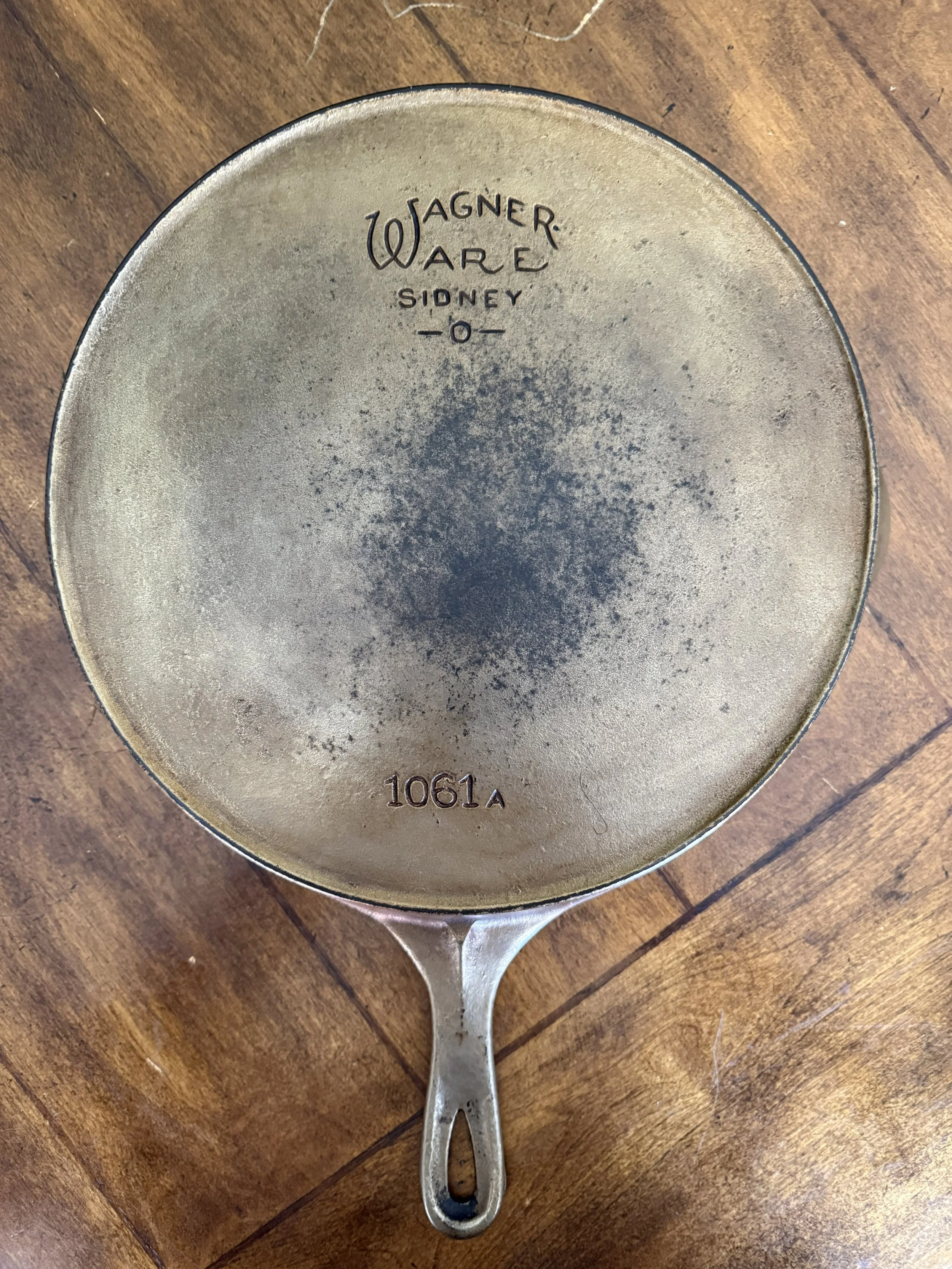
Base of the No. 11 skillet showing the stylized Wagner Ware Sidney -O- logo at 12 o'clock, catalog number 1061A at 6 o'clock, and the heat ring. The aged carbon and oxidation pattern on the base is original and unrestored, documenting the piece’s working surface history.
This No. 11 arrives in the SSC collection in as-found condition — unrestored, with the original surface character intact. The base shows the heat-blued carbon deposits and age oxidation that accumulate on a working cast iron pan over decades of use. The exterior sidewalls carry the brownish patina of iron that has cycled through heat and time without the intervention of electrolysis or lye. None of this represents damage. It represents history.
The interior cooking surface tells a different story. It is clean and dark — the result of regular use and wiping over the course of the pan’s working life. The cooking surface was maintained; the exterior was not stripped. This is the most common presentation of a genuinely used working pan: the cook cared for the cooking side and left the outside to accumulate its record of heat and time.
SSC will evaluate conservation options for this piece. The as-found surface character has documentary value as a record of the pan’s use history, and any conservation approach will be considered against the goal of preserving that record while stabilizing the iron against ongoing oxidation. The markings — logo, catalog number, size mark — are fully legible in current condition and will remain so after any appropriate conservation treatment.
Catalog Number 1061A: The Pattern Letter
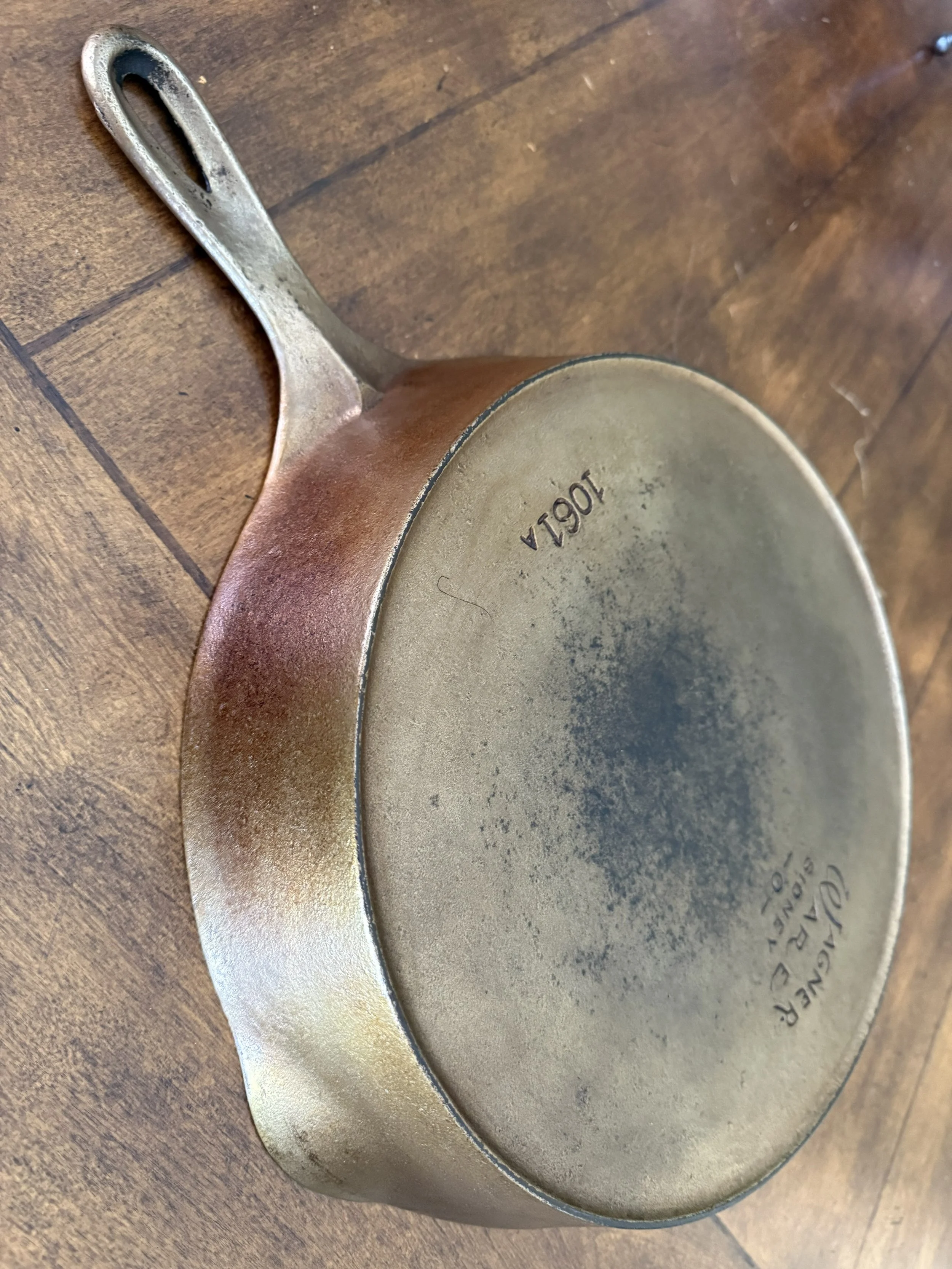
Bottom profile of the No. 11 showing the heat ring and 2⅛-inch sidewall depth. The heat ring is present and intact. The age oxidation on the outer sidewall is visible here, contrasting with the cleaner cooking floor surface visible at the top of the frame.
The catalog number on this piece — 1061A — carries information beyond the simple size identification. Wagner adopted its four-digit catalog numbering system in 1924, with the formula 1050 plus size number for regular skillets: 1061 for the No. 11. The letter following the number — A in this case — is the pattern letter, identifying which specific sand mold pattern was used to cast the piece.
Pattern letters are not date codes. They do not indicate that an A piece is older than a B piece in any absolute sense, since multiple patterns for the same size could be in use simultaneously, and patterns were recut or replaced as they wore out without following a strict sequential timeline. What pattern letter A does indicate is that this piece was cast from the first pattern designated for the No. 11 size in the catalog-number era — the original mold from which all subsequent No. 11 pattern cuts derived.
The presence of catalog number 1061A alongside the stylized logo at the standard 12 o’clock position, combined with the heat ring, places this piece in the c. 1924–1935 window — after catalog numbers were adopted and before the smooth-bottom transition eliminated the heat ring on the No. 11.
Markings Analysis

Handle detail of the No. 11. The size mark '11' is incised at the handle junction where the handle meets the pan body — clearly legible despite the unrestored exterior surface. The classic Wagner teardrop hanging loop is intact at the handle terminus.
The stylized Wagner Ware Sidney -O- logo on this piece appears at the 12 o’clock position — the standard high placement that became fixed after the early years of the stylized logo era. This logo was introduced around 1922 and remained in continuous use through 1959, and the 12 o’clock position was the standard from approximately 1924 onward.
Catalog number 1061A appears at the 6 o’clock position. The size mark ‘11’ is incised at the handle junction on the top of the pan — visible in the handle detail photograph. No MADE IN USA marking is present, confirming pre-1959 manufacture. All three marking elements — logo, catalog number, size mark — are fully legible in the seller photographs and confirm the piece’s identity and dating without ambiguity.
The heat ring on the base is present and intact. As with the No. 12, the No. 11 was eventually produced in smooth-bottom form after approximately 1930–1935. The heat ring here is consistent with the earlier, 1924–1935 heat-ring production period.
Piece Details
Manufacturer
Wagner Manufacturing Company, Sidney, Ohio
Piece Type
Cast Iron Skillet
Form
Standard skillet with main handle, heat ring base, scalloped pour spouts. No assist handle — correct for No. 11.
Material
Cast Iron
Markings
Stylized Wagner Ware Sidney -O- logo (looped W) at 12 o'clock; catalog no. 1061A at 6 o'clock; '11' incised at handle junction on top of pan
Catalog Number
1061A — pattern letter A designates the first mold pattern cut for the No. 11
Logo Position
12 o'clock — standard high position, consistent with post-1924 production
Size
No. 11 — Top diameter: 12 1/2 in. | Bottom diameter: 10 7/8 in. | Depth: 2 1/8 in.
Heat Ring
Yes — present; No. 11 produced in both heat-ring (pre-c.1935) and smooth-bottom (c.1935–1959) configurations
Made in USA Mark
Absent — confirms pre-1959 collector-era production
Logo Era
Stylized Wagner Ware Sidney -O- — High Position, Heat Ring, Catalog Number (c. 1924–1935)
Date of Manufacture
c. 1924–1935
Place of Manufacture
Sidney, Shelby County, Ohio
Condition
As-found — unrestored; original surface patina throughout; exterior shows age oxidation and carbon; interior cooking surface clean and dark; no cracks, no repairs; all markings fully legible
Acquisition Date
August 28, 2025
Acquisition Source
eBay — Seller: trigrules
eBay Item Number
326741431583
Order Number
16-13499-42265
SSC Catalog Number
SSC-WGNR-SKL-011
Collection Designation
Wagner Ware Sidney -O- Complete Skillet Set — No. 0 through No. 14
Corporate Timeline: Wagner Manufacturing Company
1891
Wagner Manufacturing Company founded in Sidney, Shelby County, Ohio. Opens with 20 employees; within three months melts 9,200 lbs of iron daily.
1892
Nickel-plated hollow ware introduced.
1894
Wagner becomes one of the first American companies to manufacture cast aluminum cookware.
1897
Wagner acquires Sidney Hollow Ware Company. William H. Wagner joins to run the operation.
1903
Sidney Hollow Ware sold back to original owner Phillip Smith.
c. 1914
'Wagner Ware' branding introduced on hollow ware.
c. 1922
Stylized 'W' logo introduced — the iconic looped letterform shared by 'Wagner' and 'Ware,' positioned above SIDNEY and -O-.
1924
Four-digit catalog numbering system adopted. Regular skillets: 1050 + size number = catalog number. No. 11 = catalog no. 1061. Pattern letter A = first mold pattern for this size.
c. 1930–35
Smooth-bottom construction introduced for sizes 4–12. Heat-ring No. 11 examples date from 1924 to approximately 1935.
c. 1930–40
Pie Logo variant — stylized W in wedge-shaped border, 'CAST IRON SKILLET' at 6 o'clock. Most collectible Wagner logo; approximately ten-year window.
1946–52
Wagner family divests. Company sold to Randall Company of Cincinnati, Ohio.
1957
Randall Wagner division acquires Griswold Manufacturing from McGraw-Edison.
1959
Textron acquires Randall. SIDNEY -O- removed from logo. Last year of collector-era production.
1969
Textron sells Wagner and Griswold lines to General Housewares Corporation (GHC).
1999
Sidney foundry closes permanently after 108 years of production.
2022–23
Wagner Cast Iron relaunches with Wagner family guidance. Former Sidney foundry building demolished June 2023.
Why This Piece Matters
The Wagner Ware Sidney -O- No. 11 matters because it is scarce in a way that accumulates quietly. It is not dramatically rare in the manner of the No. 13 or No. 14 — no assist handle to mark it as a commercial giant, no extreme size to make it conspicuous. It is simply a size that appears in the market less often than it should, that collectors pursuing a full run encounter as a genuine gap, and that in pattern letter A presents the earliest mold designation for the size in the catalog-number era.
It matters as an unrestored piece in a collection that will increasingly feature restored examples. The as-found surface of this No. 11 — the carbon, the oxidation, the age patina on the exterior alongside the clean dark interior — documents what a working cast iron pan looks like after decades of actual use rather than after professional restoration. Both states have value in a museum collection. This piece represents the former.
It matters because the stylized W above SIDNEY and -O- on its base is the mark of the largest hollow ware plant in the world, as it once described itself, cast in a city in Ohio that put its name into every piece it made. That name and that mark endure when everything else about the foundry — the building, the equipment, the workers, the family that built it — is gone.
The iron endures. The markings tell the truth. The story deserves to be told.
Sources & Further Reading
Physical examination of piece: stylized Wagner Ware Sidney -O- logo at 12 o'clock; catalog no. 1061A at 6 o'clock; size mark '11' at handle junction; heat ring present; no MADE IN USA marking. Five seller photographs examined prior to acquisition.
The Cast Iron Collector (castironcollector.com) — Evolution of the Wagner Trademark; Numbers & Letters; Wagner Manufacturing Co. page. Primary reference for logo dating, catalog number system, pattern letter explanation, and heat-ring/smooth-bottom transition timeline.
Wagner Cast Iron (wagnercastiron.com/pages/story) — Official Wagner family history. Foundry founding, innovations, corporate ownership chain, foundry demolition 2023.
Wagner Cast Iron FAQ (wagnercastiron.com/pages/faq) — Catalog number formula: 1050 + size = catalog number for regular skillets.
Panman.com — Cast Iron Size and Capacity Charts (David G. Smith). No. 11 standard dimensions: top diameter 12 1/2 in., bottom 10 7/8 in., depth 2 1/8 in.
Cast Iron Collector Forums (castironcollector.com/forum) — Wagner Ware collecting thread; Smooth Bottom 1935–1959 questions thread. Confirms No. 11 produced in both heat-ring and smooth-bottom configurations.
The Book of Griswold & Wagner (Wallaces-Homestead / Krause Publications) — Standard collector reference volume.
eBay acquisition record — Order No. 16-13499-42265, seller: trigrules, August 28, 2025. Item: Wagner Ware Cast Iron Skillet Sidney O 1061A #11.
SSC Internal Collection Records — Wagner Ware Sidney -O- Complete Skillet Set documentation. SSC-WGNR-SKL-011 acquired as-found and unrestored; conservation evaluation pending.
About Steve’s Seasoned Classics
Steve’s Seasoned Classics is an online museum dedicated to preserving and documenting the heritage of American cast iron, with a focus on Ohio foundry pieces from the 19th and early 20th centuries. The SSC collection features over 130 pieces with detailed provenance, historical research, and photography for each item.
