Wagner Ware Tea Kettle — WAGNER / SIDNEY / O Lid Mark
STEVE'S SEASONED CLASSICS
An Online Museum of American Cast Iron Heritage
stevesseasonedclassics.com
Wagner Specialty & Variant Collection · Tea Kettles & Teapots · Museum Collection
Sidney, Shelby County, Ohio · c. 1915–1920s
SSC MUSEUM COLLECTION · Catalog No. SSC-WAG-KTL-SM-SIDNEYO-001
WAGNER / SIDNEY / O Lid Mark | Wire Bail with Coil Guard | Heat Ring | Original Brass Finial
c. 1915–1920s • Wagner Manufacturing Co., Sidney, Ohio
★ EARLY PERIOD MARK — Wagner Specialty & Variant Collection ★

Base view of the Wagner Ware tea kettle: the heat ring is clearly defined at the base perimeter, stepping cleanly from the flat base surface. No maker's mark appears on the kettle body base — all brand identification is carried on the lid, following Wagner's standard configuration for the teapot and tea kettle form. The sand casting surface texture is consistent throughout. Two distinct marking elements are present at the lower left quadrant of the base: a raised gate scar — the irregular, slightly elevated remnant where molten iron entered the sand mold through the gate channel during casting — and an associated numeral 8, a small legible raised mark distinct from the surrounding surface texture and from the gate scar itself. The gate scar is physical evidence of early sand mold casting practice and an authenticity indicator. The numeral 8 is consistent with a pattern or mold identification mark used internally at the foundry. The heat ring is intact and sound.
The Wagner Manufacturing Company of Sidney, Ohio, is best known in the collector community for its skillets — the arc-mark series, the Sidney-O series, the smooth-base late production pieces that defined the Wagner brand across more than eight decades of operation. What the skillet focus obscures is the breadth of what Wagner actually made. Teapots and tea kettles were a consistent part of the Wagner hollow ware line from the early years of production through the mid-20th century — functional pieces for the wood and coal stove era, when a cast iron kettle sitting on the back of the stove was standard household equipment in American kitchens, keeping water hot for tea, for washing, and for any purpose that required a ready supply of hot water without a separate heating event.
This tea kettle carries the WAGNER / SIDNEY / O lid marking — the earlier period configuration without the WARE suffix and without the MADE IN USA designation added in later production. The absence of both elements places this piece in the earlier phase of the Wagner hollow ware production timeline, consistent with the arc WAGNER and straight SIDNEY marking convention documented as c. 1915 through the 1920s. The original brass finial knob is present on the lid. The wire bail with coiled wire heat guard is intact. The heat ring is sound. This is a complete, fully original Wagner tea kettle in a configuration that represents the maker in its mature early period — before the branding evolution that would eventually add WARE and MADE IN USA to the lid marking.
For the SSC Wagner Specialty and Variant Collection, this piece serves a specific documentary purpose: it extends the Wagner record beyond the skillet line into the full range of what Sidney, Ohio, produced. The tea kettle is not a skillet variant — it is a fundamentally different form, serving a different function, made to a different pattern, and carrying the Wagner mark in a format specific to the kettle form. Documenting it alongside the skillet production establishes that the SSC collection understands Wagner as a complete foundry, not merely as a skillet manufacturer.
Piece Details
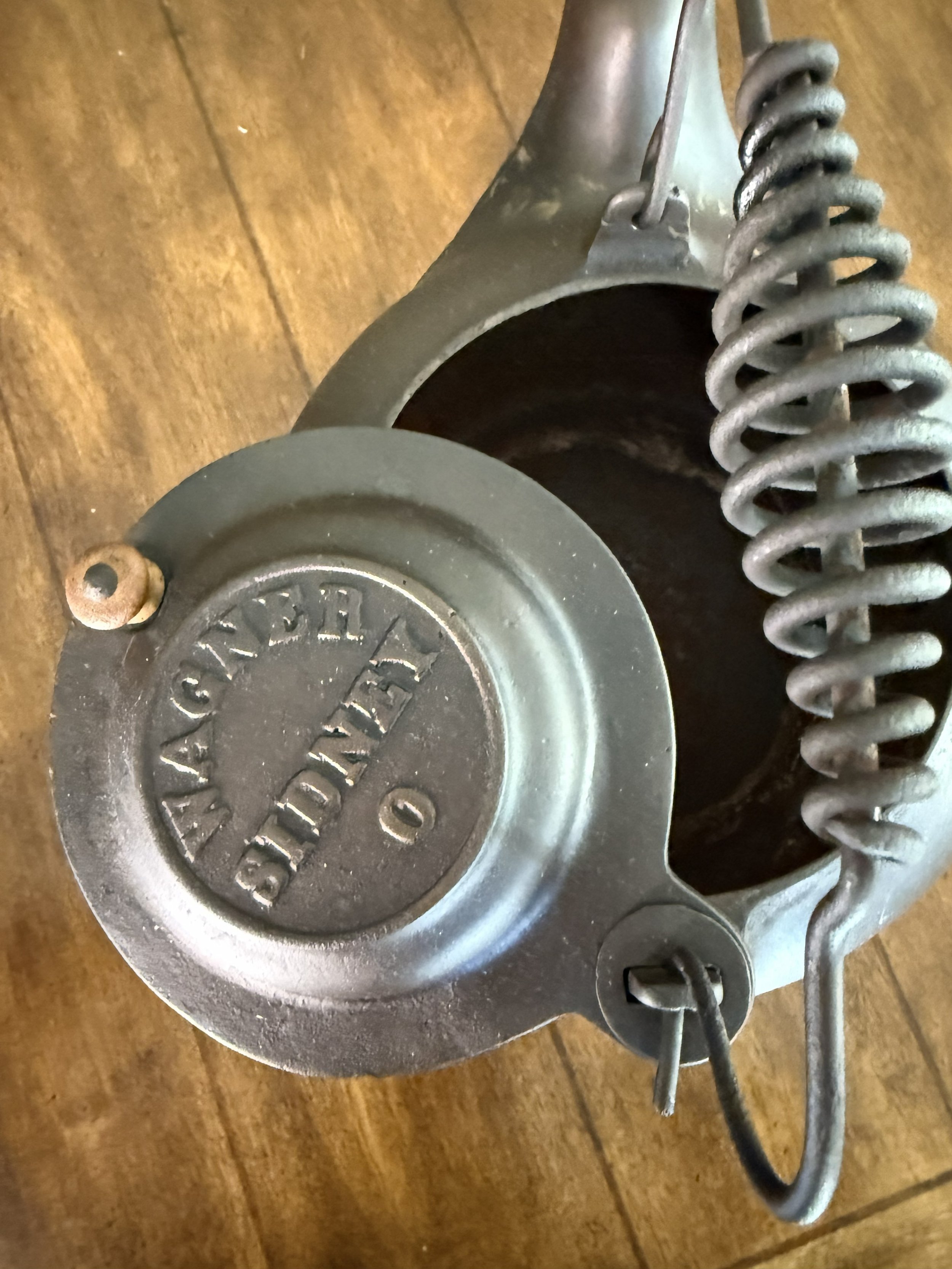
Close-up of the Wagner tea kettle lid showing the WAGNER / SIDNEY / O marking on the raised circular boss at the lid center: WAGNER arching across the upper field of the boss, SIDNEY in a straight horizontal line at center, and O below — the abbreviation for Ohio used by Wagner in this period. No WARE suffix. No MADE IN USA designation. The original brass finial knob is present at the lid top, secured through the center of the boss. The wire bail attachment hardware is visible — the bail hooks through a small cast ear on the kettle body, with a wire clasp securing the lower attachment point. The coiled wire heat guard wrapping is intact on the bail.
Manufacturer
Wagner Manufacturing Co.
Brand Mark
WAGNER / SIDNEY / O — WAGNER arching across upper field of lid boss, SIDNEY straight at center, O below; no WARE suffix; no MADE IN USA; early period lid-only marking configuration standard to the Wagner teapot and tea kettle form
Marking Location
Lid only — raised circular boss at lid center; kettle body base is unmarked, consistent with standard Wagner tea kettle production
Piece Type
Tea Kettle / Teapot
Body Form
Bulbous round cast iron body; angled pour spout integral to body casting; flanged lid opening with recessed collar; flat base with heat ring
Lid
Circular domed lid with raised marking boss at center; original brass finial knob present and intact; lid seats in the flanged collar on the kettle body
Handle
Wire bail handle arching over the top of the kettle body; coiled wire heat guard wrapping on bail for safe handling at temperature; bail hooks through cast ears on body sides; wire clasp at lower attachment point
Bottom Configuration
Heat ring present and fully intact at base perimeter; flat base surface; sand casting surface texture consistent with period production; two distinct casting artifacts present at lower left quadrant — see Gate Scar and Base Numeral entries below
Gate Scar
Raised irregular patch at lower left quadrant of base — the remnant where molten iron entered the sand mold through the gate channel during casting; slightly elevated above surrounding surface with irregular profile and edge characteristic distinguishing a true gate scar from surface texture variation; not dressed or ground, consistent with early Wagner production practice on non-functional base surfaces of specialty hollow ware; presence of an undressed gate scar is a production era indicator and physical authentication evidence — later reproductions and mid-century automated production pieces do not carry gate scars
Base Numeral 8
Small legible numeral 8 at lower left quadrant of base, adjacent to but distinct from the gate scar; raised mark separate from the surrounding sand cast texture; not a size number in the skillet sense — Wagner tea kettles did not use the standard skillet size numbering system; most consistent with an internal pattern or mold identification number used at the foundry to track which pattern a given casting came from; corroborates early sand mold production period dating consistent with the lid mark configuration
Finial
Original brass/copper colored finial knob on lid top — present and intact; this is original hardware and not a later replacement
Date of Manufacture
c. 1915–1920s — dated by lid marking configuration: arc WAGNER, straight SIDNEY, O abbreviation without WARE suffix or MADE IN USA designation; consistent with early Wagner hollow ware production period
Place of Manufacture
Sidney, Shelby County, Ohio
Condition
Very Good — lid marking clearly legible with arc WAGNER, SIDNEY, and O all present; original brass finial intact; wire bail with coil guard structurally sound; heat ring intact; body surface shows period patina and light carbon consistent with age and use; no cracks, chips, or repairs; display ready
Acquisition Date
October 21, 2025
Acquisition Source
eBay — Seller: luvinjunque
eBay Item Number
127174744472
Order Number
03-13740-73604
SSC Catalog Number
SSC-WAG-KTL-SM-SIDNEYO-001
The WAGNER / SIDNEY / O Lid Mark: Dating and Significance
The marking on a Wagner tea kettle or teapot is carried entirely on the lid — specifically on the raised circular boss at the lid center. This is the standard Wagner configuration for the teapot and kettle form: the body base is unmarked, and the identification of the piece depends entirely on the lid remaining with the piece. A Wagner kettle body without its original lid is unattributable. The presence of this lid, with its marking clearly legible, is therefore the primary condition factor for this piece.
The marking itself — arc WAGNER, straight SIDNEY, O — is the earlier period configuration. The full WAGNER WARE designation, with WARE added to the arc marking, appeared in later production along with the MADE IN USA designation required by U.S. trade law for pieces made after specific federal marking requirements came into effect. This piece has neither WARE nor MADE IN USA, placing it in the earlier production window consistent with c. 1915 through the 1920s. The arc WAGNER with straight SIDNEY convention documented in collector reference literature aligns with this dating.
The collector community has not established a comprehensive and universally agreed dating framework for Wagner teapot and kettle lid marks specifically — the reference literature is more developed for Wagner skillets than for the specialty hollow ware forms. What can be stated confidently is that the absence of the MADE IN USA marking places this piece before the period when that designation was in standard use, and the absence of WARE is consistent with the earlier pre-Ware period marking convention. The piece is early Wagner — not the earliest, but early enough that the branding evolution that would define the later production run had not yet fully taken hold.
Gate Scar and Base Numeral 8: Casting Evidence and Authentication
Examination of the base under raking light reveals two distinct marking elements at the lower left quadrant that are worth documenting separately from the general base description. The first is a raised gate scar — the irregular, slightly elevated remnant where molten iron entered the sand mold through the gate channel during casting. Gate scars have a specific visual character that distinguishes them from surface texture variation: a slightly irregular raised profile, an uneven edge where the gate iron solidified against the mold wall, and a surface quality that differs from the surrounding sand cast texture. On early cast iron pieces produced before foundry automation standardized gate removal, gate scars were routinely left undressed on the non-functional base surfaces of hollow ware — the base of a tea kettle does not contact food and does not require the smooth finish of a cooking surface, so there was no production reason to grind or dress the gate scar on pieces like this one.
The significance of the gate scar for authentication and dating is straightforward: later reproductions, recast pieces, and mid-century production using automated or semi-automated methods do not carry true gate scars. The progressive elimination of gate scars from the base surfaces of cast iron cookware tracks closely with the mechanization of foundry production across the first half of the 20th century. A visible, undressed gate scar on the base of this tea kettle is therefore physical evidence corroborating the early production dating established by the lid mark — the WAGNER / SIDNEY / O configuration without WARE or MADE IN USA pointing to c. 1915–1920s. The gate scar says the same thing the lid mark says, in a different language.
The second element is a small legible numeral 8 at the same lower left quadrant of the base, adjacent to the gate scar but distinct from it in character — a deliberate mark rather than a casting artifact. This is not a size number in the sense that Wagner skillet size numbers are size numbers: tea kettles did not use the standard 3-through-14 skillet sizing convention, and there is no No. 8 tea kettle in the Wagner production catalog. The most consistent interpretation is an internal pattern or mold identification number — a foundry marking system that allowed production workers to track which pattern a given casting came from, useful for quality control and pattern maintenance across a production run. Single-digit pattern identifiers on specialty hollow ware forms are consistent with early-period Wagner foundry practice. The numeral 8 does not change the piece's collector rarity — that rests on the lid mark, the original hardware, and the condition — but it deepens the physical record and adds a layer of documentation that experienced collectors and researchers will recognize as significant.
The Wire Bail and Coiled Heat Guard: Form and Function
The wire bail handle on a cast iron tea kettle is a design solution to a practical problem: how to provide a grip for a vessel that will sit on a hot stove surface and be filled with boiling water, without that grip being either too hot to hold safely or too rigidly attached to allow the kettle to be tipped for pouring. The wire bail arching over the top of the kettle body can be lifted to vertical for carrying and tilted to either side for pouring, pivoting on the two cast ears mounted on the body sides. The flexibility of the wire allows the bail to move through its full arc without the resistance of a rigid handle.
The coiled wire heat guard wrapping one side of the bail is the safety solution for the thermal problem: bare wire conducting heat directly from the kettle body through the bail to the user's hand is a practical hazard. The coiled wire wrapping — tight, even coils of a finer wire wound around the bail — creates an air gap between the bail and the hand, substantially reducing heat transfer. The coiling is tight enough to provide a secure grip surface while open enough to allow the air insulation effect. On this piece the coiled wire guard is intact and evenly wound, consistent with the original factory configuration.
The lower bail attachment uses a wire clasp or hook to secure the bail end to the cast ear on the kettle body. This is a more delicate attachment point than the upper pivot and the element most likely to fail on a well-used kettle — the wire fatigues under repeated flexing. On this piece both attachment points are intact and the bail moves freely through its full range. The original functionality is preserved.

Side view of the Wagner Ware tea kettle showing the full form: the bulbous round cast iron body sitting on the heat ring base, the angled pour spout extending from the body at right, the flanged lid opening with the domed lid seated in the collar, the wire bail arching over the top with the coiled wire heat guard visible on the left side of the bail, and the brass finial knob at the lid apex. The lid marking boss is visible on the lid top. The overall proportions are compact and purposeful — this is the classic American cast iron tea kettle form, built for daily stove-top use in the wood and coal era.
The Original Brass Finial: Completeness and Condition
The brass finial knob at the top of the lid is the element most commonly missing on antique cast iron teapots and tea kettles reaching the collector market. The finial is a small piece of hardware — brass or copper colored metal, turned or cast, threaded into the lid boss — that serves as the grip point for lifting the lid and that provides the visual cap to the lid's raised profile. Because it is a separate, small hardware element rather than part of the casting, it is easily lost, easily damaged, and frequently replaced with non-original hardware or simply left absent on pieces that have been through decades of use and household transitions.
On this piece the original brass finial is present and intact. It appears to be the original factory hardware — the color, scale, and style are consistent with Wagner's production period hardware for this form. The presence of the original finial is a meaningful condition point: it confirms that this piece has not been substantially disassembled, that the lid has been kept with the body throughout its history, and that whoever cared for this kettle over its lifetime understood it as a complete object worth maintaining intact.

Open detail view of the Wagner Ware tea kettle showing the lid raised: the flanged opening of the kettle body is visible, and the interior of the kettle body can be seen. The lid with its WAGNER / SIDNEY / O marking boss and brass finial is shown in the raised position. The wire bail clasp hardware at the lower lid attachment point is visible. The kettle opening diameter is consistent with the small size designation. Interior condition is consistent with period use.
The Tea Kettle in the Wagner Hollow Ware Line
Wagner Manufacturing Company operated in Sidney, Ohio, from 1891 through the mid-20th century, producing one of the most complete lines of cast iron hollow ware in American foundry history. Skillets in multiple sizes and configurations were the core of the production run, but Wagner's catalog extended well beyond skillets to include Dutch ovens, roasters, griddles, waffle irons, gem pans, and specialty forms — of which the teapot and tea kettle were a consistent and long-running component.
The tea kettle occupied a specific functional niche in the cast iron hollow ware market: it was a stove-top vessel rather than a cooking vessel, designed to sit on the back of a wood or coal range and maintain a supply of hot water for household use. In the era before central hot water systems were standard in American homes — which describes most of the period during which this kettle was made and sold — a cast iron kettle on the stove was essential daily equipment. Wagner's version combined the foundry's characteristic casting quality with the practical design elements the form required: a wide base for stability on the stove ring, a tight-fitting lid to maintain heat, a wire bail for safe transport, and a spout geometry appropriate for controlled pouring.
By the early 20th century, cast iron teapots and kettles were widely available from multiple foundries, and Wagner's offerings competed with Griswold's similar form and with regional foundry production. The collector market for Wagner tea kettles today reflects this history: they appear with some regularity in antique markets, but early-period examples with the WAGNER / SIDNEY / O marking, original hardware intact, and body in sound condition are a smaller subset of the surviving population than the numbers would suggest.
Wagner Manufacturing Co.: Company History
Wagner Manufacturing Company was founded in Sidney, Shelby County, Ohio, in 1891 by brothers Milton and Bernard Wagner. Sidney sits in western Ohio, in the same regional foundry tradition as the Favorite Stove & Range complex at Piqua and Columbus — the dense Ohio cast iron manufacturing corridor that produced the dominant American cast iron cookware brands of the late 19th and early 20th centuries. Wagner entered the market with a full line of hollow ware and built a reputation for quality that placed it in direct competition with Griswold of Erie, Pennsylvania, as one of the two premier American cast iron cookware makers.
The company produced under several mark configurations across its production history. The early period used simpler location-based marks — WAGNER arching with SIDNEY and the O abbreviation for Ohio — without the WARE suffix. The mature production period added WARE to create the WAGNER WARE designation that became the best-known form of the mark. Later production added MADE IN USA and eventually SIDNEY -O- with the stylized hyphen-O-hyphen configuration. Each mark configuration provides collectors with a dating framework, though the transitions were gradual and overlapping rather than precisely dated.
Wagner was acquired by General Housewares Corp. in 1952, which also acquired Griswold in 1957, briefly bringing both premier American cast iron makers under a single corporate ownership. Production continued under both names but quality declined as cost pressures increased. The Wagner and Griswold brands were eventually sold multiple times. The Sidney, Ohio, foundry that produced this tea kettle in the 1915–1920s operated as a family-controlled independent manufacturer at the peak of American cast iron cookware production — before acquisition, consolidation, and eventual decline changed the character of what the foundry made and how it made it.
Corporate Timeline: Wagner Manufacturing Co.
1891
Milton and Bernard Wagner found Wagner Manufacturing Company in Sidney, Shelby County, Ohio. Production of cast iron hollow ware begins. Early marking uses WAGNER arc with SIDNEY and O location designation.
c. 1900–1914
Early production period. Tea kettles, teapots, skillets, and full hollow ware line in production. Mark configuration uses arc WAGNER with straight SIDNEY and O — the earlier period mark carried on this piece.
c. 1915–1920s
Estimated production period for this tea kettle based on lid marking configuration. Arc WAGNER, straight SIDNEY, O — without WARE suffix or MADE IN USA. Consistent with collector reference literature dating for this mark convention.
c. 1920s–1940s
WAGNER WARE designation in full use. MADE IN USA designation added per federal marking requirements. The Sidney-O stylized mark eventually adopted. Full production of skillet, specialty, and hollow ware lines continues.
1952
Wagner Manufacturing Company acquired by General Housewares Corp. Production continues under the Wagner Ware name. Quality begins to decline under cost pressures.
1957
General Housewares also acquires Griswold, briefly uniting the two premier American cast iron makers under single corporate ownership. The era of independent Ohio foundry production effectively ends.
2025
Steve's Seasoned Classics acquires this tea kettle from eBay seller luvinjunque. Documented as SSC-WAG-KTL-SM-SIDNEYO-001, the first tea kettle and first specialty hollow ware piece in the SSC Wagner collection at $141.02.
Why This Piece Matters
The Wagner Ware tea kettle matters for three reasons that are distinct but compound each other. First, it extends the SSC Wagner collection beyond the skillet form and documents Wagner as the complete foundry it was — a maker whose hollow ware line included not just the skillets that dominate the collector market but the full range of cast iron forms that equipped American kitchens in the wood and coal stove era. A museum collection that documents only Wagner skillets is incomplete; this tea kettle begins the correction.
Second, the early-period WAGNER / SIDNEY / O marking — without WARE, without MADE IN USA — gives the piece a specific documentary value within the Wagner production timeline. It represents Wagner before the branding evolution that defined the company's mature period, at a moment when the Sidney foundry was establishing the quality reputation that would carry the mark for the next three decades. The lid marking is the primary dating evidence, and its configuration is unambiguous.
Third, the original hardware — brass finial intact, wire bail with coil guard complete, all attachment points sound — gives this piece a completeness that is more common in collector aspiration than in collector reality. Wagner tea kettles are findable; complete, early-period examples with all original hardware and legible lid markings are a smaller subset. This piece is in that subset.
The iron endures. The markings tell the truth. The story deserves to be told.
Sources & Further Reading
CastIronCollector.com — Wagner Ware reference documentation: marking configurations, production periods, and dating framework for the Wagner hollow ware line.
BoonieHicks.com — Wagner cast iron dating guide: arc WAGNER and straight SIDNEY marking conventions and estimated production periods.
CastIronCollector.com Forums — Wagner Sidney O Tea Kettle thread: collector community identification and dating discussion for the Wagner tea kettle form.
Griswold & Cast Iron Cookware Association (GCICA) — Wagner Ware specialty hollow ware documentation and collector reference resources.
WorthPoint.com — Historical auction records for Wagner tea kettles in comparable marking configuration and condition.
SSC Internal Collection Records — Wagner Specialty and Variant Collection overview; Ohio Foundry Corridor collection documentation.
About Steve's Seasoned Classics
Steve's Seasoned Classics is an online museum dedicated to preserving and documenting the heritage of American cast iron cookware, with a focus on Ohio foundry pieces from the 19th and early 20th centuries. The SSC collection features over 60 pieces with detailed provenance, historical research, and photography for each item.
www.stevesseasonedclassics.com
