The Cleveland Foundry Co. Star & Sunburst Sad Iron Trivet
SSC MUSEUM COLLECTION
Catalog No. SSC-CLEVFDY-TRV-1891-001
Cast Iron Trivet | Star & Sunburst Design | Gate Marked | Pat. 1891 | Cleveland, Ohio
Patented 1891 • The Cleveland Foundry Co. • Ohio Foundry Corridor
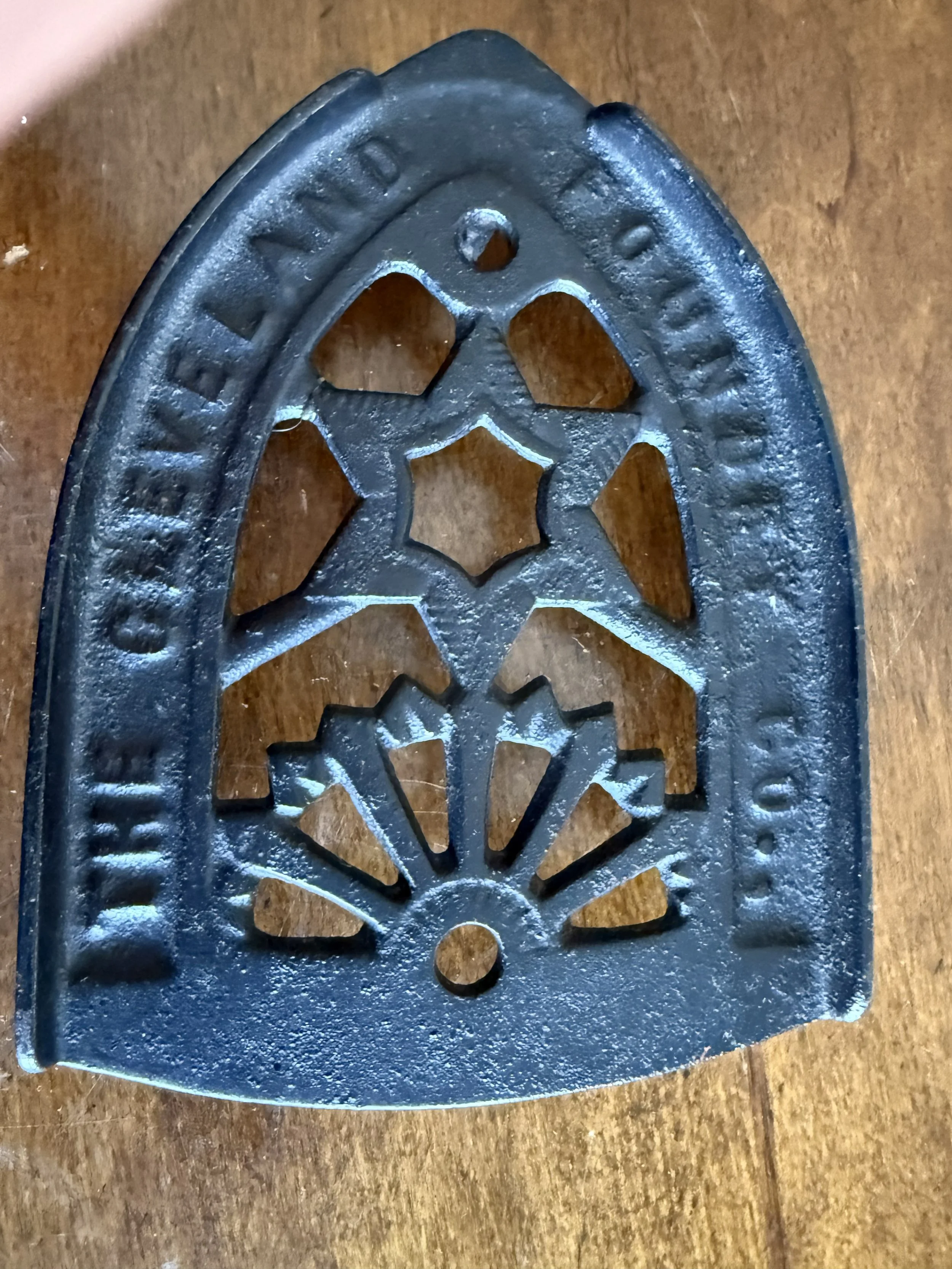
Top view showing “THE CLEVELAND FOUNDRY CO.” cast in raised letters around the arched rim of this sad iron trivet. The decorative openwork design features a six-pointed star at the center, flanked by geometric cutouts, with a sunburst/fan pattern at the base. The shield-shaped form matches the profile of a sad iron—this trivet was designed to hold a hot flat iron safely between passes during laundry day. Three feet visible at the corners elevate the trivet above the ironing surface.
The Cleveland Foundry Company is one of those names that hides a much bigger story. Founded in 1888 by Henry P. Crowell and Francis E. Drury in Cleveland, Ohio, the company began as a cast iron foundry producing stoves, sad irons, trivets, and household hardware. Within three years of its founding, it was patenting designs—including the star and sunburst pattern on this trivet, dated 1891. Within two decades, it had renamed itself the Cleveland Metal Products Company. Within three decades, it had become the Perfection Stove Company—one of the most recognized names in American heating and cooking appliances for the next half century. The Perfection oil heater, the Perfection water heater, the Perfection cooking stove: all descended from this Cleveland foundry that started out casting sad iron trivets with decorative cutout patterns.
This trivet is from the company’s earliest period—just three years after its founding. The 1891 patent date places it in the Cleveland Foundry Company era, before the name changes that would eventually obscure its origins. The gate marks on the bottom confirm pre-1875 casting technology was still in use at the foundry (or more likely, that the trivet’s mold design originated in this earlier tradition), and the decorative openwork pattern—a six-pointed star surrounded by geometric shapes with a sunburst fan at the base—shows that even a utilitarian laundry tool was treated as an opportunity for ornamental casting in the 1890s.
This is a Cleveland’s Forgotten Foundries piece, joining the Lake City Malleable Co. casting ladle, the Superior Foundry Inc. melting bowl, and other Cleveland-made cast iron in the SSC collection. It is also the second sad iron accessory in the collection, joining the Ohio Stove Co. Pearl No. 7 sad iron pan (SSC-OHIOSTOVE-PAN-1875-001)—two different pieces from two different Ohio cities, both designed to serve the same domestic laundry technology that dominated American household work for over a century.
The Gate Marks and the Design

Bottom/underside view showing the gate marks and the three cast feet that elevate the trivet above the ironing surface. The openwork star and sunburst pattern is visible from this angle, and the overall shield shape—matching the profile of a sad iron—is clearly defined. The gate marks on this piece are consistent with sand mold casting technology.
The shield shape of this trivet is not decorative—it is functional. A sad iron has a pointed front and a flat back: the pointed front glides into fabric folds and under buttons, while the flat back provides a stable base when the iron is stood on end. The trivet’s shape mirrors the iron’s footprint exactly, so that when a hot iron is placed on the trivet between passes, it sits securely with no overhang. The three feet on the bottom elevate the trivet above whatever surface it rests on—an ironing board, a table, a stove shelf—preventing the heat of the iron from scorching the surface below. And the openwork cutout pattern serves a thermal function as well as a decorative one: the openings allow air to circulate beneath the hot iron, dissipating heat and preventing the trivet itself from becoming a burn hazard.
Every element of the design—the shape, the feet, the openwork—is functional. That it is also beautiful is a reflection of the era in which it was made: the 1890s, when American foundries treated even the most utilitarian objects as opportunities for craft. The star and sunburst pattern is not incidental decoration. It is a patented design that someone at the Cleveland Foundry Company conceived, drew, modeled, and filed paperwork to protect. The 1891 patent date on this piece is evidence that the company took its ornamental ironwork seriously enough to invest in intellectual property protection.
Piece Details
Manufacturer
The Cleveland Foundry Co.
Piece Type
Sad Iron Trivet / Iron Rest
Design
Star & Sunburst openwork pattern with geometric cutouts
Form
Shield-shaped (matching sad iron profile); three cast feet; hanging hole at apex
Material
Cast Iron (gate marked)
Marking
“THE CLEVELAND FOUNDRY CO.” cast in raised letters around arched rim
Patent Date
1891
Approximate Dimensions
6 inches long × 4.5 inches wide × 0.75 inches tall
Date of Manufacture
Circa 1891–1910 (Cleveland Foundry Co. name period)
Place of Manufacture
Cleveland, Cuyahoga County, Ohio
Condition
Good — legible company name; intact design; three feet intact; gate marks visible; restored/blacked finish
Acquisition Date
March 3, 2026
Acquisition Source
eBay — Seller: tho_271
eBay Item Number
396379523243
Order Number
25-14294-04031
SSC Catalog Number
SSC-CLEVFDY-TRV-1891-001
Collection Designation
Cleveland’s Forgotten Foundries
The Cleveland Foundry Co.: From Trivets to Perfection
The Cleveland Foundry Company was founded in 1888 by Henry P. Crowell and Francis E. Drury in Cleveland, Cuyahoga County, Ohio. In its earliest years, the company operated as a general cast iron foundry producing stoves, heating appliances, sad irons, trivets, and household hardware—the standard product mix for an urban foundry in the late nineteenth century. The 1891 patent date on this trivet places it within the company’s first three years of operation, making it a founding-era piece from a Cleveland foundry that would grow into a nationally recognized brand.
In 1894, the company published a catalog for its “Puritan Oil Heating Stoves”—a product line that would define the company’s future direction. Oil heating stoves were the coming technology: cleaner than coal, more convenient than wood, and adaptable to the urban apartments and suburban homes that were transforming the American housing landscape. The Cleveland Foundry Company bet on oil, and the bet paid off. By 1910, the company’s focus had shifted so decisively toward metal products and heating appliances that it renamed itself the Cleveland Metal Products Company. By 1921, it had become the Perfection Stove Company—the name under which it would operate for the next three decades, producing the Perfection oil heaters and cooking stoves that became fixtures in American homes from coast to coast.
The corporate arc from Cleveland Foundry to Perfection Stove is one of the great transformation stories in Ohio industrial history: a small Cleveland foundry casting trivets and sad irons in 1891 became a national housewares brand within a single generation. This trivet dates from the very beginning of that arc—a founding-era piece from a company that had not yet imagined what it would become.
Corporate Timeline: Cleveland Foundry Co. to Perfection Stove
1888
The Cleveland Foundry Company founded by Henry P. Crowell and Francis E. Drury in Cleveland, Cuyahoga County, Ohio. The foundry produces cast iron stoves, sad irons, trivets, and household hardware.
1891
This Star & Sunburst sad iron trivet is patented. The company is three years old.
1894
Cleveland Foundry publishes its Puritan Oil Heating Stoves catalog for the 1894–1895 season. Oil heating becomes the company’s strategic direction.
1910
The company renames itself the Cleveland Metal Products Company, reflecting its expanded product line beyond traditional foundry casting.
1921
The company becomes the Perfection Stove Company. The Perfection brand of oil heaters and cooking stoves becomes nationally recognized.
1955
Perfection Stove Company acquired by the Hupp Corporation. Operations continue under the Perfection name.
1981
The Perfection division is acquired by Schwank, Inc. The Perfection name is eventually discontinued.
Two Sad Iron Accessories: Cleveland and Portsmouth
The SSC collection now holds two cast iron accessories from the sad iron era—two pieces from two different Ohio cities, both designed to serve the same domestic laundry technology. The Ohio Stove Co. Pearl No. 7 sad iron pan (SSC-OHIOSTOVE-PAN-1875-001) is a tray that sat on a parlor stove to heat multiple sad irons simultaneously. This Cleveland Foundry Co. trivet is the stand that held a hot iron safely between passes, protecting the ironing surface from scorch marks and giving the cook a secure place to park the iron while swapping it for a freshly heated one.
Together, the pan and the trivet document the complete sad iron workflow: heat the irons on the pan, press the fabric, set the cooling iron on the trivet, pick up a hot one from the pan, repeat. Two pieces of cast iron infrastructure from two Ohio foundries—one from Portsmouth on the Ohio River (c. 1872–1875), one from Cleveland on Lake Erie (1891)—spanning two decades and two regions of the state, both serving the same back-breaking domestic labor that occupied American women for the better part of two centuries.
Why This Piece Matters
The Cleveland Foundry Co. Star & Sunburst trivet matters for three reasons. First, it is a founding-era piece from a company that became Perfection Stove—one of America’s most recognized heating appliance brands—documented here in its humblest form, casting decorative trivets three years after its founding. Second, it adds to the Cleveland’s Forgotten Foundries grouping, joining Lake City Malleable and Superior Foundry as evidence that Cleveland’s industrial casting heritage extended far beyond the steel mills that dominate the city’s popular image. Third, at $12.50, it is one of the least expensive pieces in the entire SSC collection—a reminder that significant industrial history does not require a significant budget to acquire. It requires only the knowledge to recognize what you are looking at and the commitment to document it properly.
The iron endures. The markings tell the truth. The story deserves to be told.
Sources & Further Reading
MileStair.com — Perfection Stove Company History: corporate name evolution from Cleveland Foundry Company (1888–1910) to Cleveland Metal Products Company (1910–1921) to Perfection Stove Company (1921–1955). Founded by Henry P. Crowell and Francis E. Drury.
A Stove Less Ordinary (stovehistory.blogspot.com) — Cleveland Foundry Co. Puritan Oil Heating Stoves catalog listed for 1894–1895 season.
Wagner & Griswold Society Foundry List — Cleveland foundry presence confirmed in regional foundry database.
About Steve’s Seasoned Classics
Steve’s Seasoned Classics is an online museum dedicated to preserving and documenting the heritage of American cast iron, with a focus on Ohio foundry pieces from the 19th and early 20th centuries. The SSC collection features over 130 pieces with detailed provenance, historical research, and photography for each item.
