The Adams & Britt Cincinnati Cast Iron Stove Kettle Griddle
SSC MUSEUM COLLECTION
Catalog No. SSC-ADAMSBRITT-KTL-1872-001
Stove Kettle with Hinged Griddle Lid | Bail Handle | Pour Spout | Dated 1872 | Cincinnati, Ohio
Dated 1872 • Adams & Britt • Ohio Foundry Corridor

Top view of the hinged griddle lid following SSC conservation—lye degreasing and Renaissance Wax preservation. The markings are strikingly legible: “ADAMS & BRITT” arching across the upper portion and “CIN’TI O.” arching across the lower, with the date “1872” cast in large numerals at center. A raised finial between the date numerals provides a grip for lifting the griddle lid. The double concentric ring pattern frames the maker’s mark and date, with a decorative scalloped border along the outer edge. The bail handle and pour spout are visible at top. This is one of the most visually striking pieces in the SSC collection—154 years old and carrying every letter of its maker’s name as clearly as the day it was cast.
Some pieces arrive at SSC as raw material for research. Others arrive as finished stories. This one arrived as both—and then, after conservation, it revealed itself as something more. The Adams & Britt stove kettle griddle dated 1872 has always been one of the most important pieces in the SSC collection: a dated artifact from an obscure Cincinnati hollow ware partnership, carrying the full company name, city, and year of manufacture cast directly into the iron. But when it emerged from the lye tank and was preserved with Renaissance Wax, the piece transformed. The markings that had been partially obscured under layers of old seasoning and accumulated grime became fully legible. The casting quality—the crispness of the letters, the precision of the concentric rings, the decorative scallops along the lid’s edge—became visible in a way they had not been since the nineteenth century.
This is now one of the most beautiful pieces in the SSC collection. The bare iron surface, stabilized under a protective layer of Renaissance Wax rather than reseasoned, reveals the original casting in its full detail. Every letter of “ADAMS & BRITT” is sharp. Every digit of “1872” is crisp. The city mark “CIN’TI O.” is complete and unambiguous. It is a piece that proves what SSC’s conservation philosophy is built to achieve: remove what time has added, preserve what the foundry created, and let the iron speak for itself.
Adams & Britt: A Cincinnati Partnership Lost to Time

Detail view of the griddle lid markings after conservation. The raised letters are now fully legible: “ADAMS & BRITT” in the upper arc, “CIN’TI O.” in the lower arc, and “1872” at center with a lifting finial between the digits. The casting quality is exceptional—the letters are well-formed, evenly spaced, and sharply defined. The double concentric ring that frames the markings is a decorative touch that elevates this from a utilitarian kettle lid to a piece of industrial craftsmanship. This level of detail in a maker’s mark suggests a company that took pride in its products—even though almost nothing about the company survives beyond the products themselves.
Adams & Britt of Cincinnati, Ohio, is one of the most obscure manufacturers in the SSC collection. The partnership is known almost exclusively through its surviving marked pieces and through two entries in foundry databases. The WAGS Society foundry list records “ADAMS & BRITT CIN’ O.” as a maker of tea kettles and cross-references the name with the related firm “BRITT & FOLGER CIN’ O.,” also listed as tea kettle manufacturers. The Cast Iron Collector database includes the same cross-reference.
No company history has been located. No newspaper advertisements, no city directory listings, no patent filings, and no trade publication mentions have been identified in accessible archival sources. The date cast into this kettle—1872—is the single most specific piece of evidence for when the firm was active. It places Adams & Britt in Cincinnati during the early 1870s, a period when Cincinnati was one of the largest stove and hollow ware manufacturing centers in the United States, producing over 185,000 stoves annually for nationwide distribution. Adams & Britt was part of that industrial ecosystem—a small partnership casting tea kettles and stove accessories in a city dominated by larger firms like Wm. Resor & Co. and the foundry that would become Favorite Stove & Range.
The Britt surname connects Adams & Britt to the related firm Britt & Folger, also documented as Cincinnati tea kettle makers. Whether Britt left one partnership to join another, or whether the two firms operated simultaneously, is unknown. What is known is that both partnerships manufactured the same product type—tea kettles—in the same city, and both are documented in the same foundry databases. This kettle griddle, with its 1872 date, may be the primary surviving evidence that the Adams & Britt partnership existed at all.
The Stove Kettle Griddle: Form and Function

Profile view showing the kettle’s bulged body, the pour spout rising from the top, and the hinged griddle lid with its decorative scalloped edge and maker’s mark. The bail handle hangs to the side. The overall form is a stove kettle—a vessel designed to sit in a stove-eye opening on a wood-burning or coal-burning cooking stove, with the body suspended in the heat and the lid flush with the stove top. The pour spout allowed water or liquid to be poured without removing the kettle from the stove. After conservation, the bare iron surface shows the casting texture and the smooth, even walls of a well-made piece.
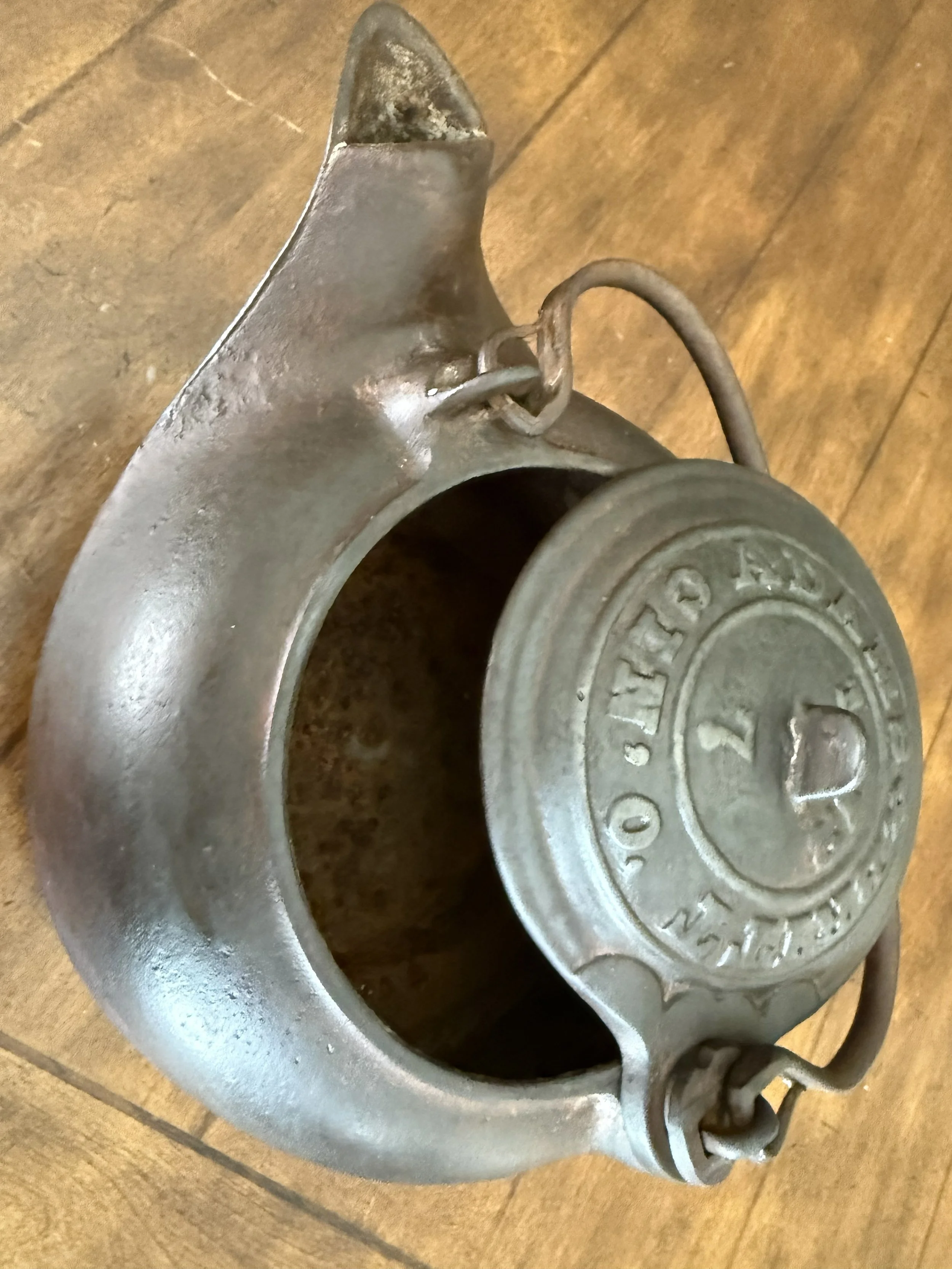
Lid-open view showing the interior of the kettle body and the underside of the hinged griddle lid. The griddle lid, when opened, reveals the kettle opening—a circular mouth sized to accept liquid or ingredients. When closed, the flat griddle surface sat flush with the stove top and could be used as a cooking surface while the kettle heated water below. This dual-function design—kettle below, griddle above—was a space-efficient solution for small stove tops. The hinged connection between the lid and the kettle body is visible at left. The bail handle attachment lug is visible at the rim.
This is a stove kettle griddle—a specialized form of hollow ware designed for wood-burning and coal-burning cooking stoves. The kettle body drops into a stove-eye opening, suspending the vessel over the fire. The flat griddle lid sits flush with the stove top, creating a dual-purpose cooking surface: water or broth heats in the kettle below while the flat lid serves as a griddle above. The pour spout allows the cook to pour heated liquid without removing the kettle from the stove eye. The bail handle provides a means of lifting the entire assembly.
The hinged griddle lid is the defining feature. When closed, it creates a flat, circular cooking surface that integrates seamlessly with the stove top. When opened on its hinge, it exposes the kettle mouth for filling, stirring, or adding ingredients. The date 1872 cast into the lid—along with the maker’s name and city—means this is a datable artifact: not an estimate, not a range, but a specific year cast into the iron by the foundry that made it.
Conservation: Lye and Renaissance Wax
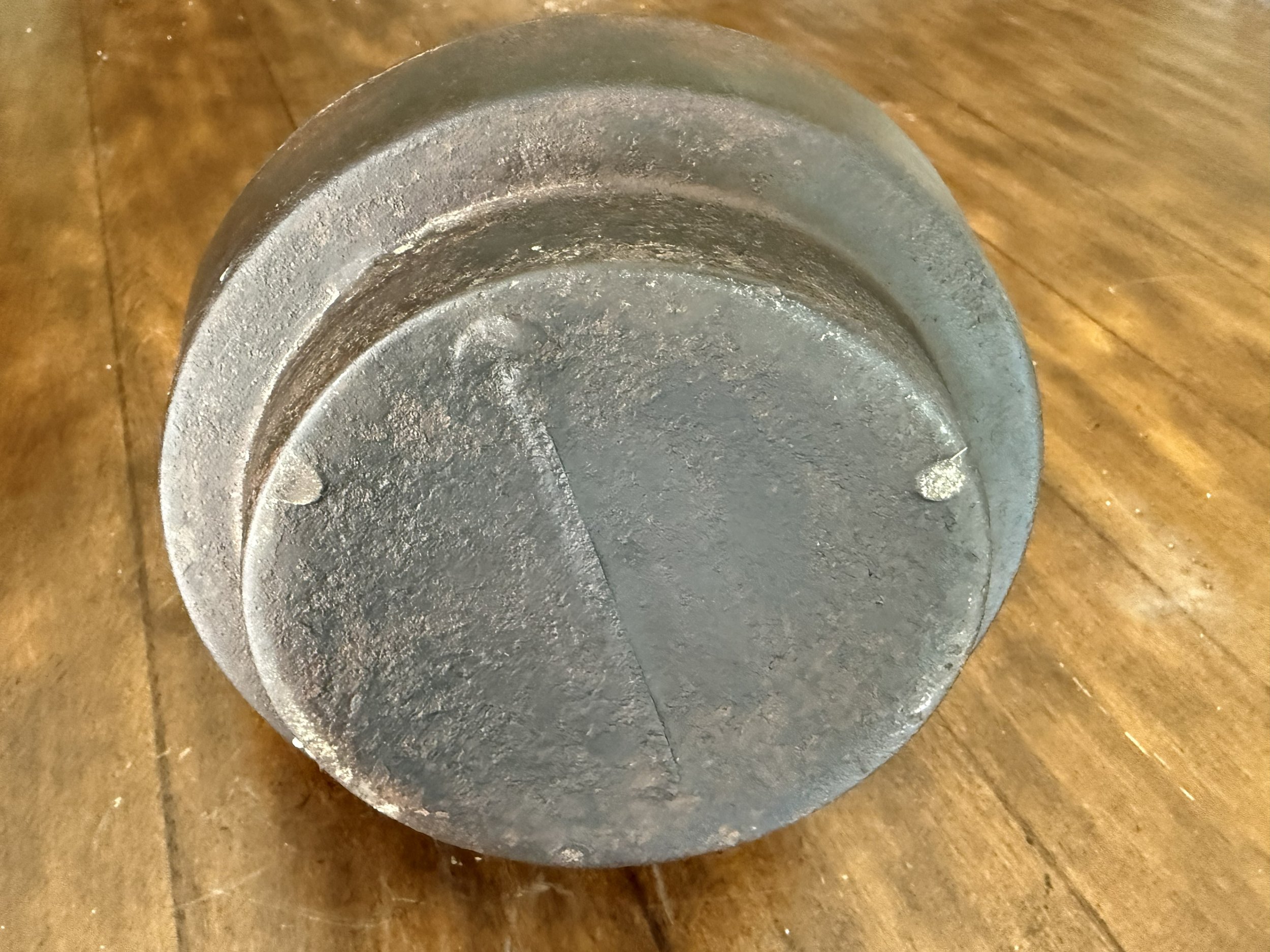
Bottom view showing the kettle base after conservation. The gate mark—a raised linear casting scar running across the bottom—is clearly visible, confirming pre-flask or early flask casting methodology consistent with the 1872 date. The flat bottom is sized to drop into a stove-eye opening. The surface shows the bare iron texture preserved under Renaissance Wax—no seasoning has been applied, allowing the original casting quality to remain visible for study and documentation.
This piece was conserved using the SSC Archival Black™ protocol through the lye degreasing stage, then preserved with Renaissance Wax rather than reseasoned. The decision was deliberate. The maker’s marks on the griddle lid—the most historically significant surface on the piece—are cast in raised letters that are best preserved and displayed in their bare iron state. Reseasoning would darken the surface and reduce the contrast between the raised letters and the flat background, making the markings less legible in photographs and in person. Renaissance Wax provides a stable, museum-standard protective coating that prevents oxidation without altering the appearance of the bare iron.
The result speaks for itself. The markings are now more legible than they have been at any point in the past century. Every letter, every digit, every decorative element on this lid is visible and sharp. The bare iron surface reveals casting details—the texture of the sand mold, the crispness of the letter edges, the uniformity of the concentric rings—that would be hidden under seasoning. This is what museum conservation looks like: not making a piece look new, but making its evidence visible.
Piece Details
Manufacturer
Adams & Britt, Cincinnati, Ohio
Piece Type
Cast Iron Stove Kettle with Hinged Griddle Lid
Form
Bulged stove kettle with pour spout, wire bail handle, and flat hinged griddle lid; designed to drop into a stove-eye opening with the griddle lid flush with the stove top
Material
Cast Iron
Marking
“ADAMS & BRITT” and “CIN’TI O.” in raised letters on griddle lid, with “1872” at center; decorative double concentric rings and scalloped border
Purpose
Dual-function stove-top vessel: kettle for heating water/liquid below, flat griddle surface for cooking above; designed for wood-burning or coal-burning cooking stoves
Date of Manufacture
1872 (cast into the griddle lid)
Place of Manufacture
Cincinnati, Hamilton County, Ohio
Condition
Conserved — lye degreased under SSC Archival Black™ protocol; preserved with Renaissance Wax; all markings crisp and fully legible; gate mark visible on bottom; bail handle intact and functional; pour spout intact; hinge functional; no cracks, chips, or structural damage
Acquisition Date
March 13, 2026
Acquisition Source
eBay — Seller: pefa-87
eBay Item Number
127291783301
Order Number
24-14353-86784
SSC Catalog Number
SSC-ADAMSBRITT-KTL-1872-001
Collection Designation
Ohio Foundry Corridor
Corporate Timeline: Adams & Britt
c. 1860s–1870s
Adams & Britt operates as a hollow ware partnership in Cincinnati, Hamilton County, Ohio, manufacturing tea kettles and stove accessories. The firm is contemporary with Cincinnati’s broader stove and hollow ware manufacturing boom, which produced over 185,000 stoves annually by the 1870s.
1872
The date cast into the griddle lid of this stove kettle—the single most specific piece of evidence for the firm’s active period. Adams & Britt is operating in Cincinnati during one of the city’s peak manufacturing decades.
Date Unknown
The related firm Britt & Folger is documented in the same foundry databases as a Cincinnati tea kettle manufacturer. The Britt surname connects the two partnerships, though the nature and timing of the transition are undocumented.
Post-1872
No further dated evidence of Adams & Britt operations has been located. The firm’s dissolution date, the identities of the partners, and the circumstances of closure remain undocumented in accessible archival sources.
Cincinnati in 1872: The Context
The year 1872 places this kettle in a specific moment in Cincinnati’s industrial history. By the early 1870s, Cincinnati was one of the largest manufacturing cities in the United States—a river city with foundries, machine shops, packing houses, and metalworkers producing goods for distribution across the Midwest and beyond. The stove industry alone was producing over 185,000 units annually. In this same city, in this same year, William K. Boal was acquiring the Cincinnati foundry that would eventually become the Favorite Stove & Range Company in Piqua. Wm. Resor & Co. was manufacturing Monitor stoves and ranges from their established foundry. Perin & Gaff was producing everything from fluting irons to barn pulleys from their four-hundred-page catalog.
Adams & Britt was a small partnership in this industrial landscape—two men casting tea kettles and stove accessories in a city full of foundries. They were not famous. They did not build mansions or found museums. They cast iron, marked it with their names and their city, and sold it. This kettle, dated 1872, is what survives. It is the proof that Adams & Britt existed, that they worked in Cincinnati, and that they made cast iron of sufficient quality to last 154 years.
Why This Piece Matters
The Adams & Britt stove kettle griddle matters because it is a dated artifact from a manufacturer that has otherwise vanished from the historical record. No company history, no advertisements, no patent filings, no city directory listings—only the iron they cast and the names they put on it. The date 1872 is not an estimate. It is not a range. It is a year, cast into the lid of a kettle by the hands that made it, and it has survived without alteration for 154 years.
It matters because the conservation revealed what was always there. Under layers of old seasoning and accumulated grime, the Adams & Britt name was waiting to be seen again. The lye tank removed what time had added. The Renaissance Wax preserved what the foundry created. The result is one of the most visually striking pieces in the SSC collection—a bare iron artifact with markings so crisp and legible that they look as though they were cast yesterday.
Two hundred and fifty dollars on eBay. A kettle with a griddle lid, a date, and a name that nobody recognizes. It is the primary surviving evidence that two men named Adams and Britt once cast iron together in Cincinnati, Ohio, in the year 1872. SSC will make sure that evidence is preserved, documented, and told.
The iron endures. The markings tell the truth. The story deserves to be told.
Sources & Further Reading
Physical examination of piece: Adams & Britt Cincinnati cast iron stove kettle griddle. Conserved under SSC Archival Black™ protocol (lye degreasing) and preserved with Renaissance Wax. Marked “ADAMS & BRITT” and “CIN’TI O.” with date “1872” on hinged griddle lid. Gate mark on bottom.
WAGS (Wagner and Griswold Society) Foundry Database (wag-society.org) — “ADAMS & BRITT CIN’ O.” listed as tea kettle manufacturer. Cross-referenced with “BRITT & FOLGER CIN’ O.” as related firm, also tea kettles.
CastIronCollector.com — Foundry Database. Cross-references Adams & Britt with Britt & Folger of Cincinnati.
SSC Internal Collection Records — Cincinnati manufacturer pieces: Wm. Resor & Co. (SSC-RESOR-WAF-1880-001), Perin & Gaff Mfg. Co. (SSC-PG-FLT-KNOX-001, SSC-PG-PLY-1876-001), H.S. Pease (SSC-PEASE-KTL-1874-001), Kingery Mfg. Co. (SSC-KINGERY-SCP-1894-001), John David Browne (SSC-BROWNE-BRM-1865-001). Adams & Britt is among nine Cincinnati makers in the SSC collection.
About Steve’s Seasoned Classics
Steve’s Seasoned Classics is an online museum dedicated to preserving and documenting the heritage of American cast iron, with a focus on Ohio foundry pieces from the 19th and early 20th centuries. The SSC collection features over 130 pieces with detailed provenance, historical research, and photography for each item.
