Favorite Piqua Ware No. 8A Skillet
SSC MUSEUM COLLECTION
Catalog No. SSC-FPW-SKL-8A-Smiley-001
Smiley Face Logo | Pattern Letter A | Piqua, Ohio
Circa 1916–1935 • Favorite Stove & Range Co.

Bottom view showing the Favorite Piqua Ware Smiley logo at 12 o’clock, size marking “8” with pattern letter “A” at 6 o’clock.
The No. 8 is the workhorse of American cast iron. Across every major foundry—Wagner, Griswold, Lodge, Wapak, and Favorite—the No. 8 was the bestselling size, the skillet that anchored the product line and earned its place in more American kitchens than any other. At approximately 10– to 10¾ inches across the cooking surface, it is the perfect family pan: large enough to fry a full chicken, sear four pork chops, or bake a proper skillet of cornbread, yet light enough to handle with one hand.
This Favorite Piqua Ware No. 8A carries the beloved Smiley logo and the pattern letter “A,” identifying it as a casting from the first—or primary—working pattern for the No. 8 size. The “A” suffix is not a size variant or a model designation; it is a foundry tool, a way for the Favorite Stove & Range Company to track which specific pattern produced which specific skillet. If this pan had emerged from the mold with a defect—a rough spot, a thin wall, a misaligned pour spout—the “A” told the foundry exactly which pattern to inspect and repair.
As the most popular size in the lineup, the No. 8 required more working patterns than any other—multiple molds running simultaneously to keep up with demand. This is why collectors encounter No. 8 skillets with pattern letters ranging deep into the alphabet, while smaller or less common sizes rarely go beyond A or B. The “A” on this piece marks it as a product of the original pattern—the first one cut, the template from which all subsequent No. 8 patterns were derived.
Piece Details
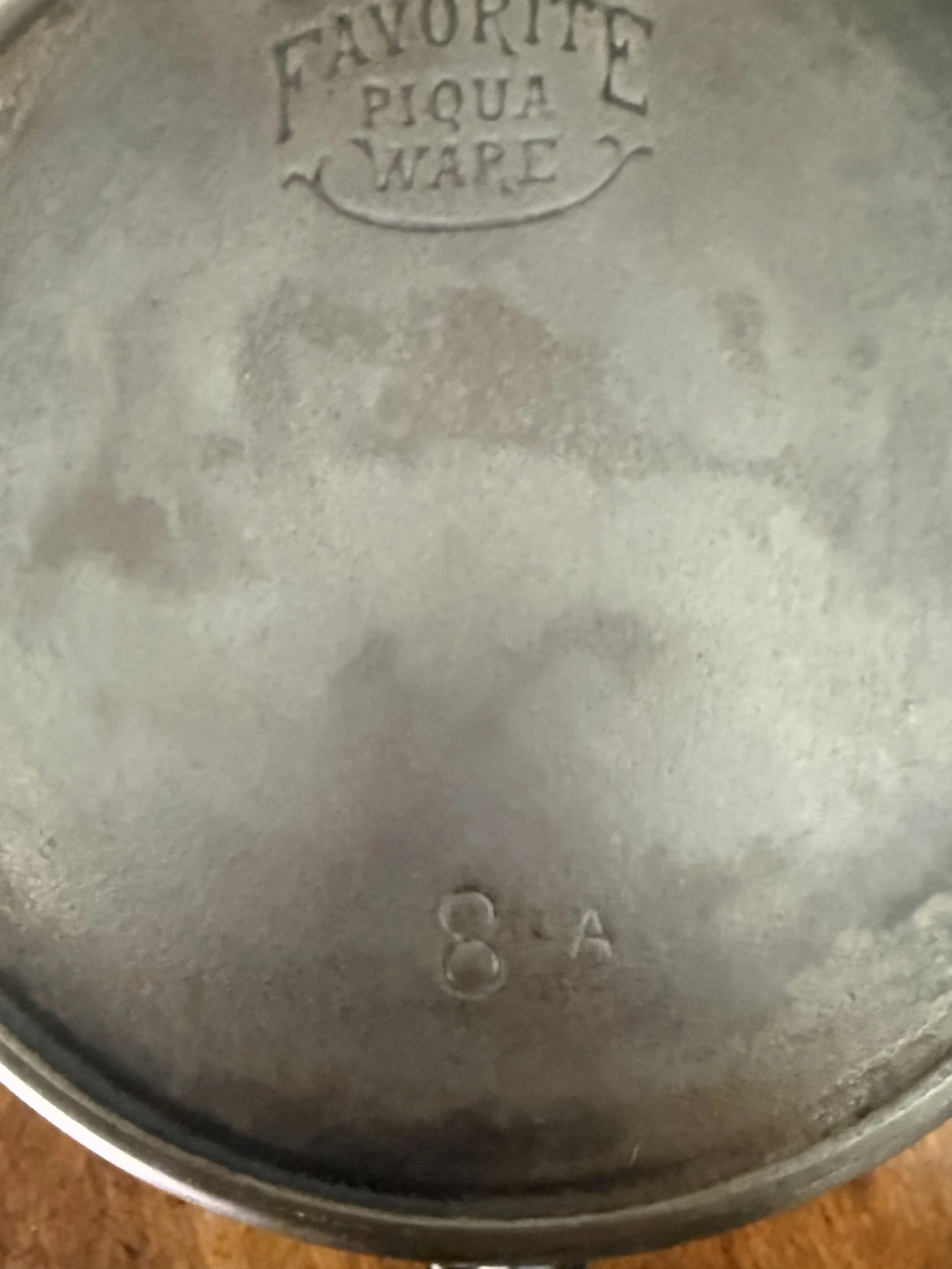
Close-up of the bottom markings: Smiley logo at top, size number “8” with pattern letter “A” below. The “A” identifies the first working pattern used to cast this size.
Manufacturer
Favorite Stove & Range Co.
Brand
Favorite Piqua Ware
Piece Type
Skillet
Size Number
No. 8
Pattern Letter
A (first working pattern)
Logo Variant
Smiley Face Logo
Approximate Dimensions
10¾” diameter × 15” overall length × 2” deep
Date of Manufacture
Circa 1916–1935
Place of Manufacture
Piqua, Miami County, Ohio
Condition
Sits flat, no wobble, no warp, no cracks, no chips, fully seasoned
Acquisition Date
November 26, 2025
Acquisition Source
eBay — Seller: co_19691
eBay Item Number
317357797262
Order Number
14-13879-81961
SSC Catalog Number
SSC-FPW-SKL-8A-Smiley-001
Understanding Pattern Letters: What the “A” Means
Every cast iron skillet begins with a pattern—a precise, three-dimensional model of the finished product, typically machined from aluminum or carved from wood. The pattern is pressed into damp sand to create the mold cavity, then carefully removed, leaving a negative impression into which molten iron is poured. Each pattern produces one mold, and each mold produces one skillet. For a high-demand size like the No. 8, a single pattern could not keep pace with production requirements, so foundries created multiple identical patterns—each assigned a unique letter.
The pattern letter system served a critical quality control function. Over time, patterns wear. Sand packing gradually erodes fine details. A tiny crack in the pattern becomes a raised line on every skillet it produces. A worn edge creates thin walls or rough surfaces. By assigning each pattern a unique letter—A, B, C, and so on—the foundry could trace any quality issue to the specific pattern responsible. When inspectors found a batch of skillets with a recurring defect, they pulled the offending pattern from the line for repair or replacement without disrupting production from the other patterns.
The “A” designation on this No. 8 indicates the first working pattern in the series. While it is tempting to assume that “A” means the oldest or most original, the reality is more nuanced—pattern letters were a practical tracking system, not a chronological record. The A pattern would have been in use alongside B, C, and potentially many others throughout the production period. What the letter does tell us is that this skillet can be definitively linked to a specific pattern within the Favorite foundry’s manufacturing operation.
For collectors, pattern letters add a layer of specificity to identification. Two No. 8 Smiley skillets may look identical at first glance, but an 8A and an 8C came from different patterns and may show subtle differences in casting detail, wall thickness, or logo crispness depending on the condition of each pattern at the time of casting. The SSC museum documents pattern letters for every piece where they are present, building a record that may eventually help researchers map the production history of Favorite’s most popular sizes.
A note on provenance: the original eBay listing described this piece as “Favorite Piqua Ware 8 B Smiley Face Logo Cast Iron Skillet.” Physical examination of the actual markings confirms the pattern letter is “A,” not “B.” Misidentification of pattern letters is common in the secondary market, which underscores the importance of hands-on inspection and photographic documentation—exactly the kind of verification that SSC performs for every piece in the museum collection.
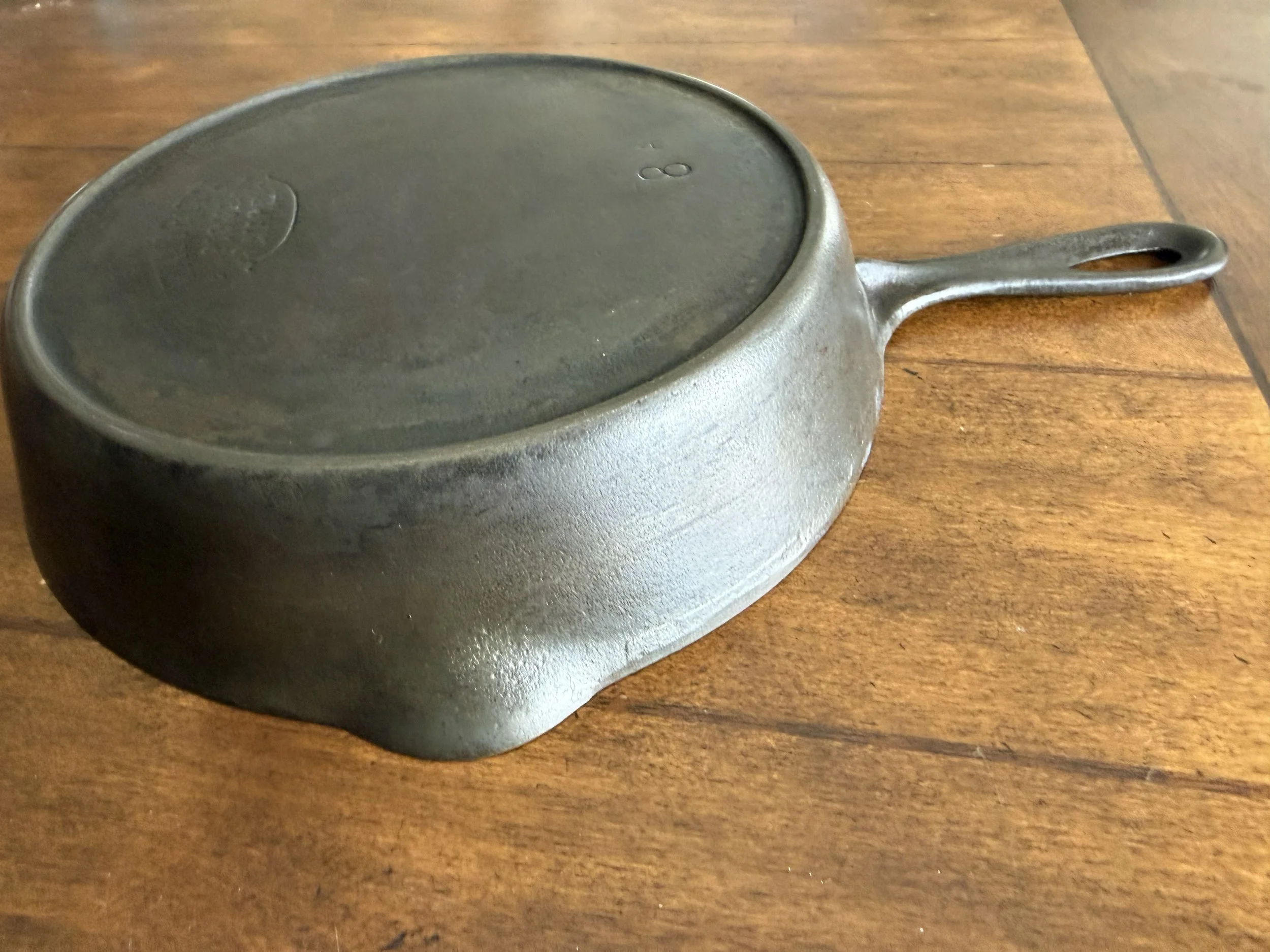
Profile view showing the smooth bottom (no heat ring), thin walls, and the classic Favorite Piqua Ware silhouette.
The Company: From Cincinnati to “The Favorite City”
The story of this skillet begins not in Piqua, but in Cincinnati. In 1848, William C. Davis founded W.C. Davis & Company, a stove and hollow ware manufacturer on the banks of the Ohio River. After the Civil War, the firm reorganized as Great Western Stove Works. In 1872, a young industrialist named William King Boal purchased partial ownership of the company, and by 1880 he had assumed full control, renaming it Favorite Stove Works.
Boal was an ambitious industrialist. When the Piqua Board of Trade came calling in 1886 with an extraordinary offer—eight free acres of land, eight new brick factory buildings, free natural gas for ten years, and tax exemptions—Boal signed on. Production began on February 25, 1889, with over 250 employees working in eight buildings on College Street.
The impact on Piqua was immediate and profound. The company became the city’s largest manufacturer. The community became known as “The Favorite City.” Workers settled on the hill west of the factory on what became known as “Stove Works Hill,” where generations of families would make their living in the foundry.
William King Boal died on January 2, 1916 at age 84. His son, William Stanhope Boal, succeeded him as president and significantly expanded the production of hollow ware—the cast iron cookware we collect today. Under his leadership, the Smiley logo became the company’s signature mark, appearing across the full range of skillets, Dutch ovens, and specialty pieces.
The Great Depression hit the company hard. William Stanhope Boal died on December 17, 1933. The firm reorganized under William C. Katker, who became the fourth company president, but it was too late. In 1935, the Favorite Stove & Range Company was liquidated. Foster Stove Company of Ironton, Ohio purchased the patents, patterns, dies, and trademarks—but the Piqua foundry never produced another piece.
The Smiley Logo: Favorite’s Most Beloved Mark
Favorite Stove & Range used approximately eight different logos on its cookware over the years. The earliest pieces bear a simple block letter trademark, and the consensus among collectors and researchers places the Smiley logo in the later period of production—roughly 1916 through 1935—making it a product of the William Stanhope Boal era.
The Smiley logo features “FAVORITE” arched across the top in an elegant serif font, with “PIQUA” centered below it, and “WARE” beneath that. What gives the logo its nickname is the graceful curved line beneath “WARE” that resembles a subtle smile. On this No. 8A, the logo is cleanly cast and fully legible, positioned at 12 o’clock on the bottom with the size and pattern markings at 6 o’clock.
The Favorite Family: Four Brands, One Foundry
What many casual collectors do not realize is that Favorite Piqua Ware was only one of several brand names produced under the Favorite Stove & Range umbrella. The complete family includes four distinct brands:
Favorite Piqua Ware — The flagship brand. Premium quality hollow ware bearing the company’s own name, produced under various logos including the block letter, stylized, and Smiley variants.
Columbus Hollow Ware (“The Favorite”) — A subsidiary operation producing skillets marked “The Favorite” in Columbus, Ohio from approximately 1882 to 1902.
Miami — The budget-friendly brand, marked with a distinctive diamond logo containing the word “MIAMI.” Named after Miami County, where Piqua is located.
Puritan — A private-label brand manufactured for Sears, Roebuck & Co. These pieces were sold through the Sears catalog, bringing Favorite’s casting quality to a nationwide retail audience.
The Steve’s Seasoned Classics museum collection includes documented pieces from all four of these brands—a distinction we believe makes SSC the first and only online resource to present the complete Favorite family under one roof.
Physical Characteristics & Construction
The No. 8 is where Favorite Piqua Ware’s craftsmanship shines brightest. As the flagship size—the pan that moved the most units and represented the brand to the widest audience—the No. 8 received the foundry’s best attention. Thin walls, light weight, and a glassy smooth cooking surface place it squarely in the company of the finest American cast iron ever produced.
This particular 8A does not feature a raised heat ring on the bottom, placing it among the later production pieces designed for use on gas and electric ranges rather than the flat cooking eyes of wood- and coal-burning stoves. The absence of a heat ring, combined with the Smiley logo, suggests manufacture in the later years of the 1916–1935 production window, as the company adapted its designs to the modernizing American kitchen.
The cooking surface shows the fine machining marks characteristic of foundry finishing—evidence that this pan was ground and polished after casting, a labor-intensive step that distinguished premium American cast iron from lesser products. The handle features the characteristic Favorite Piqua Ware teardrop-shaped hanging hole, and the pan has dual pour spouts on each side of the rim.
The seller’s listing specifically emphasized “No Wobble No Warp,” and the piece confirms this—it sits perfectly flat on all surfaces, a testament to both the quality of the original casting and the care with which it has been maintained over the past century.

Top view showing the smooth cooking surface with visible machining marks, dual pour spouts, and teardrop hanging hole.
Collector’s Context
The No. 8 is the most commonly encountered size in the Favorite Piqua Ware Smiley lineup—a reflection of its status as the best-selling pan in the line. For collectors, this means the No. 8 is more accessible than the scarcer sizes (No. 6, No. 7, No. 9, and above), and pricing reflects that availability. The acquisition price of $89.99 for this 8A represents fair market value for a clean, flat, well-seasoned example with a crisp Smiley logo.
What makes the No. 8 essential to any serious Favorite Piqua Ware collection is not rarity but representativeness. This is the size that defined the brand for most consumers. When a household in 1920s Ohio bought a Favorite Piqua Ware skillet, more often than not it was a No. 8. It is the pan that earned the company’s reputation for quality, and it is the pan that most people picture when they think of Favorite cast iron.
In the Steve’s Seasoned Classics collection, this No. 8A joins Smiley-logo siblings at sizes No. 3, No. 5B, No. 6, and No. 7, building toward a comprehensive documented size run. The pattern letter “A” adds a useful data point for researchers studying Favorite’s production methods—particularly when compared against other No. 8 examples with different pattern letters that may surface in the future.
Provenance & Acquisition
This No. 8A skillet was acquired on November 26, 2025, via eBay from seller co_19691, under eBay item number 317357797262 (order 14-13879-81961). The listing described it as “Favorite Piqua Ware 8 B Smiley Face Logo Cast Iron Skillet No Wobble No warp.” As noted above, physical examination confirms the pattern letter is “A,” not “B” as listed. The total acquisition cost was $117.14, comprising $89.99 for the item, $18.00 for USPS Ground Advantage shipping, and $9.15 in sales tax. The piece arrived well-packed and in the condition described: no cracks, no chips, no wobble, no warp, with a well-established seasoning and a clearly legible Smiley logo.
Corporate Timeline: From W.C. Davis to Liquidation
1848
William C. Davis founds W.C. Davis & Company in Cincinnati, Ohio, manufacturing stoves and hollow ware.
1865
After the Civil War, the firm reorganizes as Great Western Stove Works.
1872
William King Boal purchases partial ownership of Great Western Stove Works.
1880
Boal assumes full control after Davis’s retirement, renames the company Favorite Stove Works.
1881
The Favorite Stove Works Company is formally organized with Boal as President and Samuel P. Cheseldine as Secretary and Treasurer.
1882
Columbus Hollow Ware Company begins operations, producing skillets marked “The Favorite.”
1886
Boal signs contract with the Piqua Board of Trade to relocate the foundry.
1889
Favorite Stove & Range Company of Piqua, Ohio begins production on February 25 with 250+ employees in eight brick buildings on College Street.
1893
Stanhope Boal registers the “Favorite” trademark.
1896
Workforce exceeds 300; annual production surpasses 50,000 stoves.
1902
Columbus Hollow Ware Company ceases operations.
1916
William King Boal dies January 2 at age 84. His son William Stanhope Boal succeeds him and expands hollow ware production significantly.
1919
A labor strike lasting eleven days hits the plant, with workers demanding a 25% wage increase.
1923
William Stanhope Boal becomes Chairman of the Board.
1928
William C. Katker becomes the fourth company president.
1933
William Stanhope Boal dies December 17. The Great Depression devastates sales.
1935
Favorite Stove & Range is liquidated. Foster Stove Company of Ironton, Ohio purchases patents, patterns, dies, and trademarks.
Why This Piece Matters
Every collection needs its anchor, and the No. 8 is the anchor of Favorite Piqua Ware. It is the size that most Americans cooked with, the size that most foundry workers cast, and the size that best represents the everyday reality of early 20th-century American kitchens. While rarer sizes command higher prices and generate more excitement among specialists, the No. 8 is the skillet that tells the truest story of how cast iron was actually used.
This 8A also carries a quiet lesson about the importance of verification in cast iron collecting. The eBay listing identified the pattern letter as “B”; the actual marking on the iron reads “A.” In a field where identification, dating, and provenance depend on accurate reading of incised markings—often worn, obscured by seasoning, or photographed in poor light—hands-on examination remains irreplaceable. The SSC museum’s commitment to photographic documentation and physical verification ensures that every detail recorded in our catalog reflects what is actually on the iron, not what a listing says should be there.
The iron endures. The markings tell the truth. The story deserves to be told.
Sources & Further Reading
CastIronCollector.com — “Numbers & Letters” reference page: pattern letters, molder’s marks, and quality control systems.
CastIronCollector.com — Favorite Stove & Range Co. reference page and collector forums.
MentalScoop.com — “Decoding Cast Iron Numbers and Lettering”: detailed analysis of pattern letter systems.
BoonieHicks.com — “Guide to Favorite Piqua Ware: Favorite Stove and Range Co.”
CastIronCanada.com — “Favorite Stove and Range History” — primary source research on W.C. Davis lineage.
Piqua Public Library Local History Department — “Favorite Stove” historical article, including Lois J. Fair contributions.
1909 History of Miami County, Ohio — Troy Historical Society biography entry for the Favorite Stove & Range Co.
About Steve’s Seasoned Classics
Steve’s Seasoned Classics is an online museum dedicated to preserving and documenting the heritage of American cast iron cookware, with a focus on Ohio foundry pieces from the 19th and early 20th centuries. The SSC collection features over 60 pieces with detailed provenance, historical research, and photography for each item.
