Favorite Piqua Ware No. 3 Skillet — Unmarked, Two-Dot Attribution
SSC MUSEUM COLLECTION
Catalog No. SSC-FPW-SKL-03-UM-001
Unmarked Base | Two-Dot Mark | Piqua Attribution | Piqua, Ohio
Circa 1916–1935 • Attributed: Favorite Stove & Range Co.

Bottom view of the No. 3: a completely unmarked base carrying no brand cartouche, no size numeral, and no trade name—only the heat ring at the perimeter and two small dots near the handle junction that constitute the sole physical marking evidence. Attribution to Favorite Piqua Ware is based on physical characteristics consistent with known Piqua production, not on a visible logo.
Most cast iron in the SSC collection announces itself. The Smiley cartouche, the “THE FAVORITE” arc, the Miami diamond—these are marks that tell you immediately where the iron came from and who made it. This No. 3 says nothing. The base is clean, unmarked, carrying no brand and no size numeral. If you pick it up knowing nothing about Favorite Piqua Ware, nothing on the surface of the iron will tell you what it is. Only the two small dots near the handle junction remain as physical marking evidence, and even those require interpretation.
The attribution to Favorite Piqua Ware production at the Piqua, Ohio foundry is inferential, assembled from physical evidence rather than stamped directly into the iron: the heat ring configuration consistent with known Piqua production practice; the handle profile and hanging loop style matching documented FPW specimens in the SSC collection and in the broader reference literature; the overall proportions and casting character consistent with the Favorite Stove & Range production floor of the 1916–1935 period. The two dots near the handle junction are a documented marking convention in Piqua production that appears on certain pieces from this era. None of this is conclusive in isolation. Taken together, it is the strongest available case for Piqua attribution in the absence of a visible brand mark.
The No. 3 size itself adds to the documentary interest. Small skillets—the Nos. 2, 3, and 4 of any foundry’s line—were produced in lower volumes than the workhorses, used for specialized tasks rather than daily family cooking, and survived in smaller numbers through the 20th century. A No. 3 from any Ohio foundry is an uncommon find. An unmarked No. 3 with a credible Piqua attribution is a documentation opportunity that the SSC collection pursues precisely because it represents a gap in the typical collector record: the piece that got away from the standard identification framework and requires careful physical analysis to place.
Piece Details

Detail of the base near the handle junction showing the two dots that constitute the only physical marking evidence on this piece. The base surface texture is visible—granular and consistent with period sand-cast iron from the Piqua foundry corridor. No brand cartouche, size numeral, or trade name appears anywhere on the base.
Manufacturer
Attributed: Favorite Stove & Range Co. (not confirmed by visible mark)
Brand
Attributed: Favorite Piqua Ware (no brand mark present)
Attribution Basis
Heat ring configuration; handle profile and loop style; casting character; two-dot mark near handle junction—all consistent with known Piqua production c. 1916–1935
Piece Type
Skillet
Size Number
No. 3
Base Marking
Completely unmarked — no brand cartouche, no size numeral, no trade name; two small dots near handle junction only
Two-Dot Mark
Two small raised dots cast near handle junction; documented marking convention in Piqua production; function unresolved (gate mark, production code, or pattern identifier)
Bottom Configuration
Heat ring present; smooth cooking base inside ring
Pour Spouts
None visible at this size
Handle Style
Flat handle with teardrop/keyhole hanging loop; consistent with FPW handle design language
Date of Manufacture
Circa 1916–1935
Place of Manufacture
Attributed: Piqua, Miami County, Ohio
Condition
Good — structurally sound; sits flat; no cracks or chips; base clean; interior granular-textured with developing seasoning; honest working condition
Acquisition Date
January 29, 2026
Acquisition Source
eBay — Seller: sanantoniohoarder
eBay Item Number
236451118866
Order Number
27-14143-03558
SSC Catalog Number
SSC-FPW-SKL-03-UM-001
The Attribution Problem: How Unmarked Cast Iron Gets Identified
Unmarked cast iron is not unusual. American foundries of the late 19th and early 20th centuries did not universally brand every piece they produced. Some pieces came off the line without a logo because the pattern for that size or form did not carry one. Some had marks that wore off the pattern over repeated casting cycles, leaving later pieces with faint or absent impressions. Some were produced for distribution channels—hardware wholesalers, general merchandise accounts, institutional buyers—that did not require or did not want a brand mark on the cooking surface. The absence of a mark is a data point, not a disqualification.
Attributing an unmarked piece to a specific foundry requires assembling a case from physical evidence. For this No. 3, the case rests on four categories of evidence. First, the heat ring: its diameter, height, and position relative to the base perimeter are consistent with Favorite Piqua Ware production practice and inconsistent with the major competing Ohio foundries of the period—Wagner and Griswold used different heat ring profiles on their small skillets. Second, the handle: the flat handle with teardrop hanging loop, the handle-to-body junction geometry, and the overall handle proportions match documented FPW specimens in the No. 3 and No. 4 sizes. Third, the casting character: the surface texture, the sidewall thickness, and the overall weight distribution are consistent with the Piqua foundry’s production standards of the 1916–1935 period. Fourth, the two dots: a marking convention documented in Piqua production that appears on certain pieces from this era and is not commonly documented in Wagner or Griswold production of comparable size.
None of these evidence categories is individually conclusive. A heat ring of the right dimensions could have come from other foundries. A handle profile matching FPW specimens could be coincidence. The two dots could be artifact rather than intentional mark. But the convergence of all four evidence categories pointing toward the same Piqua attribution, in the absence of any physical evidence pointing elsewhere, constitutes a reasonable basis for the attribution as stated in this catalog record. SSC documents this piece as “attributed” rather than “confirmed” to make that distinction explicit, and invites any collector with additional comparative evidence—particularly other unmarked Piqua No. 3 specimens with the two-dot mark—to contribute to the record.
The Two Dots: What They Are and What They Mean
The two small dots near the handle junction are the only intentional marking evidence on this piece, and they require their own analysis. In American foundry practice, small raised dots or circular depressions on the base of a cast iron skillet near the handle junction typically served one of three functions: as gate markers indicating the location of the iron entry point into the mold; as pattern identification codes used by the foundry to track which pattern produced a given piece; or as production batch or quality control codes applied to distinguish pieces cast under specific conditions or for specific customers.
In the Favorite Piqua Ware context, the two-dot configuration near the handle junction appears on a subset of documented pieces and is treated in the collector reference literature as a Piqua-associated marking convention, though its precise foundry function has not been definitively established. The BoonieHicks documentation of Favorite Piqua Ware notes the dot marking convention without resolving its meaning—an honest acknowledgment that the physical evidence available to the collector community does not yet support a definitive interpretation. SSC adopts the same position: the two dots are documented as present, their Piqua association is noted, and their specific meaning remains an open research question.
What the two dots do establish, in combination with the physical attribution evidence above, is that this piece was not simply a generic, unaffiliated casting. The dot convention points to a specific production context—a specific foundry floor, a specific pattern system, a specific period of production—even if that context cannot be fully specified from the marks alone. The dots are evidence of intentional marking practice. They are worth documenting.
The No. 3 in the Favorite Piqua Ware Size Run
The No. 3 is the smallest size in the Favorite Piqua Ware line represented in the SSC collection, and it is significantly smaller than any other piece in the FPW sub-collection. At roughly 6½ to 7 inches across the cooking surface, this is not a family cooking pan—it is a specialty or single-serving vessel, sized for tasks that the larger skillets handled awkwardly or not at all: a single fried egg, a small portion of butter for basting, a tableside serving pan for individual portions, or a specialty preparation where precise heat control over a small surface area mattered more than cooking volume.
The functional niche of the No. 3 explains both its place in the production line and its relative scarcity in the collector market. It was produced in lower volume than the Nos. 7, 8, and 9 because fewer households needed it for daily cooking tasks. It was more likely to be lost or discarded because its small size made it easy to misplace and its specialized function made it easy to substitute with other kitchen tools as cooking habits changed through the 20th century. A No. 3 in any condition from any Ohio foundry is a find worth documenting. An attributed Piqua No. 3 with the two-dot convention is rarer still.

Profile view of the No. 3 showing the compact proportions characteristic of the small-size FPW skillet: shallow sidewall depth relative to the cooking surface diameter, the heat ring clearly defined at the base perimeter, and the flat handle with teardrop loop. The small scale of the piece is evident in comparison to the handle length.
Physical Characteristics & Condition Assessment
The No. 3 is a compact, well-proportioned small skillet with physical characteristics consistent throughout with the Piqua attribution. The base carries a heat ring—present and well-defined at the perimeter, providing the primary stove-eye contact surface—and the cooking area inside the ring is smooth relative to the outer base surface. The handle is flat with the teardrop hanging loop at the terminus, following the FPW handle design language documented in the companion No. 7 and No. 8A entries. The overall weight and balance are appropriate to the No. 3 size, and the piece sits flat without warping or wobble.
At this scale, pour spouts are not present—a No. 3 was not typically used in applications requiring liquid pouring, and the small rim diameter made pour spout casting less practical than on larger sizes. The handle junction is clean with the two dots visible in close examination, and the handle itself shows no cracks or structural compromise at the body join.
Condition is assessed as Good. The piece is structurally sound—no cracks, chips, cold shuts, or warping. The base is clean and flat. The interior surface, visible in the top view photograph, is granular and textured rather than the smooth machine-finished surface found on higher-grade FPW pieces: this is honest period-cast iron showing the natural texture of sand-cast production without surface machining. The seasoning is developing and the piece is functional. For documentation purposes, the condition is appropriate to an attributed small-size skillet from a 90-plus-year-old production run, and the absence of logo definition is a feature of the unmarked configuration rather than a condition issue.
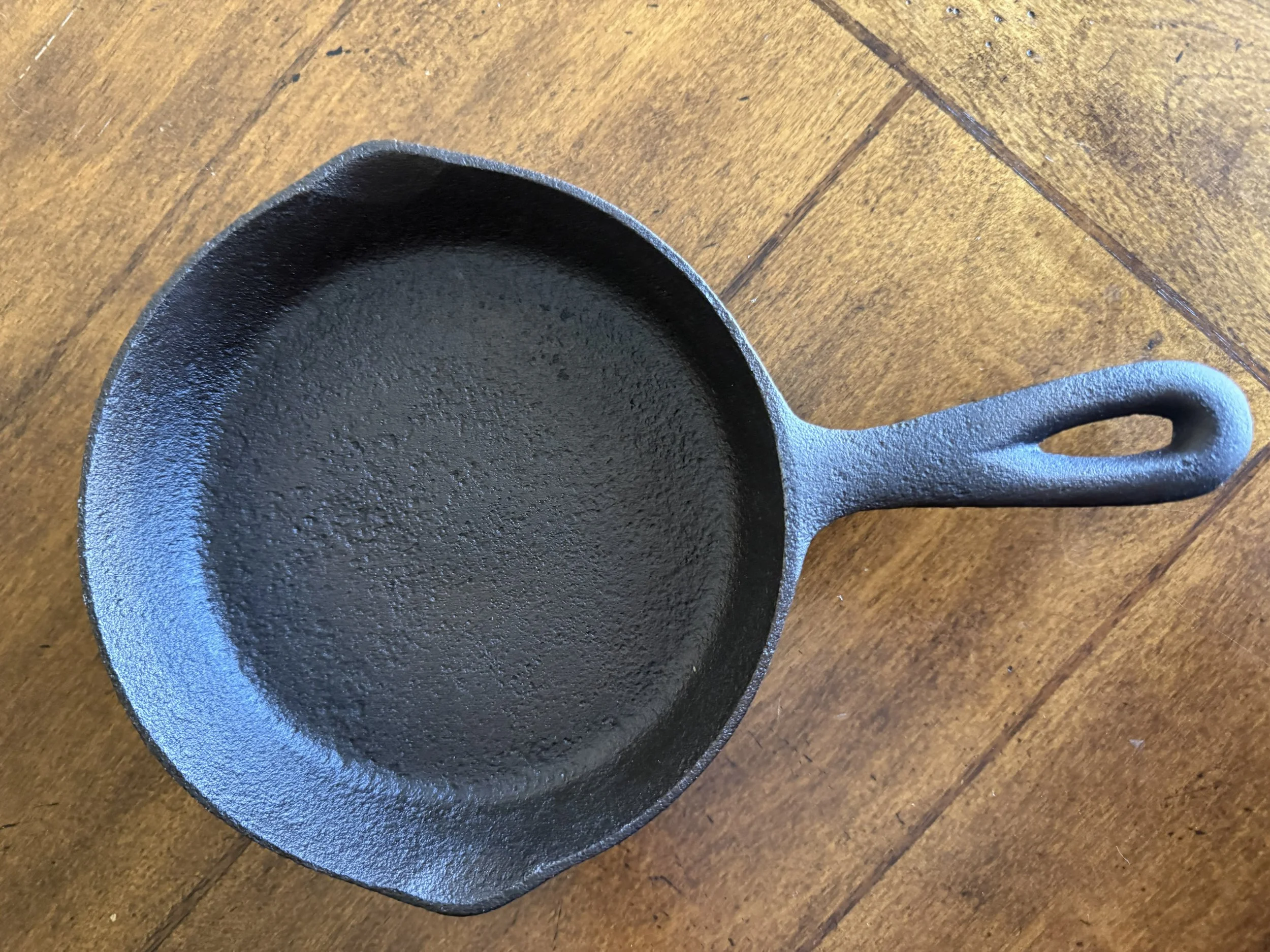
Top view showing the interior cooking surface of the No. 3—granular-textured, honest period cast iron without machine finishing, with developing seasoning and no structural damage. The compact cooking bowl and proportional handle are consistent with a small-size specialty skillet from the Piqua foundry corridor, c. 1916–1935.
The Company: Favorite Stove & Range Co.
Favorite Stove & Range Company operated in Piqua, Miami County, Ohio, producing cast iron cookware under the Favorite Piqua Ware brand and parallel trade names including Miami and Puritan. The company operated in the early 20th century alongside Wagner Manufacturing and other Ohio foundry corridor producers. The complete size run for Favorite Piqua Ware extended from small specialty sizes like the No. 3 through the large institutional No. 12, with the No. 8 as the production-volume workhorse. Unmarked pieces attributable to Piqua production exist throughout the size run but are more commonly documented in the smaller sizes, where the commercial logic of logo investment was weaker relative to the volume of pieces produced.
Provenance & Acquisition
This No. 3 skillet was acquired on January 29, 2026, via eBay from seller sanantoniohoarder, under eBay item number 236451118866 (order 27-14143-03558). The listing described the piece as “Antique 1916-35 Unmarked FAVORITE Piqua #3 Cast Iron Skillet 2 Dots Under Handle.” The acquisition cost was $31.98 for the item plus $8.00 USPS Ground Advantage shipping and $3.39 in sales tax, for a total of $43.37.
The seller’s listing attribution—“Unmarked FAVORITE Piqua”—is consistent with the physical examination conducted on receipt. The two dots are present near the handle junction. The heat ring, handle profile, and casting character are consistent with the Piqua attribution. No physical evidence contradicting the Piqua attribution was observed. The piece is cataloged as SSC-FPW-SKL-03-UM-001, the “UM” designator in the catalog number indicating the unmarked configuration, distinguishing it from logo-bearing FPW entries in the collection.
Corporate Timeline: Favorite Stove & Range Co.
c.1905
Favorite Piqua Ware brand and Smiley logo enter production in Piqua, Miami County, Ohio. The full size run, including small sizes like the No. 3, is established.
1916–35
Dating range for this No. 3 based on seller attribution and physical characteristics consistent with this production period. Unmarked pieces are produced alongside logo-bearing pieces during this era.
c.1930s
Favorite Stove & Range operations wind down. Piqua cast iron production consolidates.
2026
Steve’s Seasoned Classics acquires this unmarked No. 3 from eBay seller sanantoniohoarder. Documented as SSC-FPW-SKL-03-UM-001, the first No. 3 and first unmarked-attribution piece in the SSC FPW sub-collection.
Why This Piece Matters
The Favorite Piqua Ware No. 3 unmarked skillet matters for reasons that have nothing to do with logo definition or marking clarity—and that is precisely the point. The SSC collection already holds multiple well-marked FPW specimens: the Smiley single-logo pieces, the dual Smiley + Miami No. 7 and No. 8A. Those pieces announce themselves. This one does not. It requires the collector to look past the absence of a mark and ask: what does the iron itself tell me? The answer, assembled from heat ring geometry, handle profile, casting character, and the two-dot convention, is a credible Piqua attribution that would not exist without careful physical analysis.
Documenting unmarked pieces honestly—with the attribution marked as inferential, the evidence basis stated explicitly, and the open questions identified—is part of what separates a museum collection from an accumulation of display objects. The SSC collection exists to preserve the physical record of Ohio cast iron heritage, and that record includes the pieces that did not get a logo as surely as it includes the pieces that did. The No. 3 is in the collection because it represents a real gap in the standard documentation framework, and filling that gap with careful, honest attribution work is what SSC is here to do.
The iron endures. The markings tell the truth. The story deserves to be told.
Sources & Further Reading
BoonieHicks.com — “Guide to Favorite Piqua Ware”: documentation of FPW physical characteristics, size run, dot marking conventions, and attribution methodology for unmarked pieces.
CastIronCollector.com — Favorite Stove & Range Co. reference page: operational dates, location, and production period documentation.
WorthPoint.com — Historical auction records for unmarked Piqua attribution small-size skillets.
SSC Internal Collection Records — FPW No. 7 dual-logo entry, SSC-FPW-SKL-07-SM-001; FPW No. 8A dual-logo entry, SSC-FPW-SKL-08-SM-001—physical comparison reference for heat ring and handle profile attribution analysis.
About Steve’s Seasoned Classics
Steve’s Seasoned Classics is an online museum dedicated to preserving and heritage of American cast iron cookware, with a focus on Ohio foundry pieces from the 19th and early 20th centuries. The SSC collection features over 60 pieces with detailed provenance, historical research, and photography for each item.
