A.G. Patton — Cast Iron Tea Kettle
SSC MUSEUM COLLECTION
Catalog No. SSC-AGPAT-TK-001
A.G. Patton | Cast Iron Tea Kettle | Columbus, Ohio
A.G. Patton / Patton Manufacturing Company • Columbus, Franklin County • c. 1874–1900

Top view showing the A.G. Patton tea kettle with its full maker’s mark on the lid: “A.G. PATTON” arched above and “COLUMBUS, O.” arched below, surrounding a decorative concentric ring pattern. Wire bail handle, pour spout at left. Original patina intact.
In the city of Columbus, Ohio—the state capital and one of the Midwest’s major 19th-century industrial centers—A.G. Patton operated a foundry that produced cast iron hollow ware from approximately 1874 to 1900. The company is known to collectors under several names: Brooks & Patton in its earlier configuration, the Patton Manufacturing Company in its primary operating period, and sometimes simply as “A.G.P.” from the initials cast into some of its products. This tea kettle—marked with the full name “A.G. PATTON / COLUMBUS, O.” on its lid—bears the most complete form of the Patton maker’s mark, identifying not just a company but the man himself.
The gate mark on the bottom of this kettle is the most significant diagnostic feature of the piece. A gate mark is a raised ridge or scar left on the bottom of a casting where molten iron entered the sand mold through a horizontal gate channel. This method of casting was standard in American foundries through the mid-to-late 19th century but was largely phased out by the late 1880s as bottom-gated and side-gated mold designs became the industry norm. The presence of a gate mark places this kettle in the earlier portion of Patton’s production period—likely the 1870s or 1880s—making it one of the oldest datable pieces in the SSC collection.
A.G. Patton’s history intersects with one of the more complex narratives in Ohio cast iron: the Columbus Hollow Ware Company. In 1897, Patton obtained the Columbus Hollow Ware naming rights and contracted with the Ohio State Penitentiary to produce cast iron cookware using prison labor. That later chapter of Patton’s career is a separate story from this tea kettle, which dates from the foundry’s earlier, independent production period. But the connection matters—it places Patton at the center of Columbus’s cast iron manufacturing history across multiple decades and multiple business configurations.
Piece Details
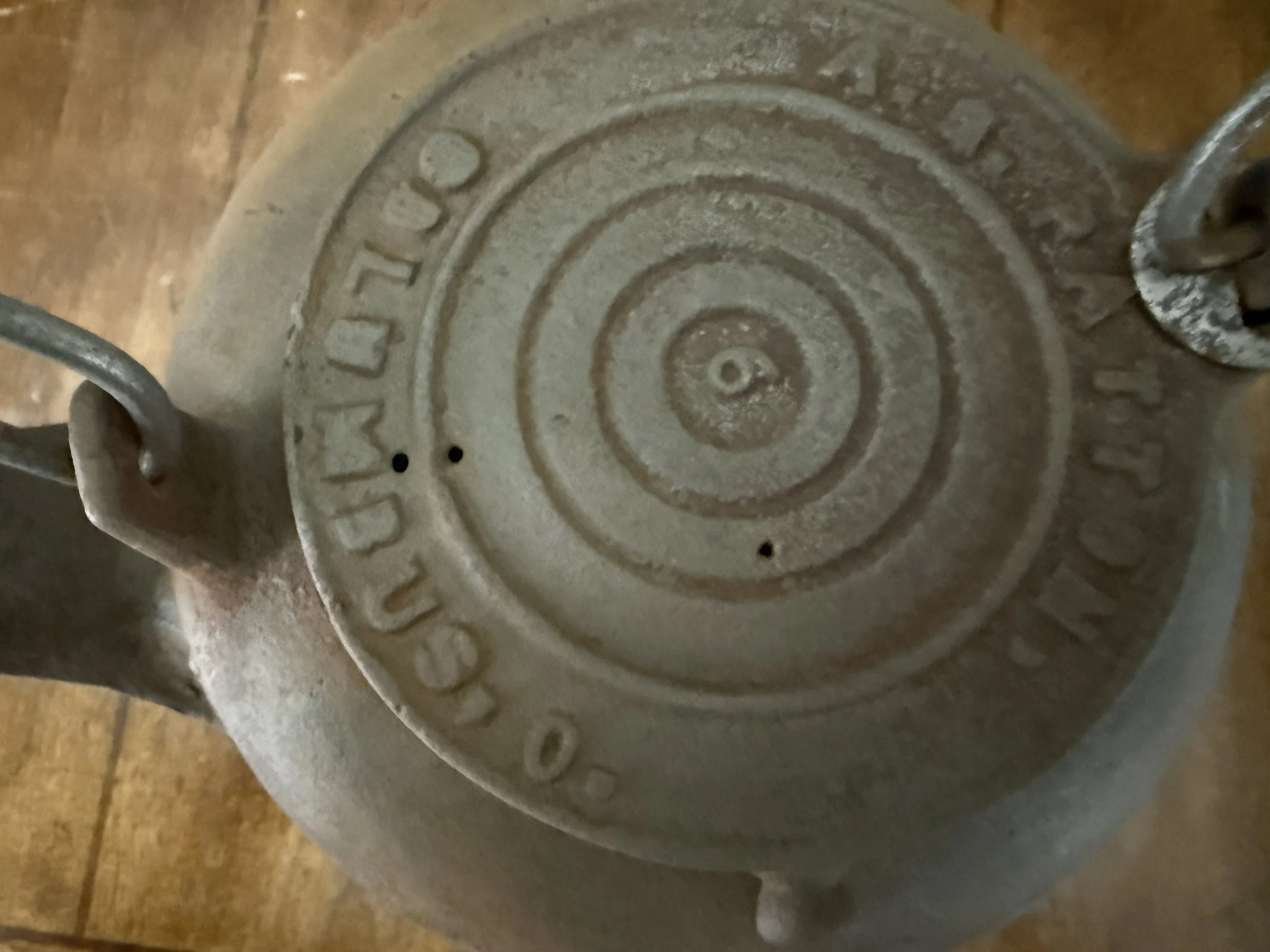
Close-up of the lid marking: “A.G. PATTON” in raised letters arched above the concentric ring decoration, with “COLUMBUS, O.” arched below. The lettering is cast directly into the iron lid and remains crisp and fully legible. Steam vent holes visible near center.

Bottom view showing the gate mark — a raised ridge running across the flat base where molten iron entered the sand mold during casting. Gate marks are diagnostic of pre-1890s manufacture and indicate horizontal sand mold casting, the standard foundry method of the mid-to-late 19th century.
Manufacturer
A.G. Patton (Columbus, Ohio) — also associated with Patton Manufacturing Company (1874–1900) and Brooks & Patton
Piece Type
Cast iron tea kettle / stove-top water kettle
Material
Cast iron body with wire bail handle
Construction
Round body with pour spout; hinged flat lid with concentric ring decoration and maker’s mark; wire bail handle with pivot ears; flat bottom with gate mark indicating sand mold casting
Lid Marking
“A.G. PATTON” arched above center; “COLUMBUS, O.” arched below center; concentric circle decorative pattern in center of lid
Bottom
Flat bottom with visible gate mark — a raised ridge or scar from the gate channel where molten iron entered the sand mold during casting; diagnostic of pre-1890s manufacture
Gate Mark Significance
Gate marks indicate sand mold casting using a horizontal mold with a single gate entry. This method was largely phased out by the late 1880s in favor of bottom-gated and side-gated molds. A gate mark dates this kettle to the earlier period of Patton’s Columbus operations
Date of Manufacture
Estimated 1874–1890s (gate mark indicates earlier production within the Patton Mfg. Co. period)
Place of Manufacture
Columbus, Franklin County, Ohio
Condition
As-found original patina — retained without preservation treatment; lid marking crisp and fully legible; wire bail handle intact; pour spout intact; gate mark clearly visible on bottom; surface oxidation consistent with 19th-century use and storage; no cracks or structural damage
Preservation Note
Original patina retained; no Archival Black™ protocol applied — piece preserved in as-found condition
Acquisition Date
March 5, 2026
Acquisition Source
eBay — Seller: riferg_23
eBay Item Number
357881334104
Order Number
10-14324-67752
Purchase Price
$23.00 item + $27.06 shipping + $4.24 tax = $54.30 total
SSC Catalog Number
SSC-AGPAT-TK-001
Additional Views

Profile view showing the tea kettle’s form: round body, curved pour spout, wire bail handle in the raised position. The kettle was designed for use on a wood or coal stove, sitting directly on the stove top or inserted into a stove eye opening. The proportions are characteristic of mid-to-late 19th-century Ohio foundry tea kettles.

Open view with lid pivoted to show the kettle interior and the hinged lid construction. The “A.G. PATTON” marking is visible on the lid face. The wide mouth allowed easy filling from a pump or bucket; the pour spout directed the flow when serving.
Historical Background
The Patton Foundry Lineage: Brooks & Patton to Patton Mfg. Co.
A.G. Patton’s Columbus foundry operated under several names over its roughly quarter-century lifespan. The earliest known configuration is Brooks & Patton, a partnership that produced waffle irons and tea kettles in Columbus. The Wagner and Griswold Society’s foundry database lists “PATTON MFG. CO. COLUMBUS, OHIO 1874–1900” with a cross-reference to Brooks & Patton, and separately lists “A. G. P. Columbus, O” for waffle irons and pots. These entries—all pointing to the same Columbus operation—document a foundry that used at least three different marks on its products: the partnership name, the company name, the owner’s initials, and—as on this tea kettle—the owner’s full name.
The fact that this kettle is marked “A.G. PATTON” rather than “PATTON MFG. CO.” or “BROOKS & PATTON” may indicate a transitional period in the company’s branding, or it may simply reflect Patton’s preference for personal identification on certain products. In an era when small foundry owners often cast their own names into their products, the “A.G. PATTON / COLUMBUS, O.” mark is the most personal and direct form of the maker’s identity.
The Gate Mark: Dating Evidence in Iron
The gate mark on the bottom of this kettle is a foundry artifact—a physical trace of the casting process itself. In sand mold casting, molten iron enters the mold through a channel called a gate. In horizontal mold designs—standard through most of the 19th century—the gate leaves a raised ridge or scar on the bottom of the finished casting. By the late 1880s, American foundries had largely transitioned to bottom-gated and side-gated mold designs that eliminated the visible gate mark. The presence of a gate mark is therefore one of the most reliable indicators that a piece of cast iron was produced before approximately 1890.
For this A.G. Patton tea kettle, the gate mark confirms manufacture during the earlier portion of the company’s 1874–1900 production window—most likely the 1870s or 1880s. This makes the kettle a first-generation Patton product, cast in Columbus before the company’s later involvement with the Ohio State Penitentiary and the Columbus Hollow Ware Company.
A.G. Patton and Columbus Hollow Ware
In 1897, A.G. Patton obtained the naming rights to the Columbus Hollow Ware Company—a separate entity that had been founded in 1882 by Jesse F. and E.B. Hatcher. The original Columbus Hollow Ware Company operated a foundry within the Ohio State Penitentiary, using contracted inmate labor to produce cast iron cookware marketed under “The Favorite” brand. Under Patton’s ownership, the reestablished Columbus Hollow Ware Company continued contracting with the penitentiary. Cast iron produced during this prison-contract period is believed to be largely unmarked.
This history makes A.G. Patton a central figure in Columbus’s cast iron story—a man who ran his own foundry for over two decades, then acquired the naming rights to another company and moved production into the state prison system. The tea kettle in the SSC collection dates from the earlier, independent chapter of that story—before the prison contracts, before Columbus Hollow Ware, when Patton was casting iron under his own name in his own Columbus foundry.
SSC Collection Context
This A.G. Patton tea kettle joins the SSC’s existing Brooks & Patton tea kettle to form a two-piece documentation of the Patton foundry lineage in Columbus. Together, the two pieces span the full range of the company’s branding: the partnership name (Brooks & Patton) and the owner’s personal mark (A.G. Patton). The gate mark on this kettle identifies it as the older of the two pieces, dating it to the first generation of Patton’s Columbus production.
The Patton connection also extends the SSC’s documentation of the broader Columbus Hollow Ware story—a narrative that includes the Hatcher brothers, the Ohio State Penitentiary, “The Favorite” brand, and ultimately the Favorite Stove & Range Company of Piqua. Columbus and Piqua are the two anchor cities of the Favorite Corporate Lineage grouping, and A.G. Patton is the man who connected them.
The gate mark tells the age. The lid tells the name. The iron tells the story. And the story leads from a Columbus foundry to a state prison to a Piqua stove factory—all through a single man’s career in Ohio cast iron.
A.G. Patton / Columbus Hollow Ware — Company Timeline
1874
A.G. Patton establishes or takes over a foundry operation in Columbus, Ohio. The company produces cast iron hollow ware including tea kettles, waffle irons, and pots. The firm is also known as Brooks & Patton during an earlier or overlapping period, and later as the Patton Manufacturing Company.
1874–1890s
Patton’s Columbus foundry produces gate-marked cast iron hollow ware, including this tea kettle. Gate marks indicate horizontal sand mold casting, a method largely phased out by the late 1880s.
1882
The Columbus Hollow Ware Company is founded by Jesse F. and E.B. Hatcher, operating a foundry within the Ohio State Penitentiary using inmate labor. The company produces cast iron cookware under “The Favorite” brand name. This is a separate entity from A.G. Patton’s operation, though their histories later intersect.
1897
A.G. Patton obtains the Columbus Hollow Ware Company naming rights. Under Patton’s leadership, the reestablished company contracts with the Ohio State Penitentiary to manufacture cast iron cookware. Prison-made ironware from this period is likely unmarked.
c. 1900
The Patton Manufacturing Company ceases operations. The WAGS foundry database lists the company’s period of production as 1874–1900.
2026
Steve’s Seasoned Classics acquires this A.G. Patton tea kettle from eBay seller riferg_23. The piece is documented as SSC-AGPAT-TK-001, joining the SSC’s existing Brooks & Patton tea kettle in documenting the full arc of Columbus’s Patton foundry lineage.
Why This Piece Matters
An A.G. Patton tea kettle with a gate mark is a piece of Columbus, Ohio foundry history that predates the automobile, predates electric light in most Ohio households, and predates the corporate consolidation that would eventually merge Columbus’s cast iron makers into larger entities. The gate mark places it in the 1870s or 1880s—the earliest period of Patton’s independent Columbus foundry operations. The full-name marking—“A.G. PATTON / COLUMBUS, O.”—identifies not a corporation but a man, a specific Ohio foundryman who put his name on his products and sent them out into the world.
For the SSC, this kettle documents the human center of the Columbus cast iron story. Brooks & Patton was a partnership. Patton Mfg. Co. was a company. Columbus Hollow Ware was an institution. But A.G. Patton was the man who tied them all together—and this tea kettle, gate-marked and bearing his name, is the earliest direct evidence of his work in the SSC collection.
Sources & Further Reading
Cast Iron Collector — Columbus Hollow Ware Co. (castironcollector.com): foundry profile with founding date, production period, Hatcher family founders, and Ohio Penitentiary connection.
Boonie Hicks — The Favorite: Vintage Cast Iron by the Columbus Hollow Ware Co. (booniehicks.com): detailed history of Columbus Hollow Ware including A.G. Patton’s 1897 acquisition of naming rights and prison contract.
Wagner and Griswold Society — Foundry Database (wag-society.org): listings for “A. G. P. Columbus, O” (waffle irons, pots), “PATTON MFG. CO. COLUMBUS, OHIO 1874–1900,” and “BROOKS & PATTON COLUMBUS, OH.”
Cast Iron Collector Forums — A.G.P. Columbus identification discussion (castironcollector.com/forum): collector identification of A.G.P. marked pieces as products of the A.G. Patton foundry.
eBay listing and invoice documentation — Item 357881334104, Order 10-14324-67752.
About Steve’s Seasoned Classics
Steve’s Seasoned Classics is an online museum dedicated to preserving and documenting the heritage of American cast iron, with a focus on Ohio foundry pieces from the 19th and early 20th centuries. The SSC collection features over 130 pieces with detailed provenance, historical research, and photography for each item.
