The Adams & Britt Cast Iron Stove Kettle Griddle
SSC MUSEUM COLLECTION
Catalog No. SSC-ADAMSBRITT-KTL-1872-001
Stove Kettle with Griddle Lid | Bail Handle | Pour Spout | Dated 1872 | Cincinnati, Ohio
Circa 1872 • Adams & Britt • Ohio Foundry Corridor

Top view showing the hinged griddle lid with “ADAMS & BRITT” and “CINCINNATI” cast in raised letters around the perimeter of the lid, with the date visible in the center ring. The bail handle swings over the lid for carrying. The pour spout is visible at the lower edge. This is a stove kettle griddle—a dual-purpose piece designed to boil water on a cast iron stove while the inverted lid served as a small griddle surface for warming or cooking.
There is a category of cast iron that sits at the intersection of two functions and one name. The stove kettle griddle was a piece of hardware designed for the cast iron cooking stove: a kettle for boiling water, fitted with a flat or slightly domed lid that could be inverted and used as a griddle for warming bread, toasting, or light cooking. It sat in a stove-eye opening, its body dropping into the hole while its rim rested on the stove plate. The lid faced upward, heated by the fire below, serving as a cooking surface while the water in the kettle below came to a boil. One piece, two purposes, and a name—cast into the lid in raised letters—that identified the foundry that made it.
This stove kettle griddle carries the name Adams & Britt of Cincinnati, Ohio, with a date of 1872 cast into the lid. Adams & Britt was a Cincinnati hollow ware partnership known to have produced tea kettles and related stove hardware in the years following the Civil War. The firm is cross-referenced in the WAGS Society foundry database with Britt & Folger of Cincinnati—a later or concurrent partnership involving the same Britt family—both listed as manufacturers of tea kettles. Beyond these foundry-list entries, Adams & Britt has virtually no surviving documentation: no catalogs, no advertisements, no city directory entries that have been digitized and indexed. The firm exists in the historical record almost entirely through the physical objects that carry its name.
That makes this piece exactly the kind of artifact the SSC collection was built to preserve. Adams & Britt is obscure. Adams & Britt is defunct. Adams & Britt is Cincinnati. And this stove kettle griddle—dated, marked, and carrying the full company name and city—is one of the few surviving documents of its existence.
The Stove Kettle Griddle: A Dual-Purpose Form

Detail view of the lid markings showing “ADAMS & BRITT” and “CINCINNATI” cast in raised letters within concentric rings on the lid surface. A small cast handle or finial at center allows the lid to be lifted or the piece to be inverted for use as a griddle. The casting quality is consistent with a mid-grade Reconstruction-era Cincinnati foundry—functional, legible, and built for daily use on a wood-burning stove.
The stove kettle griddle was a standard product form in the American hollow ware industry of the mid-to-late nineteenth century. Cast iron cooking stoves of the period had removable circular plates—called stove eyes or stove lids—that exposed openings of various sizes over the firebox. Hollow ware manufacturers produced kettles, pots, and specialized pieces sized to fit these openings. The stove kettle was one such piece: a flat-bottomed or bulged kettle with a flanged rim that sat in a stove-eye opening, allowing direct heat from the fire to reach the kettle body. The griddle lid added a second function: when placed on the kettle, the flat lid absorbed heat from below and could be used to warm bread, toast, or cook small items.
This Adams & Britt example features the complete form: a round kettle body with a pour spout, a wire bail handle for lifting, a hinged griddle lid with raised markings, and a flat bottom designed to sit in a stove eye. The bail handle is forged iron, attached to cast lugs on opposite sides of the rim. The pour spout is cast as part of the kettle body. The lid is hinged to the rim and carries the company name, city, and date in raised letters arranged in concentric rings on the upper surface.

Profile view showing the kettle body, bail handle, pour spout, and hinged griddle lid. The kettle’s round body is designed to drop into a stove-eye opening with the flanged rim resting on the stove plate. The pour spout allows the kettle to serve as a water boiler or tea kettle. Old black paint or japanning is visible over the entire surface, with wear and patina consistent with extensive stove-top use in the 1870s–1880s.
Adams & Britt: A Cincinnati Hollow Ware Partnership
Adams & Britt of Cincinnati, Ohio, is documented in the WAGS (Wagner and Griswold Society) foundry database as a manufacturer of tea kettles, cross-referenced with the related firm Britt & Folger of Cincinnati. The cross-reference indicates that the two firms shared a principal—almost certainly a member of the Britt family—and that one succeeded or operated alongside the other. The WAGS entry lists both firms as Cincinnati tea kettle makers, placing them squarely in the city’s hollow ware industry.
Cincinnati in the early 1870s was home to a dense concentration of stove and hollow ware manufacturers. W.C. Davis & Co. (later the Great Western Stove Works and eventually Favorite Stove Works) was operating from Pearl and Butler streets. W. Resor & Co. was manufacturing waffle irons and tea kettles. Perin & Gaff Manufacturing Co. was producing its vast catalog of general hardware. L. Massman & Son was making tea kettles. F.P. Davis & Co. and W.C. Davis & Co. were casting dutch ovens and skillets. Chamberlain & Co. was making tea kettles. Adams & Britt was part of this ecosystem—one of many small partnerships casting hollow ware in the foundry district of a city that was, in 1872, one of America’s leading manufacturing centers.
The date on this piece—1872—places it in a specific and consequential moment in Cincinnati’s foundry history. In 1872, W.K. Boal was acquiring the W.C. Davis stove foundry that would eventually become Favorite Stove Works and then Favorite Stove & Range Co. of Piqua. The city’s foundry industry was consolidating and professionalizing, with smaller partnerships being absorbed by larger operations. Adams & Britt represents the pre-consolidation era: a small, named partnership producing standard hollow ware forms—tea kettles, stove kettles, griddle lids—for the local and regional market. The transition from Adams & Britt to Britt & Folger suggests either a change in partnership (Adams departing, Folger joining) or a reorganization of the same business under different principals.
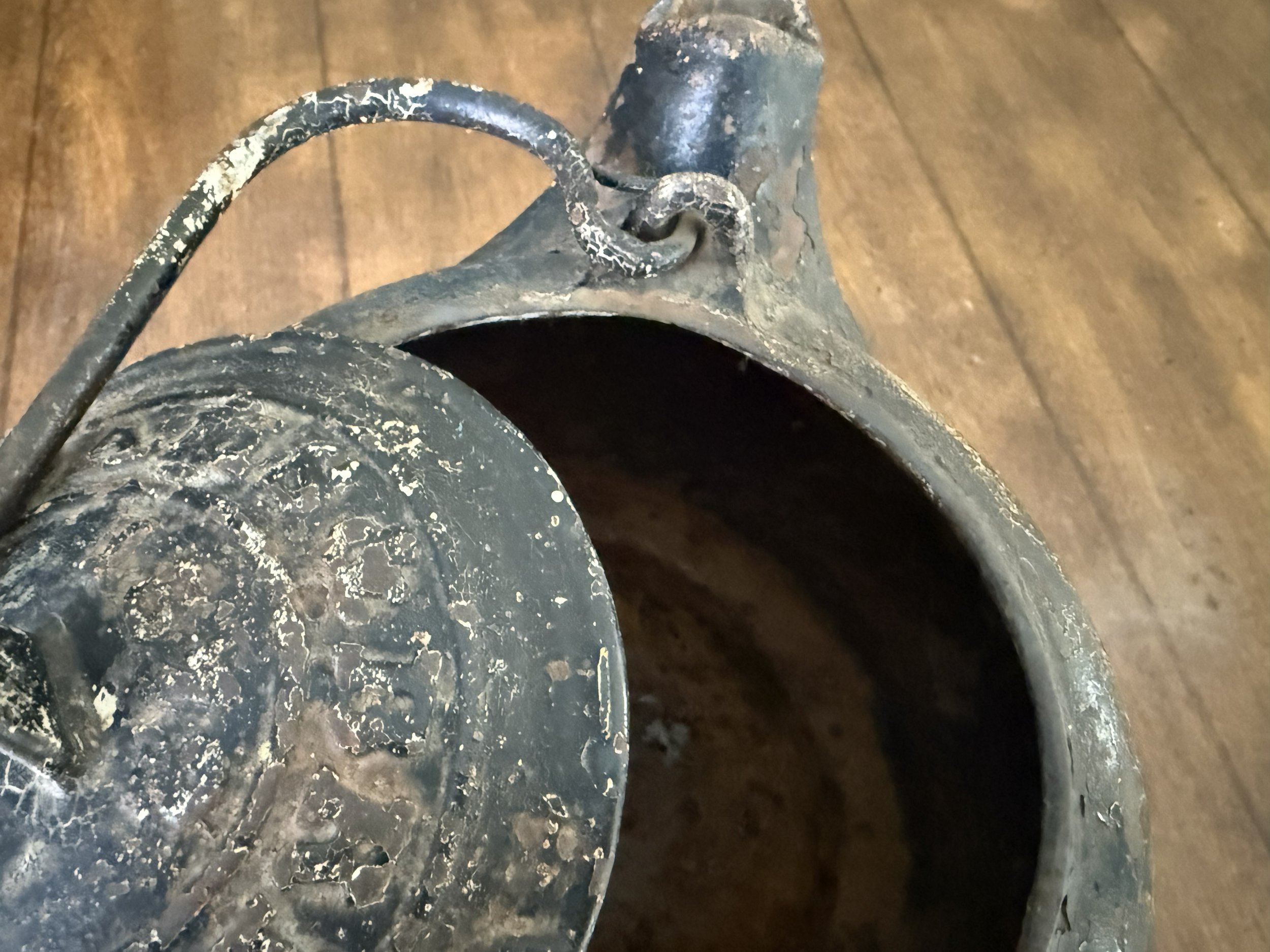
Lid-open view showing the interior of the kettle body and the underside of the hinged griddle lid. The bail handle attachment points—cast lugs with forged wire bail—are visible on the rim. The lid hinge mechanism allows the lid to swing open for filling. The interior shows the heavy casting walls and the wear patterns of a kettle that saw regular stove-top service.
Piece Details
Manufacturer
Adams & Britt, Cincinnati, Ohio
Piece Type
Cast Iron Stove Kettle Griddle (kettle with hinged griddle lid)
Form
Round stove kettle with flat bottom, pour spout, forged wire bail handle, and hinged griddle lid with raised markings
Material
Cast Iron (body and lid), Wrought Iron (bail handle)
Marking
“ADAMS & BRITT” and “CINCINNATI” in raised letters on lid; date of 1872
Purpose
Dual-purpose stove-top kettle for boiling water and griddle cooking; designed to sit in a stove-eye opening
Date of Manufacture
1872 (date cast on lid)
Place of Manufacture
Cincinnati, Hamilton County, Ohio
Condition
Fair to Good — legible company name, city, and date on lid; bail handle intact; pour spout intact; hinge functional; old black paint/japanning with wear consistent with stove-top use; interior shows service wear; corrosion hole in bottom (approx. ½” x ¼”) from extended stove-top use — consistent with iron thinning from prolonged heat and moisture exposure
Acquisition Date
March 13, 2026
Acquisition Source
eBay — Seller: pefa-87
eBay Item Number
127291783301
Order Number
24-14353-86784
Purchase Price
$250.00 item + $25.75 shipping + $23.37 tax = $299.12 total
SSC Catalog Number
SSC-ADAMSBRITT-KTL-1872-001
Collection Designation
Ohio Foundry Corridor
Corporate Timeline: Adams & Britt
c. 1860s–1870s
Adams & Britt established in Cincinnati, Hamilton County, Ohio, as a hollow ware partnership manufacturing tea kettles, stove kettles, and griddle lids. The firm operates within Cincinnati’s dense foundry district alongside W.C. Davis & Co., W. Resor & Co., Perin & Gaff Mfg. Co., L. Massman & Son, and other stove and hollow ware manufacturers.
1872
This stove kettle griddle is manufactured, carrying the date “1872” cast into the lid alongside the company name and city. This is the same year W.K. Boal begins acquiring the W.C. Davis stove foundry, signaling the beginning of Cincinnati’s foundry consolidation era.
c. 1870s–1880s
The Adams & Britt partnership evolves into or is succeeded by Britt & Folger of Cincinnati—a related firm involving the same Britt family principal. Both firms are documented in the WAGS Society foundry database as manufacturers of tea kettles from Cincinnati.
Late 19th c.
Both Adams & Britt and Britt & Folger cease operations. Neither firm appears in later foundry directories or collector references beyond the WAGS cross-reference entry. The companies are known today almost exclusively through surviving marked pieces.
Cincinnati’s Hollow Ware Ecosystem in 1872
The SSC collection now documents a growing number of Cincinnati manufacturers, each operating in the same city during the same era but serving different corners of the market. W. Resor & Co. made waffle irons and tea kettles. Perin & Gaff Manufacturing Co. produced a four-hundred-page catalog of general hardware including bells, pulleys, sad irons, and fluting machines. Kingery Manufacturing Company made ice cream scoops, peanut roasters, and food-service equipment. John David Browne patented broom heads and apple parers. And now Adams & Britt adds another node to the network: a small hollow ware partnership casting stove kettles and griddle lids for Cincinnati’s domestic market.
Together, these pieces document a city that was not defined by a single foundry or a single product line. Cincinnati’s iron industry in the 1870s was a diverse ecosystem of dozens of small and medium partnerships, each casting iron for a different purpose, each serving a different customer, and each leaving its name on the pieces it produced. The stove kettle griddle from Adams & Britt is one more piece of that ecosystem—one more marked artifact from a city that was building the material infrastructure of American domestic life, one casting at a time.

Bottom view of the kettle showing the flat base designed to sit in a stove-eye opening. Surface wear and residue consistent with extensive stove-top use. A corrosion hole is present in the bottom — the result of iron thinning from decades of direct heat and moisture contact during regular stove-top service. Faint markings or size numbers may be present but are largely obscured by age and use. The flat bottom and flanged rim are characteristic of hollow ware designed for the wood-burning and coal-burning cooking stoves of the 1870s.
Why This Piece Matters
The Adams & Britt cast iron stove kettle griddle matters because it is the primary evidence that this company existed. There are no surviving catalogs. There are no known advertisements. There are no digitized city directory entries. The WAGS Society foundry database lists Adams & Britt of Cincinnati as a maker of tea kettles and cross-references it with Britt & Folger—and that is the extent of the written record. Everything else we know about this company comes from the physical objects that carry its name.
This stove kettle griddle is one of those objects. It carries the full company name—“ADAMS & BRITT”—and the city—“CINCINNATI”—and the date—“1872”—all cast in raised letters on the lid. It is a dated artifact from a documented Cincinnati hollow ware maker, produced in the same year that the city’s foundry industry was beginning the consolidation that would transform small partnerships into larger corporate operations. It is the kind of piece that, without a museum to hold it and a researcher to document it, would simply disappear—taking the evidence of Adams & Britt’s existence with it.
Two hundred and fifty dollars on eBay. A heavy iron kettle with a name on the lid and a hole worn through the bottom — evidence of the decades it spent on a stove doing exactly what it was built to do. The hole does not diminish the piece; it confirms its life. It is the only proof that Adams & Britt of Cincinnati cast iron in 1872, and it is now in a collection that will make sure that proof endures.
The iron endures. The markings tell the truth. The story deserves to be told.
Sources & Further Reading
Physical examination of piece: Adams & Britt cast iron stove kettle griddle with hinged griddle lid, bail handle, and pour spout. Lid marked “ADAMS & BRITT” and “CINCINNATI” with date of 1872 in raised cast letters.
WAGS (Wagner and Griswold Society) Foundry Database (wag-society.org) — “ADAMS & BRITT CIN’ O. (see BRITT & FOLGER CIN’ O.)” and “BRITT & FOLGER CIN’ O. — (see ADAMS & BRITT CIN’ O.) tea kettles.” Cross-referenced entries documenting both Cincinnati firms as tea kettle manufacturers.
Cast Iron Collector Foundry Database (castironcollector.com) — Compiled by Steve Stephens. General reference for obscure and lesser-known American cast iron hollow ware producers.
Cast Iron Historical Society (cihist.wordpress.com) — “United States Stove Industry” finding aid. Documents Cincinnati stove foundry catalogs including W.C. Davis & Co. (1872) and Wm. Resor & Co. (1878) at various library collections.
SSC Internal Collection Records — Cincinnati manufacturer pieces: Perin & Gaff Mfg. Co. (SSC-PG-FLT-KNOX-001, SSC-PG-PLY-1876-001), W. Resor & Co. (SSC-RESOR-WAF-1880-001), Kingery Mfg. Co. (SSC-KINGERY-SCP-1894-001), John David Browne (SSC-BROWNE-BRM-1865-001).
About Steve’s Seasoned Classics
Steve’s Seasoned Classics is an online museum dedicated to preserving and documenting the heritage of American cast iron, with a focus on Ohio foundry pieces from the 19th and early 20th centuries. The SSC collection features over 130 pieces with detailed provenance, historical research, and photography for each item.
