Wagner Ware Krusty Korn Kobs Junior Cornbread Pan — Pattern 1319
STEVE'S SEASONED CLASSICS
An Online Museum of American Cast Iron Heritage
stevesseasonedclassics.com
Wagner Specialty & Variant Collection · Baking Pans & Specialty Forms
Wagner Ware Krusty Korn Kobs
Junior Cornbread Pan — Pattern 1319
Pat'd July 6, 1920 · Wagner Manufacturing Co., Sidney, Shelby County, Ohio
SSC-WAG-CBP-JR-KKK-067
Base / Bottom
BOTTOM
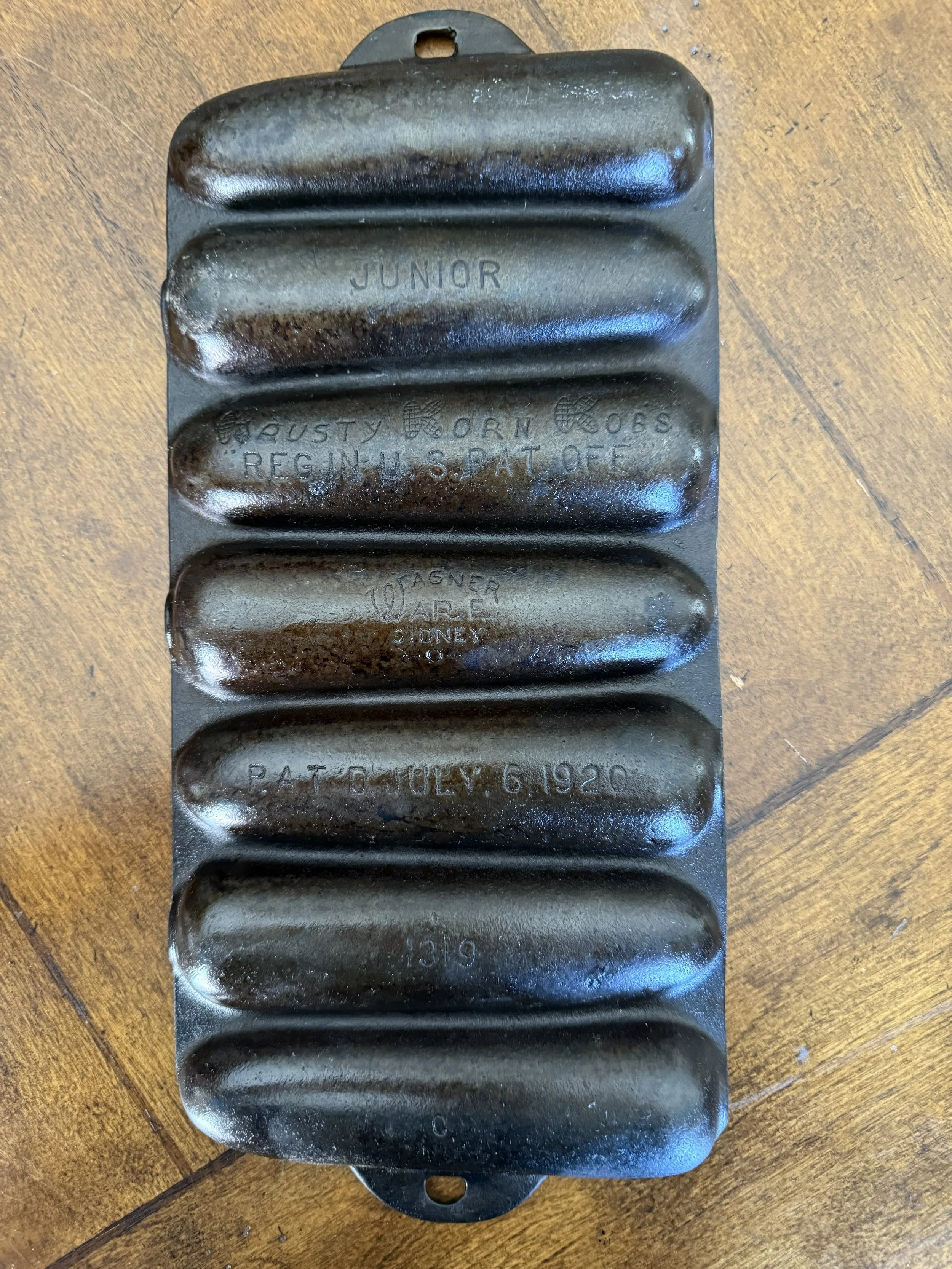
Base of the Wagner Ware Krusty Korn Kobs Junior cornbread pan showing the complete and extraordinary marking suite cast across the back surface. Reading from top to bottom: JUNIOR at the top, identifying this as the smaller of the two Krusty Korn Kobs configurations; KRUSTY KORN KOBS in bold cast letters with decorative K flourishes — the registered trade name for Wagner's corn stick pan line; REG IN U.S. PAT OFF confirming trademark registration; the full Wagner Ware / Sidney-O stylized mark in the center with WAGNER WARE in stylized script with shared W, WARE below, SIDNEY below that, and -O- below that — all elements legible; PAT'D JULY 6 1920, the specific patent date establishing the design's legal protection and providing a precise terminus post quem for production; pattern number 1319 at the lower base; and a small C mark below the pattern number. Two hang holes are cast at the top and bottom of the pan for vertical wall display. The entire back surface is deep, even, dark — excellent seasoned patina with no pitting, no cracks, no repairs. Every marking element is clear and fully legible. This is one of the most completely documented bases in the SSC collection.
Top / Interior — Cavity Detail
TOP / INTERIOR
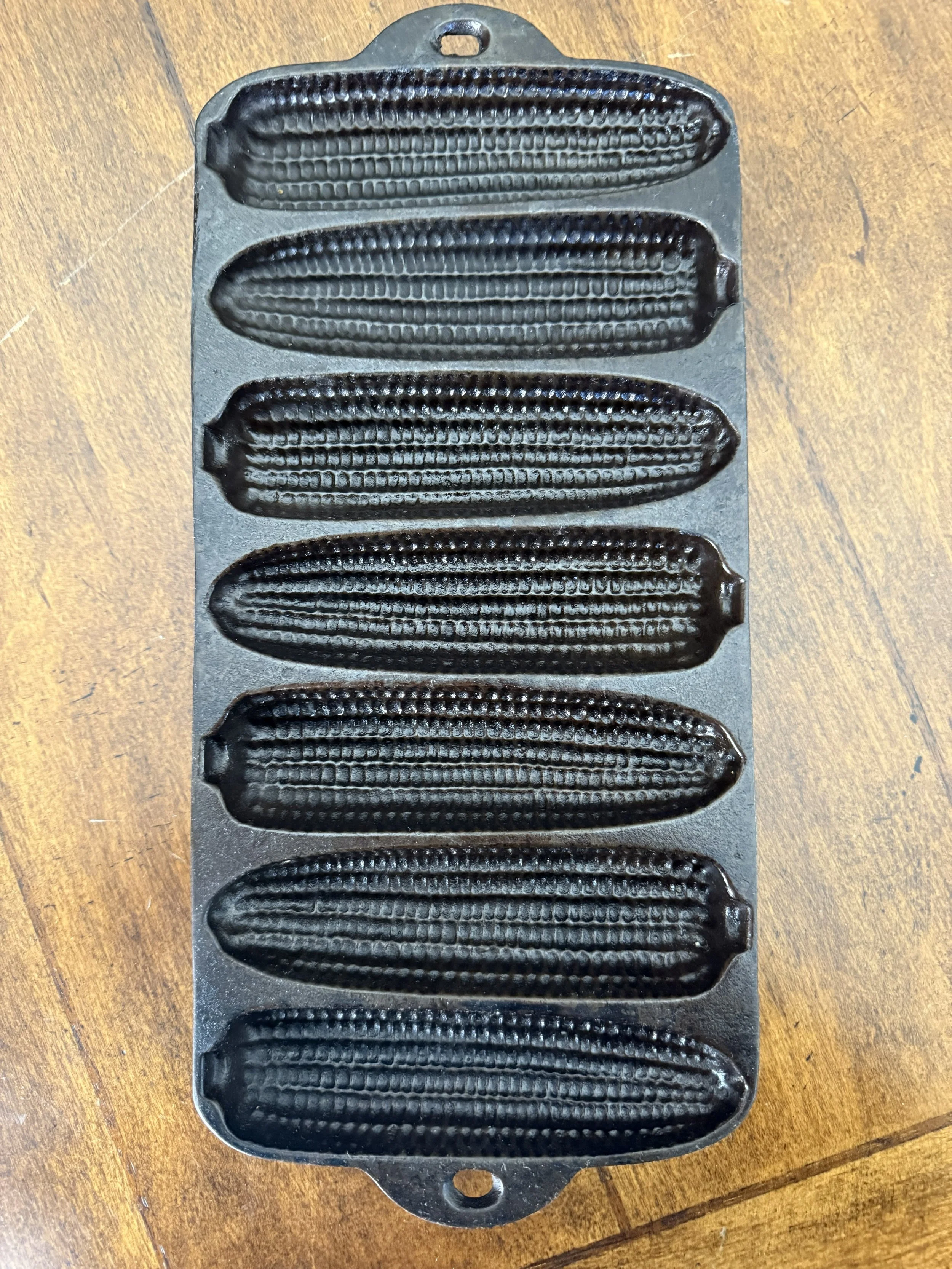
Top view of the Wagner Ware Krusty Korn Kobs Junior showing all seven corn stick cavities in exceptional condition. Each cavity is cast in the form of a miniature ear of corn — elongated oval with pointed ends, the interior surface covered in rows of precisely cast kernel texture that replicates the surface of an actual corn cob in extraordinary detail. The kernel casting is sharp, deep, and consistent across all seven cavities — no wear, no fill, no loss of definition. The casting quality on this pan is among the finest in the SSC collection: every kernel row is distinct, every cavity is clean and sound, and the deep black seasoned surface throughout the interior confirms decades of careful use and preservation. Small dividing ridges separate each cavity from the next, cast cleanly into the frame. The two hang holes at top and bottom are fully intact. The overall surface is deep black matte throughout — no rust, no pitting, no structural concerns. This pan is display and use ready at the highest standard.
Specimen Data
Mark: Wagner Ware / Sidney-O — full stylized script mark with shared W, WARE, SIDNEY, -O- all present and legible
Trade Name: KRUSTY KORN KOBS — registered trade name, REG IN U.S. PAT OFF confirmed on base
Size: JUNIOR — smaller of the two Krusty Korn Kobs configurations; 7-cavity
Pattern: 1319 — confirmed from base photograph
Patent Date: PAT'D JULY 6 1920 — precise production terminus post quem
Additional Mark: Small C mark below pattern number 1319
Cavities: 7 — each cast in full corn cob relief with detailed kernel texture
Features: Two hang holes (top and bottom); dividing ridges between cavities; full corn cob relief casting throughout
Condition: Excellent — all markings fully legible, all seven cavities sharp with complete kernel detail, deep black seasoned patina throughout, no rust, no cracks, no repairs, display and use ready
Acquisition: ShopGoodwill — Goodwill Industries of Southern Arizona — Item #246530241 — Order #58504107 — Nov 8, 2025
Collection: Wagner Specialty & Variant Collection
Catalog No.: SSC-WAG-CBP-JR-KKK-067
The Krusty Korn Kobs: Wagner's Signature Specialty Pan
The Krusty Korn Kobs cornbread pan is one of the most recognized and beloved specialty forms in the American cast iron collecting tradition — and for good reason. Wagner Manufacturing Company developed and patented the design on July 6, 1920, and the result was a pan that did something no other cornbread form had achieved: it put the corn back in cornbread. The corn stick cavity — an elongated oval cast in the precise relief of a miniature ear of corn, kernel row by kernel row across the entire baking surface — was both a functional baking form and a presentation statement. Cornbread baked in the Krusty Korn Kobs came out looking like what it was made from.
The name itself is a product of the era's marketing sensibility — alliterative, memorable, slightly whimsical, and entirely accurate. Krusty described what cast iron does to a batter surface better than any other single word: the iron's heat retention and even distribution produced a crust on every surface of the corn stick that a baking sheet or a muffin tin could never replicate. Korn Kobs identified both the ingredient and the form simultaneously. The registered trademark, confirmed on the base of this piece with REG IN U.S. PAT OFF, protected the name and the design as Wagner's intellectual property — a significant investment that signals how seriously the company regarded this pan's commercial potential.
Wagner produced the Krusty Korn Kobs in two configurations: the standard size and the Junior. This piece is the Junior — the smaller of the two, with seven cavities rather than the larger pan's configuration. The Junior was sized for individual serving portions and smaller ovens, bringing the Krusty Korn Kobs into kitchens where the full-size pan would have been impractical. Pattern 1319 identifies this specific variant in Wagner's production catalog.
The patent date of July 6, 1920, is one of the most precisely documented production markers in the Wagner specialty line. Unlike pieces that can only be dated to broad era ranges based on mark configuration, the Krusty Korn Kobs carries its own date on its base — a fixed point in the historical record that places the design's legal beginning at a specific moment in American culinary history. Production continued well beyond the patent date, but 1920 establishes the earliest possible manufacturing date for any piece carrying this mark configuration.
The Casting: Kernel by Kernel
The corn cob relief casting on the Krusty Korn Kobs Junior is a technical achievement that deserves specific documentation. Each of the seven cavities replicates the surface of a corn ear in three-dimensional detail — not a simplified or stylized corn shape, but actual kernel rows, each kernel individually defined, running the full length of the cavity in the precise arrangement of a real ear of field corn. The pointed ends of each cavity match the tapered tip and base of an actual cob.
Achieving this level of detail in cast iron required pattern work of exceptional precision. The foundry pattern — the positive form from which the sand mold was made — had to capture every kernel and every row accurately enough that the final casting in iron would reproduce the detail faithfully. At production volume, maintaining that pattern quality required careful oversight and periodic pattern replacement as the working patterns wore. The fact that this Junior pan shows sharp, complete, unworn kernel definition across all seven cavities indicates either careful use and preservation, later production from a fresh pattern, or both.
The deep black seasoned interior visible in the top photograph is the other half of what makes this pan exceptional. A well-seasoned Krusty Korn Kobs is a non-stick surface in every kernel valley and ridge — the accumulated seasoning filling and protecting the finest details of the cast relief. This piece has been maintained to that standard. The kernel detail is preserved, the seasoning is intact, and the pan is ready to produce corn sticks as good as any it produced in the first decades after its 1920 patent.
Corporate Timeline: Wagner Manufacturing Co.
1891 Milton and Bernard Wagner found Wagner Manufacturing Company in Sidney, Shelby County, Ohio. Cast iron hollow ware production begins.
c. 1914 Wagner begins designating cookware as WAGNER WARE. Brand identity formalizes.
c. 1922 The stylized WAGNER WARE script logo with shared W appears — the mark carried by this pan.
July 6, 1920 Patent issued for the Krusty Korn Kobs corn stick pan design. Production of the Krusty Korn Kobs line begins. PAT'D JULY 6 1920 appears on all pieces in the line.
c. 1920–1952 Krusty Korn Kobs production continues through the Sidney period. Both Junior and standard sizes produced. Pattern 1319 assigned to the Junior configuration.
c. 1924 4-digit pattern numbers introduced across the Wagner product line. Pattern 1319 documented for the Krusty Korn Kobs Junior.
1952 Wagner Manufacturing Company acquired by General Housewares Corporation. Independent Wagner family operation in Sidney, Shelby County, Ohio ends.
1957 GHC acquires Griswold of Erie, Pennsylvania. The independent foundry era is over.
Why This Piece Matters
The Wagner Ware Krusty Korn Kobs Junior matters to the SSC collection for three reasons that compound on each other.
First, it is one of the most completely marked pieces in the collection. The base carries the full Wagner Ware Sidney-O mark, the registered trade name, the patent date, the pattern number, the JUNIOR size designation, and a small foundry mark — more documentation cast into a single piece of iron than almost any other item in the SSC inventory. For a museum dedicated to documentation and provenance, this pan is a researcher's gift.
Second, the patent date of July 6, 1920, connects this piece to a specific moment in American culinary and manufacturing history. Cast iron specialty baking forms were a significant product category for Wagner in the 1920s and 1930s — the period between the wars when American domestic cooking was at its most cast-iron-dependent, before aluminum, before non-stick, before the plasticization of the American kitchen. The Krusty Korn Kobs was Wagner's answer to a specific cultural appetite for cornbread at the American table, and the patent represents the company's confidence in the design's commercial value.
Third, the acquisition cost of $26.00 from ShopGoodwill — $7.99 for the pan itself — is a number that belongs in the SSC record not as a curiosity but as documentation of how museum-quality cast iron still moves through the secondary market. A piece carrying a patent date, a registered trademark, a complete Wagner Ware mark, and seven perfectly sharp corn cob cavities in excellent condition arrived from a Goodwill auction for less than the cost of a modern cornbread mix. The iron endures. The market occasionally forgets. The SSC collector was paying attention.
Sources & Further Reading
David G. Smith and Chuck Wafford — The Book of Wagner & Griswold. Collector reference for Wagner Manufacturing Company production history, specialty pan documentation, and Krusty Korn Kobs pattern identification.
United States Patent Office — Patent records for cast iron corn stick pan designs, July 1920. Patent date confirmed from base marking.
Wagner Manufacturing Company historical records — Sidney, Shelby County, Ohio. Specialty pan product line documentation including the Krusty Korn Kobs Junior and standard configurations.
SSC Internal Collection Records — Wagner Specialty & Variant Collection; Ohio Foundry Corridor collection documentation.
About Steve's Seasoned Classics
Steve's Seasoned Classics is an online museum dedicated to preserving and documenting the heritage of American cast iron cookware, with a focus on Ohio foundry pieces from the 19th and early 20th centuries. The SSC collection features over 60 pieces with detailed provenance, historical research, and photography for each item.
