M. Hose & Lyon Cast Iron LadlePatented Smelting & Pouring Ladle — PAT'D AUG. 15, 1871
STEVE'S SEASONED CLASSICS
An Online Museum of American Cast Iron Heritage
stevesseasonedclassics.com
Ohio Foundry Heritage Collection · Patent Era
M. Hose & Lyon Cast Iron Ladle
Patented Smelting & Pouring Ladle — PAT'D AUG. 15, 1871
PAT'D AUG. 15, 1871 · M. Hose & Lyon · Dayton, Montgomery County, Ohio
SSC-HL-LADLE-1871-001
Top / Overhead
TOP

Top and overhead view of the M. Hose & Lyon patented cast iron smelting ladle showing the full form of the piece. The bowl is a deep, flared cup configuration — wider at the rim than at the base — with three symmetrically placed pouring spouts projecting outward at the rim at equal intervals around the circumference. This three-spout design is the primary patented feature of the Hose & Lyon ladle, allowing the operator to orient any one of the three spouts toward the target vessel without rotating the ladle in the hand — a practical improvement in the smelting and lead-pouring trades. The bowl interior is deep and even with a slight concave profile at the center bottom, appropriate for liquid metal retention. The handle extends from the bowl rim at a functional angle and terminates in a closed oval hanging loop — the full handle carrying the maker's mark in embossed lettering. The surface throughout carries even dark patina consistent with age and heat exposure. Structurally sound with no cracks, chips, or breaks visible from above. Iron is honest.
Handle Detail
HANDLE DETAIL
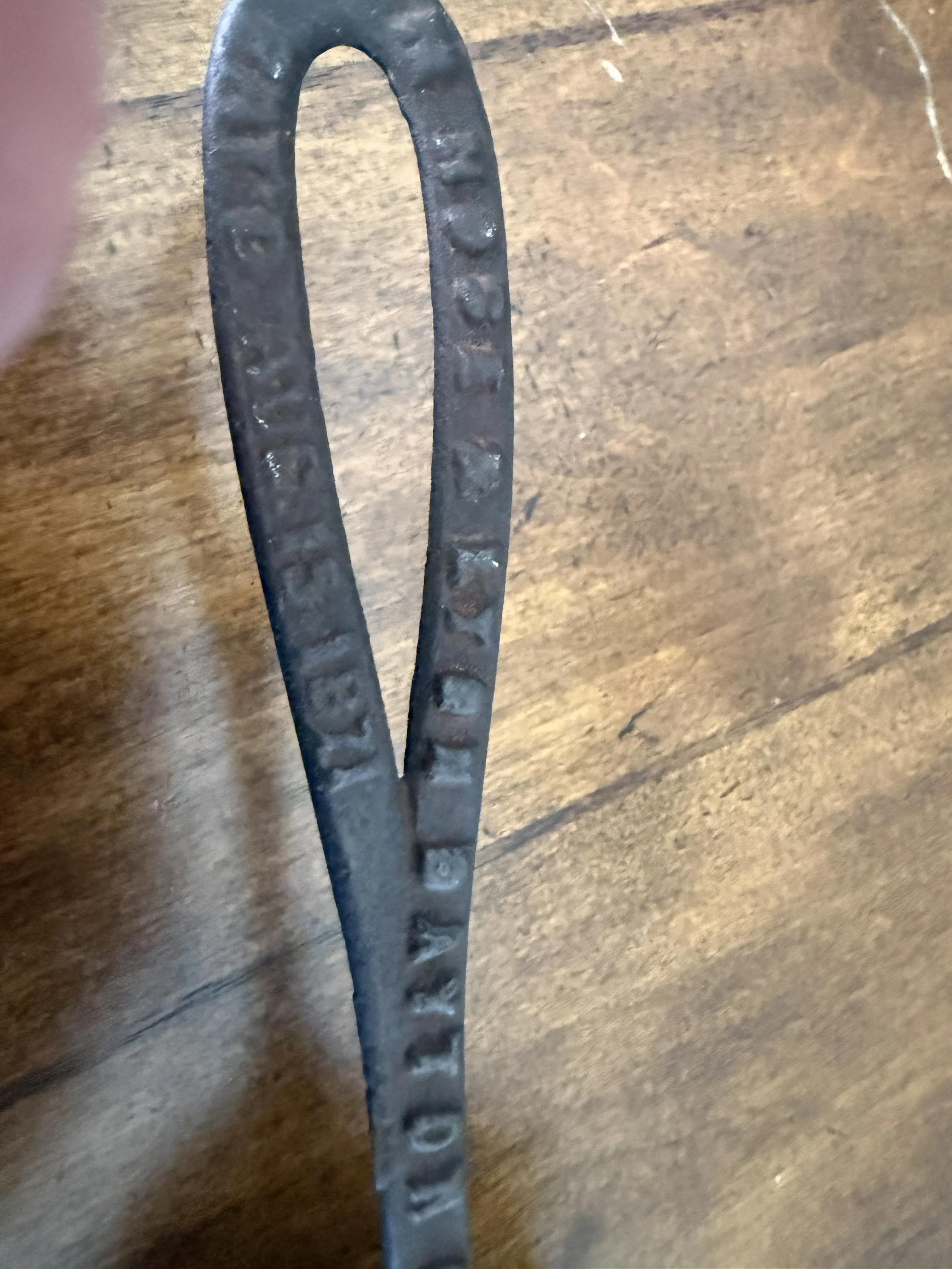
Close-up of the embossed handle mark — the primary identification feature of this patented ladle. The cast lettering runs the full length of the handle in raised block capitals reading: M HOSE & LYON / DAYTON O / PAT'D AUG 15 / 1871. The text is distributed across the flat handle surface from the bowl junction up through the oval loop at the top, wrapping continuously around both the inner and outer faces of the loop. The casting of the lettering is precise and legible — individual characters are well-defined and the spacing is consistent, indicating a properly made production mold rather than a hand-stamped or improvised mark. The loop terminus is a smooth closed oval with no casting seams at the tip, consistent with a well-maintained production pattern. Handle surface carries dark iron patina with minor surface oxidation at the transitions — no active rust, no structural compromise. The mark reads clearly: this piece is definitively identified as a product of M. Hose & Lyon of Dayton, Ohio, patented August 15, 1871.
Bottom / Base
BOTTOM

Base view of the M. Hose & Lyon smelting ladle showing the underside of the bowl form. The bowl base is slightly convex and unfinished — consistent with sand-cast production practice of the period, where the bottom face received no machining after casting. The three pour spout projections are visible at the bowl perimeter in this view, confirming the equidistant spacing of the patented triple-spout configuration. The base surface carries iron patina and oxidation variation typical of age and heat cycling. No cracks, no repairs, no structural anomalies are present. The wall thickness at the bowl base is substantial — appropriate for a vessel designed to hold molten lead, solder, or other metals at working temperatures. The handle connection to the bowl rim is clearly visible in profile, showing the cast junction between the handle shank and the outer bowl wall. Authentication confirmed: form, mark, and construction are consistent throughout.
Specimen Data
Mark: PAT'D AUG. 15, 1871 — embossed on handle running full length and loop: M HOSE & LYON / DAYTON O / PAT'D AUG 15 / 1871
Patent Date: August 15, 1871 — cast date mark; U.S. Patent Office record; patent number not confirmed in surviving records
Form: Smelting / pouring ladle — deep flared cup bowl with three equidistant pour spouts; closed-loop hanging handle
Features: Three cast pour spouts at bowl rim; full-length embossed handle mark; closed oval hanging loop; deep smelting cup form
Dimensions: Approximately 11" overall length; 3¾" bowl diameter; 2½" bowl depth (per period eBay/WorthPoint reference examples)
Bowl Profile: Flared cup — wider at rim than base; slight concave bowl interior; three spouts projecting outward at rim
Handle: Flat bar handle tapering to closed oval loop; full-length maker's mark embossed on handle faces
Condition: Unrestored — even dark iron patina throughout; minor surface oxidation; structurally sound; no cracks, no breaks, no repairs
Date: 1871 — patent date cast into handle; production period c. 1871 forward
Acquisition: eBay — Seller: morgantrailgunstuff — Item #267400104199 — Order #24-13890-79866 — Nov 28, 2025 — $49.95 + $10.00 shipping (USPS Ground Advantage) + $5.08 tax = $65.03 total
Collection: Ohio Foundry Heritage Collection
Catalog No.: SSC-HL-LADLE-1871-001
The Smelting Ladle: Form and Function
The cast iron smelting ladle is one of the oldest and most elemental tools in the metalworking tradition — a vessel designed for a single, unforgiving purpose: to move liquid metal from a crucible or melting pot to a mold, a joint, or a target surface, safely and accurately, at temperatures that would destroy any lesser material. Understanding this piece requires understanding the trades it was built for and the specific problem its patented design was engineered to solve.
In the mid-19th century, liquid metal handling was a daily operation across a wide range of American trades. Plumbers worked with molten lead to seal pipe joints — the original meaning of the word 'plumbing' derives from plumbum, the Latin for lead. Blacksmiths and foundrymen poured liquid iron and bronze into molds. Gunsmiths and ammunition manufacturers cast bullets and shot from lead melted in small iron pots over forge fires. Tinners and solderers used low-temperature alloys that required precise, controlled pouring. In every one of these trades, the ladle was the critical interface between the molten metal and its destination — and the quality of that pour determined the quality of the work.
The standard smelting ladle of the mid-19th century was a simple form: a bowl on a handle, typically with a single pouring spout. To direct the pour, the operator had to rotate the ladle in the hand or move the entire tool — an awkward operation when working over an open flame with liquid metal at several hundred degrees. The M. Hose & Lyon patented design addressed this limitation directly. By casting three equidistant pour spouts around the rim of the bowl, the Hose & Lyon ladle allowed the operator to orient any one of the three spouts toward the target without changing the grip or rotating the handle. The ladle could be held in a natural position and the nearest spout — whichever of the three best aligned with the work — became the functional pouring point. It was a practical, elegant solution to a real problem in the metal trades, and it was worth patenting.
This SSC specimen is that patented ladle — cast in Dayton, Ohio in 1871, marked with the full maker identification and patent date on its handle, and surviving in sound condition 154 years after the patent was granted. That survival, with the mark intact and legible, is the kind of primary-source documentation that makes industrial-era Ohio cast iron worth collecting and preserving.
Mark Analysis: The Hose & Lyon Patent Handle Configuration
The mark on this ladle is not a maker's mark applied to a cookware bottom — it is a patent mark cast directly into the functional handle of an industrial tool, designed to be read in the hand of the tradesman who used it. That distinction matters. This piece was not made for a domestic kitchen catalog. It was made for a working man's shop, and the Hose & Lyon name and patent date were cast into the handle so that every user, every buyer, and every competitor would know exactly who made it and when the design was protected.
The embossed lettering runs the full length of the flat handle bar and continues around the interior and exterior faces of the closed oval loop at the top — a generous allocation of casting surface to the maker's identification. The text reads M HOSE & LYON / DAYTON O / PAT'D AUG 15 / 1871 in raised block capitals. The casting quality is good — letters are well-defined and consistent, the spacing is even, and the mark has survived the piece's working life and subsequent age without significant degradation. This is a production mold in good condition, not a worn-out or damaged casting.
The 'M. Hose & Lyon' partnership name identifies the two principals of the Dayton operation. The 'M.' initial most likely refers to a principal with a first name beginning with M — possibly connected to the Dayton iron trade families active in Montgomery County in the 1860s and 1870s. Lyon is the partner surname. The Dayton designation confirms Montgomery County, Ohio production. The patent date of August 15, 1871 represents a formal U.S. Patent Office grant — a protective measure that gave Hose & Lyon the exclusive right to manufacture and sell this three-spout ladle design in the United States for seventeen years from the date of issue.
Secondary market records on WorthPoint and eBay confirm that multiple examples of this ladle exist in collector circulation, all bearing the same handle mark and the same three-spout bowl configuration. This is not a one-off casting but a genuine production run — evidence that the Hose & Lyon operation sold this design in commercial quantities to the trades it served. The SSC acquisition represents the most thoroughly documented example of this maker now in a museum collection context.
Dayton, Ohio: The Patent City and Its Foundry Trade
Dayton, Montgomery County, Ohio, was not a city that came to manufacturing gradually. By the 1870s — the decade in which M. Hose & Lyon received their patent — Dayton was already established as one of the most intensely inventive industrial cities in the United States. According to the National Park Service, citing U.S. Patent Office records, Dayton registered more patents per capita than any other American city around the turn of the 20th century. That density of invention did not emerge from nowhere in 1900 — it had been building throughout the preceding decades, in precisely the era when Hose & Lyon were doing their work.
The foundation of Dayton's industrial character was the Miami and Erie Canal, completed in 1829, which connected the city to Cincinnati to the south and eventually to Lake Erie to the north. The canal made Dayton a transit point for raw materials and finished goods, and the industries that grew up around it — mills, foundries, machine shops, hardware manufacturers — formed the base on which the later industrial giants were built. By the time NCR was founded in 1884 and the Wright brothers were tinkering with bicycles in the 1890s, Dayton's foundry and machine shop culture was already two generations deep.
In the 1860s and 1870s, Dayton's industrial inventory included iron foundries, stove works, agricultural implement manufacturers, and metalworking shops serving the railroad, construction, and building trades. M. Hose & Lyon operated within this ecosystem — a partnership producing cast iron tools for the metal trades, with enough confidence in their patented design to pursue formal patent protection in 1871. The Dayton foundry district that supported their operation was the same environment that would later produce the Platt Iron Works, Kramer Brothers Foundry, Dayton Malleable Iron, and dozens of other metal trade operations that built the city's industrial reputation.
Ohio's Miami Valley — the geographic region centered on Dayton — was iron country in the broadest sense. It was not the ore-and-blast-furnace iron of northeastern Ohio and Pennsylvania, but the precision casting and job shop iron of a manufacturing city: iron for railroads, for buildings, for plumbing, for hardware, and for the trades that used liquid metal every day. M. Hose & Lyon's smelting ladle was a product made for exactly that world.
Company Record: M. Hose & Lyon, Dayton, Ohio
c. 1860s–1870s M. Hose & Lyon operating as a foundry partnership in Dayton, Montgomery County, Ohio. Production of cast iron tools for the metal trades — smelting ladles, industrial implements, and related ironware for railroad, architectural, and trade applications.
August 15, 1871 U.S. Patent granted to M. Hose & Lyon for the three-spout cast iron smelting ladle design. Patent date cast into all production examples. Patent protection period: 17 years from grant date.
c. 1871 forward Commercial production and sale of the patented three-spout ladle. Multiple production examples confirmed in secondary market records. Sold to plumbers, gunsmiths, lead workers, foundrymen, and related trades.
c. 1888 Patent protection expires (17 years from August 15, 1871). Design enters public domain. Subsequent ladles of similar form produced by Dayton Malleable Iron Co. and other makers continue the three-spout configuration without the Hose & Lyon mark.
Post-1888 M. Hose & Lyon documentation trail ends in available records. Corporate successor, dissolution date, and ultimate fate of the partnership are not confirmed in currently available public records. SSC research ongoing.
Why This Piece Matters
The M. Hose & Lyon smelting ladle matters to the SSC collection for reasons that go beyond its physical survival and its legible mark. It is a primary-source document of Ohio's mid-19th century patent trade — evidence that the foundry culture of Dayton's Miami Valley was producing not just generic ironware but innovated, protected designs in the years immediately following the Civil War.
Most cast iron collections focus on cookware — the domestic forms that survived in the greatest numbers and remained useful as kitchen technology evolved. The smelting ladle is the industrial form: the tool of the tradesman rather than the housewife, the foundry floor rather than the kitchen hearth. When the trades it served were mechanized and transformed in the 20th century — when plumbing stopped using molten lead, when bullets were manufactured industrially rather than cast individually, when the small-shop foundry gave way to the production line — pieces like this ladle were retired and discarded. That so many examples survive is a testament to the durability of the iron itself and the completeness of the collector market that has preserved them.
This piece carries a formally granted U.S. patent date, a complete partner firm name, and a specific Ohio city designation — Dayton, O. — that places it precisely within the Ohio Foundry Corridor that SSC documents. It is 154 years old. It was made six years after the end of the Civil War, in a city that would go on to register more patents per capita than any other in America. The iron endures. The mark tells the truth. The trade it served is gone — but the tool that served it is here.
Sources & Further Reading
U.S. Patent Office Records — Patent date August 15, 1871. M. Hose & Lyon, Dayton, Ohio. Patent for triple-spout cast iron smelting ladle design. Note: 1871 Patent Office records partially destroyed in an 1877 fire; full specification may not be recoverable.
WorthPoint Price Guide — Secondary market documentation of M. Hose & Lyon ladle sales and identification records. Multiple confirmed examples with identical mark and three-spout configuration.
Dayton History / Carillon Historical Park — Dayton, Montgomery County, Ohio industrial and manufacturing heritage documentation. Heritage Center of Dayton Manufacturing and Entrepreneurship.
National Park Service — Patent per capita documentation for Dayton, Ohio c. 1900. Miami Valley industrial heritage context.
W.H. Beers & Co. — The History of Montgomery County, Ohio (1882). Primary source documentation of Dayton's 19th century industrial development.
Augustus Waldo Drury — History of the City of Dayton and Montgomery County, Ohio (1909). Dayton foundry district and manufacturing trade documentation.
SSC Internal Collection Records — Ohio Foundry Heritage Collection; Patent Era industrial cast iron documentation.
Steve's Seasoned Classics is an online museum dedicated to preserving and documenting the heritage of American cast iron cookware and industrial ironware, with a focus on Ohio foundry pieces from the 19th and early 20th centuries. The SSC collection features detailed provenance, historical research, and photography for each item.
