Akron Brass Mfg Inc — No. 10 Fireman’s Spanner Wrench
STEVE’S SEASONED CLASSICS
An Online Museum of American Cast Iron Heritage
stevesseasonedclassics.com
Ohio Foundry Corridor Collection · Industrial & Fire Service Cast Iron
Akron Brass Mfg Inc — No. 10 Fireman’s Spanner Wrench
Fire Hydrant & Hose Multi-Tool — Patent Feb. 24, 1925
Wooster, Wayne County, Ohio · c. 1925–1935 · Akron Brass Mfg Inc, Wooster, Ohio
SSC-ABM-SPW-10-001
Company Side
COMPANY SIDE

Company side of the Akron Brass Mfg Inc No. 10 spanner wrench showing the full manufacturer identification cast in raised relief along the body of the tool: AKRON BRASS MFG INC along the upper portion of the shank, WOOSTER OHIO along the lower. The lettering is clean, well-defined, and legible — cast in the confident capital letter style consistent with Akron Brass production from the Wooster era, post-1921. The tool is oriented in its compound S-curve profile, the form dictated entirely by its multi-function design: large hook jaw at one end for hydrant cap removal and valve operation, flat-blade pry tip at the opposite end, and mid-body spanner lug for hose coupling engagement. A hanging loop is cast at the large-jaw end for tool belt or apparatus mounting. The overall form is instantly recognizable to students of early 20th century fire service equipment — this is the standard Akron No. 10 configuration, the workhorse multi-tool of the American fire service in the 1920s through 1940s. Surface shows a consistent silver-gray cast iron patina with light age wear — honest working tool condition, no structural compromise.
Patent Side
PATENT SIDE
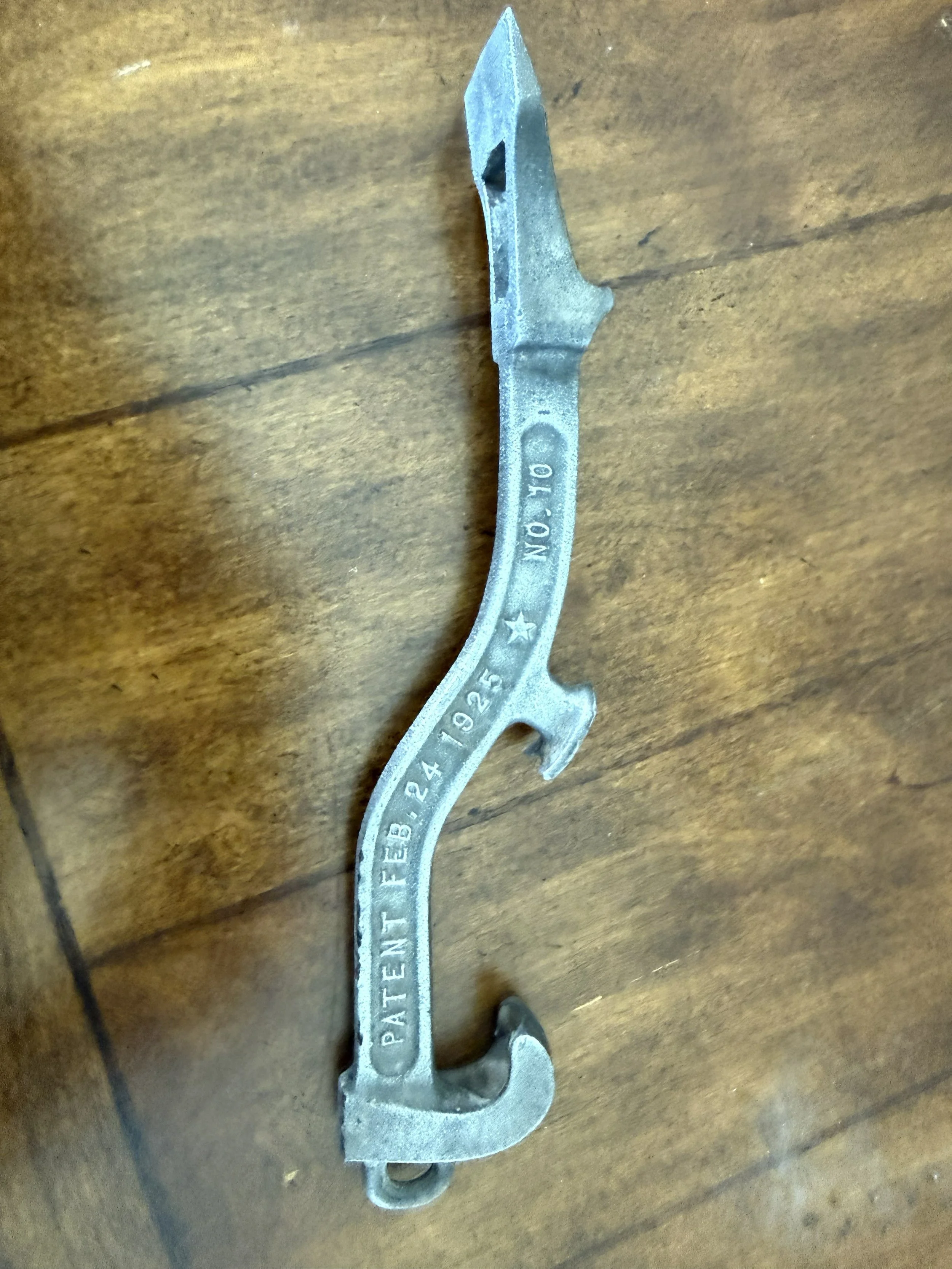
Patent side of the Akron Brass No. 10 spanner wrench showing the precise legal and product identification cast into the reverse face: PATENT FEB. 24 1925 reading along the shank with a decorative five-pointed star separator, NO. 10 at the upper body. The patent date — February 24, 1925 — is the definitive dating marker for this tool configuration, establishing both the design protection date and the earliest possible production date for pieces bearing this mark. The star separator between the patent date and the model number is a distinctive Akron Brass casting detail, a small decorative touch on an otherwise purely utilitarian object. The multi-function business end of the tool is fully visible from this orientation: the large hook jaw at the lower end, the mid-body spanner lug for hose coupling work, and the pointed pry tip at the upper end with its integrated slot for hydrant cap pin engagement. Surface condition on the patent side mirrors the company side — even, aged cast iron with no cracks, no breaks, no repairs. A structurally complete and honest example of early Akron Brass fire service production.
Specimen Data
Company Side:
AKRON BRASS MFG INC · WOOSTER OHIO — cast in raised relief along tool shank; full manufacturer identification
Patent Side:
PATENT FEB. 24 1925 ★ NO. 10 — patent date, decorative star separator, and model number cast in raised relief
Model:
No. 10 — Fireman’s Spanner Wrench / Fire Hydrant Multi-Tool
Patent Date:
February 24, 1925 — design patent; establishes earliest possible production date for this configuration
Form:
Compound S-curve cast iron multi-tool — large hook jaw (hydrant cap / valve); mid-body spanner lug (hose coupling); pointed pry tip (crowbar / pin engagement); hanging loop at jaw end
Material:
Cast iron — sand-cast; industrial fire service grade
Length:
Approximately 11 inches
Function:
Firefighting multi-tool — fire hydrant cap removal and replacement; hydrant valve operation; fire hose coupling engagement (spanner); pry / crowbar; door and debris clearance
Condition:
Unrestored — even silver-gray cast iron patina with light age wear; iron structurally sound; no cracks, no breaks, no repairs; honest working tool condition
Date:
c. 1925–1935 — patent date Feb 24, 1925; pre-incorporation Wooster production period (Akron Brass incorporated July 6, 1935)
Acquisition:
eBay — Seller: wiltro5660 — Item #167187851553 — Order #07-13899-73808 — Nov 28, 2025 — $10.00 + $9.51 shipping (USPS Priority Mail) + $1.65 tax = $21.16 total
Collection:
Ohio Foundry Corridor Collection — Industrial & Fire Service Cast Iron
Catalog No.:
SSC-ABM-SPW-10-001
The Fireman’s Spanner Wrench: Form, Function, and Fire Service Context
The fireman’s spanner wrench is one of the most purposefully engineered hand tools in the American industrial cast iron tradition. Unlike cookware, which was designed for domestic service and valued for the evenness of its heat retention, the spanner wrench was designed for emergency conditions — to be used fast, under pressure, in darkness or smoke, by a firefighter whose hands might be gloved and whose footing might be uncertain. Every feature of the No. 10’s form is a direct answer to a specific operational requirement.
The large hook jaw at one end is sized to engage standard fire hydrant cap lugs — the raised ears cast onto hydrant outlet caps that allow them to be threaded on and off under the substantial water pressure present in a charged main. The jaw geometry provides the mechanical advantage needed to break a cap free that may have been in place for months or years, corroded against its seat, with a full city water main pressing against it from the inside. The same jaw serves for valve wheel operation — engaging the operating nut on a hydrant or post valve to open or close water flow.
The mid-body spanner lug is the hose coupling engagement feature — the element that gives the tool its primary name. American fire hose couplings of the era used a rocker lug or pin lug system: a raised lug on the coupling swivel that a spanner wrench could engage to rotate and tighten or loosen the connection under the water pressure present in a charged hose line. Making a tight hose connection quickly, under pressure, in conditions where a loose coupling meant both a water loss and a potential injury hazard to anyone near the whipping line, required a tool that could provide positive engagement and mechanical advantage without slipping.
The pointed pry tip at the opposite end is the tool’s third functional identity: a pry bar and breaching tool. Firefighters entering burning structures in the 1920s and 1930s encountered wooden doors, sash windows, and light framing that could be overcome with a short pry bar. The No. 10’s tip provided that capability without requiring a separate tool on the belt. The slot or notch cut into the tip near the point provided engagement for the roll pins used on some hydrant cap designs. The hanging loop at the large-jaw end completed the tool’s working identity: it lived on the firefighter’s belt or on a hook on the apparatus, always within reach, never set down where it could be lost in the dark.
This is the complete functional logic of the No. 10 in a single cast iron form — hydrant work, hose work, and entry work, all in eleven inches of Ohio iron patented in 1925.
Akron Brass Mfg Inc: Company History and Ohio Heritage
The history of Akron Brass Mfg Inc is one of the cleaner corporate origin stories in the Ohio industrial record. In 1918, a group of employees from the B.F. Goodrich Rubber Company in Akron, Ohio formed the Akron Brass Manufacturing Company with a specific and well-timed purpose: to produce couplings for the rapidly expanding rubber-lined fire hose market. Rubber-lined fire hose had been displacing older woven and leather hose designs since the late 19th century, and the demand for quality brass couplings to connect hose sections and attach them to hydrant outlets and nozzles was growing with every year of urban expansion and fire department modernization across the country.
The company began production in a leased portion of an American cereal company building in Akron — a characteristically improvised start for a small manufacturer operating on limited capital in a leased space in another industry’s building. By 1921, the operation had outgrown those quarters and relocated to Wooster, Ohio, the county seat of Wayne County, approximately thirty miles southwest of Akron. The Wooster move placed Akron Brass in the heart of Ohio’s small manufacturing corridor — a region of county-seat industrial towns with access to railroad freight, skilled machinist labor, and the broader supply chain of the Ohio manufacturing economy.
The No. 10 spanner wrench in the SSC collection was made in Wooster, bearing the WOOSTER OHIO designation on its company side. With a patent date of February 24, 1925, and the Wooster address, this piece was cast in the pre-incorporation period — after the 1921 Wooster relocation but before the July 6, 1935 incorporation that formally constituted Akron Brass as a corporation. The AKRON BRASS MFG INC designation on the tool is therefore a slight anachronism in strict corporate terms: the “Inc” designation appears on pre-1935 castings as a common-usage corporate identifier even before formal incorporation, a practice not unusual for growing manufacturers of the era.
From the Wooster base, Akron Brass expanded continuously through the 20th century, eventually becoming a global leader in firefighting equipment with operations in over 75 countries. The 1967 introduction of the Turbojet Nozzle — the first combination fog nozzle giving the firefighter direct flow control from the nozzle itself — was an industry-defining innovation. The company remains headquartered in Wooster to this day, making it one of the longest-continuously-operating fire equipment manufacturers in the United States and one of the more durable corporate stories in the Ohio industrial record.
The No. 10 spanner wrench predates all of that growth. It is the early Wooster product — cast iron rather than the brass suggested by the company name, made for the daily operational needs of American fire departments in the decade when the internal combustion fire apparatus was displacing horse-drawn equipment and fire departments were standardizing their tools and hydrant connections across municipalities.
Wooster and Wayne County: Ohio’s Manufacturing Middle Ground
Wooster, Ohio occupies a distinctive position in the Ohio industrial geography. Located in Wayne County between the larger industrial centers of Akron and Canton to the north and east, and the agricultural heartland of central Ohio to the south and west, Wooster developed as a county-seat manufacturing town with a mixed economy of light industry, precision manufacturing, and agricultural services. The town’s population in the 1920s was in the range of 10,000 to 12,000 residents — large enough to support a skilled manufacturing labor force, small enough that a growing company like Akron Brass could be a significant local employer and community presence.
Wayne County’s location in the Ohio Foundry Corridor context is instructive. The SSC collection’s Ohio focus has documented the foundry traditions of Shelby, Mercer, and Auglaize counties to the west — the Sidney-Piqua-Wapakoneta axis — and the Lucas County industrial base of Toledo to the northwest. Wayne County represents the eastern edge of the Ohio manufacturing middle ground, where the rubber and automotive industries of Akron and the steel economy of Canton and Youngstown met the older cast iron and light manufacturing traditions of the interior. Akron Brass’s move from Akron to Wooster in 1921 followed the logic of that geography: lower costs, available space, proximity to the skilled trades, and railroad access to the regional distribution network.
The No. 10 spanner wrench was cast in this Wooster context, shipped to fire departments across Ohio and the broader Midwest, and put to work in the firehouses and on the apparatus of the era’s rapidly modernizing municipal fire services. It is an Ohio-made tool that served Ohio communities — and a document of the Wayne County industrial tradition that the SSC Ohio Foundry Corridor collection exists to preserve.
Cast Iron in the American Fire Service
The choice of cast iron for the No. 10 spanner wrench, from a company whose name advertises brass, is not a contradiction — it is a reflection of the material economics and performance requirements of fire service tool production in the 1920s. Brass was the premium material for water-contact components: couplings, nozzles, valves, and fittings where corrosion resistance, pressure integrity, and tight tolerances were essential. Cast iron was the appropriate material for hand tools where hardness, wear resistance, and low cost mattered more than corrosion resistance, and where the tool’s contact with water was incidental rather than continuous.
A spanner wrench lives on a belt or a hook, not in a water stream. It gets wet during operations, dried afterward, and put back in service. Cast iron handles that service cycle well, and its hardness makes it resistant to the impact and leverage loads that hydrant cap removal and hose coupling work impose. The weight of a cast iron tool in the 11-inch, approximately one-pound range is also appropriate for belt carry — substantial enough to feel like a real tool, not so heavy as to fatigue the wearer on long operations.
The S-curve compound form of the No. 10 is characteristic of cast iron tool design of the era — a form that would be difficult or expensive to produce in wrought iron or steel but that sand casting in gray iron handles efficiently and at low cost. The flowing curves that distribute the stresses of hook-jaw leverage along the tool’s full length, the integrated hanging loop, the cast-in spanner lug — these are sand casting solutions to functional problems, and they reflect the design maturity of an industry that had been solving similar problems in cast iron for decades before Akron Brass arrived.
Corporate Timeline: Akron Brass Mfg Inc
1918 — B.F. Goodrich Rubber Company employees form the Akron Brass Manufacturing Company in Akron, Ohio. Production begins in leased space in an American cereal company building. Initial product focus: couplings for the rubber-lined fire hose market.
1921 — Company outgrows Akron quarters and relocates to Wooster, Wayne County, Ohio. The WOOSTER OHIO designation on all subsequent castings dates from this move. Rapid expansion of product line to include hydrant wrenches, spanner tools, and fire service hardware.
February 24, 1925 — Patent date cast on the No. 10 fireman’s spanner wrench. Establishes this tool design as protected intellectual property. The SSC specimen was produced in the period following this patent grant, in the pre-incorporation Wooster production era.
July 6, 1935 — Akron Brass formally incorporates. High demand for expansion capital drives the incorporation decision. The company name and WOOSTER OHIO designation continue unchanged. Pre-1935 castings marked INC reflect common-usage corporate identification preceding formal incorporation.
1964 — Under Premier Industries ownership, facilities expanded with 24,000 sq ft on Spruce Street and 42,000 sq ft on Old Mansfield Road, Wooster. New $100,000 technology center established.
1965 — Introduction of the first electronically controlled aerial ladder fire fighting monitor, the Style 666 Ladder Pipe. Akron Brass moves from tool and fitting manufacturer toward systems engineering.
1967 — Introduction of the Turbojet Nozzle — the first combination fog nozzle providing firefighter-controlled flow directly from the nozzle. An industry-defining innovation that reshapes fire attack tactics across the American fire service.
1971–1972 — Self Locking Valve patent published (1971); Swing-Out Valve introduced (1972), becoming a North American fire apparatus valve industry standard.
Present — Akron Brass remains headquartered in Wooster, Ohio, operating as a global leader in firefighting equipment with presence in over 75 countries. One of the longest-continuously-operating fire equipment manufacturers in the United States.
Why This Piece Matters
The Akron Brass No. 10 spanner wrench matters to the SSC collection for the same reasons the Union Mfg Co cover plate and the Sidney Hollowware Co skillet matter: it is a marked Ohio piece from a documented Ohio manufacturer, and it extends the collection’s documentation of Ohio’s industrial cast iron production beyond the familiar cookware forms.
But this piece carries something the cover plate does not: a known corporate history with a clear origin date, a specific patent record, and a manufacturer that survived and grew into a global company still operating today from the same Wayne County, Ohio base. The No. 10 is not an orphan piece from an undocumented foundry. It is an early product from a company whose complete arc — from a leased cereal factory floor in Akron in 1918 to fire service equipment in 75 countries today — is part of the documented Ohio industrial record.
The patent date of February 24, 1925 places this tool in the earliest years of Akron Brass’s Wooster operation. A fire department in Wayne County, Summit County, or any of the dozens of Ohio municipalities served by Akron Brass in the 1920s would have had examples of this exact tool on every piece of apparatus. Ohio firefighters pulled hydrant caps with it, made hose connections with it, and pried doors with it. The tool did its work, retired from service, and entered the secondary market where the SSC collection found it.
The iron endures. The Wooster mark confirms the Ohio origin. The patent date tells the story precisely. And the company that cast it is still in Wooster, still making fire equipment, a century after a group of rubber company employees decided to build something better.
Sources & Further Reading
Akron Brass Company — Corporate history documentation. akronbrass.com/about-history. Primary source for founding date, Wooster relocation, incorporation, and product development timeline.
United States Patent Office records — Patent Feb. 24, 1925, Akron Brass Manufacturing Company, Wooster, Ohio. Fireman’s spanner wrench design documentation.
Wayne County, Ohio Historical Society — Wooster industrial history documentation, Wayne County manufacturing census records, 1920s–1940s.
National Fire Protection Association — Historical documentation of American fire service equipment standardization, hose coupling specifications, and hydrant connection standards in the early 20th century.
SSC Internal Collection Records — Ohio Foundry Corridor Collection; Industrial & Fire Service Cast Iron documentation; Akron Brass Mfg Inc research files.
About Steve’s Seasoned Classics
Steve’s Seasoned Classics is an online museum dedicated to preserving and documenting the heritage of American cast iron cookware and industrial ironware, with a focus on Ohio foundry pieces from the 19th and early 20th centuries. The SSC collection features over 60 pieces with detailed provenance, historical research, and photography for each item.
