Wagner Ware Sidney -O- No. 14 Cast Iron Skillet
Stylized Logo Era | Heat Ring | Helper Tab | SSC Museum Restoration
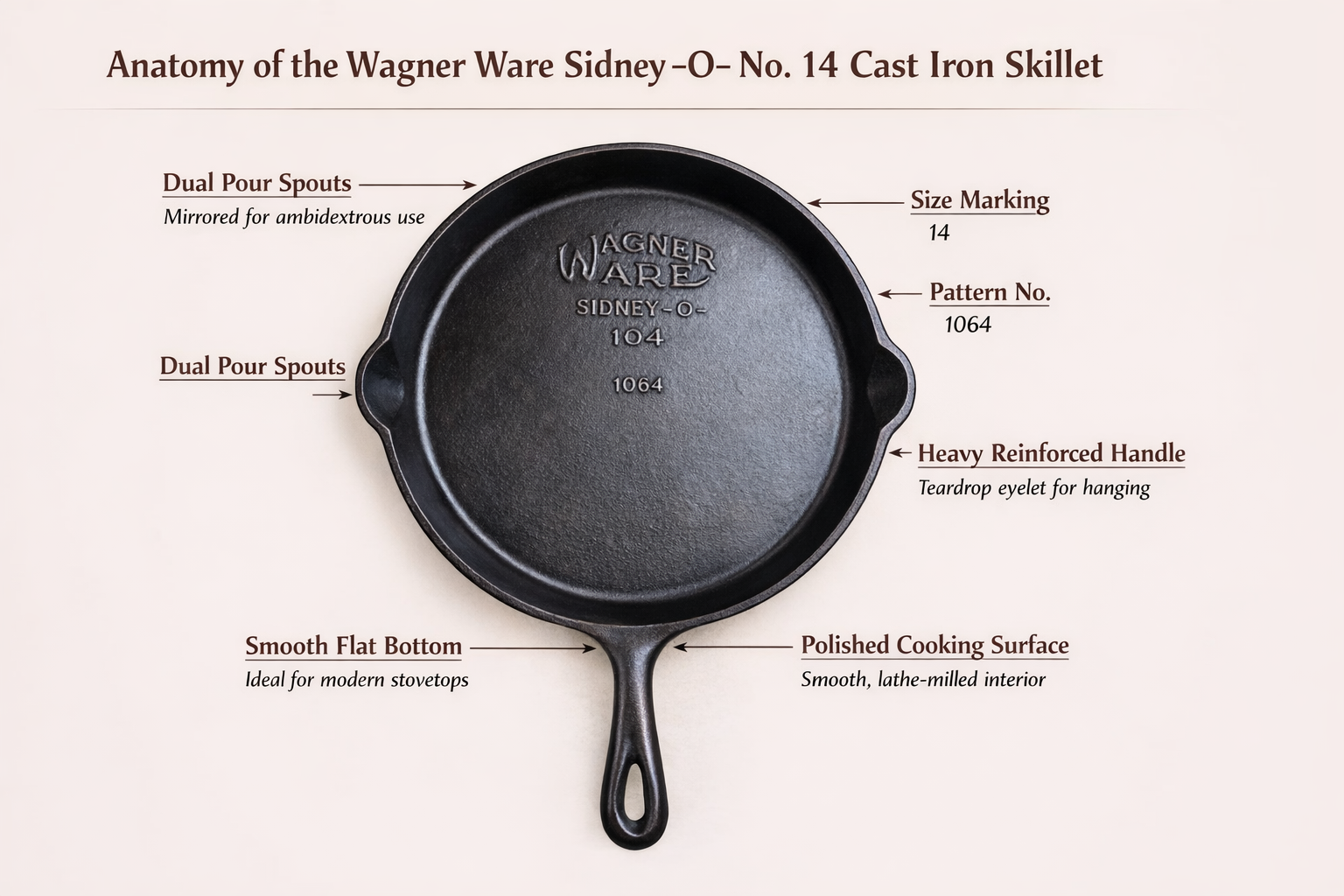
Overview: The Northern Counterpart to the Southern Giant
The Wagner Ware Sidney -O- No. 14 cast iron skillet represents the pinnacle of large‑format Northern cast iron cookware. Produced by the Wagner Manufacturing Company in Sidney, Ohio during the stylized logo era (circa 1920s–1930s), this skillet was the largest standard production skillet Wagner offered and stands as a direct industrial counterpoint to Southern giants such as Martin and Birmingham Stove & Range.
Measuring over 15 inches across the rim and weighing approximately 11.5–12 pounds, the No. 14 was never intended for casual household use. It was designed for institutional kitchens, large families, boarding houses, and serious home cooks who demanded capacity without sacrificing balance or surface refinement.
Unlike many Wagner No. 14 examples encountered today, this skillet retains a full heat ring, confirming early‑to‑mid stylized era production and making it especially desirable to collectors seeking transitional features.
Wagner Manufacturing Company: Precision at Scale
Founded in 1891 in Sidney, Ohio, the Wagner Manufacturing Company built its reputation on precision casting, lighter weight profiles, and exceptionally smooth cooking surfaces. By the 1920s, Wagner had become one of the most technically advanced cookware manufacturers in the United States.
The “Wagner Ware Sidney -O-” stylized logo, visible on the underside of this skillet, marks a period when Wagner emphasized modern branding while maintaining traditional foundry techniques. During this era, Wagner produced cookware that balanced industrial efficiency with refined finishing, setting it apart from many regional competitors.
While Wagner is often associated with smaller everyday skillets, the No. 14 demonstrates the company’s ability to scale its design philosophy upward—retaining smooth interiors, balanced geometry, and controlled weight even at extreme size.
Specifications & Design Features
Size: No. 14
Top Rim Diameter (spout to spout): ~15 1/4" – 15 3/8"
Cooking Surface Diameter: ~13"
Depth: ~2 1/4"
Length (handle to helper tab): ~20 3/4"
Weight: ~11.5 – 12 lbs
Pattern Number: 1064 (underside)
Key Features:
Stylized WAGNER WARE / SIDNEY -O- logo
Full heat ring (early stylized era trait)
Dual pour spouts
Reinforced main handle
Cast helper tab opposite handle
Smooth, lathe‑finished interior cooking surface
Image Analysis: What This Example Shows
Heat Ring Present: The underside clearly shows a continuous, raised heat ring—confirming earlier stylized‑era production rather than later smooth‑bottom variants.
Pattern Number “1064”: Crisp and legible, consistent with No. 14 Wagner production.
Logo Visibility: The stylized logo remains readable despite age, indicating minimal metal loss and correct conservation practices.
Interior Finish: The cooking surface shows classic Wagner lathe marks—evidence of original machining rather than modern grinding.
Helper Tab Geometry: The dual‑slot helper tab is intact and well‑formed, a critical safety feature on large Wagner skillets.
No Structural Deformities: Rim geometry appears true; no visible warping or distortion.
This combination of features places the skillet firmly in the early-to-mid 1920s–early 1930s production window.
Why Collectors Revere the Wagner No. 14
The Wagner No. 14 is widely regarded as a “holy grail” size for collectors—not only because of its scale, but because of how few survive in correct, usable condition.
Collectors prize this skillet for:
Largest standard skillet in the Wagner line
Smooth, light‑cast Wagner construction at extreme size
Heat ring retention (less common on later examples)
Lower production numbers compared to Nos. 8–10
Strong crossover appeal to cooks and historians alike
Finding a flat, crack‑free No. 14 with intact heat ring and legible markings is increasingly uncommon.
Restoration & SSC Museum Preservation Process
This skillet has been restored to museum-grade condition by Steve’s Seasoned Classics using the SSC archival protocol:
Full iron‑safe chemical stripping and neutralization
Preservation of original casting texture and machining marks
Structural verification for flatness and stability
Archival seasoning applied for protection and display
SSC Archive Record:
SSC‑WAG‑SKL‑14‑1064‑HR‑001
Condition Certification:
✅ No cracks or repairs
✅ Flat base — no wobble or spin
✅ Heat ring intact and original
✅ Logo and pattern number preserved
✅ Display‑ready and historically accurate
Culinary & Display Applications
Sear multiple steaks or ribeyes simultaneously
Roast poultry or large cuts of meat
Bake oversized cornbread or skillet pies
Anchor a Wagner or Ohio foundry exhibit
Serve as a centerpiece in a complete size‑run display
Despite its size, this skillet remains fully usable—a testament to Wagner’s engineering discipline.
Care & Use Best Practices
Preheat slowly and evenly
Always lift using both the main handle and helper tab
Never subject to thermal shock
Clean with hot water and a soft brush only
Dry thoroughly and oil lightly after use
References
Cast Iron Collector. (2025). Wagner Manufacturing Company History
https://www.castironcollector.com/wagner.phpGriswold Cookware. (1924). Wagner Cast Iron and Aluminum Catalog No. 30
https://griswoldcookware.com/1924-wagner-cast-iron-and-aluminum-catalog/SSC Internal Archive Record: SSC‑WAG‑SKL‑14‑1064‑HR‑001

Interior of the Wagner Ware Sidney -O- No. 14 Skillet, Pattern 1064
This overhead view reveals the smooth, lathe-finished cooking surface characteristic of Wagner's stylized logo era. Dual pour spouts and the reinforced two-slot helper tab are clearly visible, confirming its functional design for large-format cooking. The “14” size marking is cast on the handle base.

Underside of the Wagner No. 14 Skillet Showing Stylized Logo and Full Heat Ring
The stylized “WAGNER WARE / SIDNEY -O-” mark is lightly but legibly cast at the top center, with the pattern number “1064” located near the base of the pan. A continuous raised heat ring encircles the bottom—a key design feature for stovetop stability in early 20th-century models.