Stuart Ferancee-HP Miniature Advertising Skillet
STEVE'S SEASONED CLASSICS
An Online Museum of American Cast Iron Heritage
stevesseasonedclassics.com
Salesman Samples & Promotional Miniatures · Advertising Novelties · Museum Collection
Pharmaceutical Detail Piece · Iron Deficiency Anemia · c. 1920s–1940s
SSC MUSEUM COLLECTION · Catalog No. SSC-ADV-MINI-SKL-STUARTFHP-001
STUART / FERANCEE-HP / FOR IRON DEFICIENCY ANEMIA | Interior Cast Advertising Text | Teardrop Hang-Hole
c. 1920s–1940s • The Stuart Company • Pharmaceutical Advertising Novelty
★ BRILLIANT VISUAL PUN — A Cast Iron Skillet Advertising an Iron Supplement ★

Bottom view of the Stuart Ferancee-HP miniature advertising skillet: the base is flat, smooth, and entirely unmarked — all advertising text is carried on the interior cooking surface, following the standard configuration for pharmaceutical promotional miniatures of this type. No heat ring is present, confirming this piece was never intended for stove use. The flat base and unmarked underside are typical of cast iron advertising novelties produced for placement on a physician's desk or display surface. The handle terminates in a teardrop hang-hole, allowing the piece to be displayed on a hook or nail in a doctor's office waiting room or examination room.
Pharmaceutical detail men — the sales representatives who called on physicians' offices to promote prescription and proprietary medicines — worked in a world of persuasion and attention. A physician seeing ten, twenty, or thirty patients a day, receiving calls from multiple pharmaceutical representatives each week, and managing a desk covered in medical literature had limited patience for a salesman with only a verbal pitch and a pamphlet. The successful detail man needed a leave-behind: something small, useful, and memorable that would keep the product name in the physician's field of vision after the visit ended. Cast iron advertising novelties — miniature skillets, tiny anvils, small paperweights — were among the most effective solutions the industry developed.
This miniature cast iron skillet is one of the most conceptually elegant pharmaceutical advertising pieces in the SSC collection. The product being advertised is Ferancee-HP, an iron supplement manufactured by The Stuart Company for the treatment of iron deficiency anemia. The advertising vehicle is a miniature cast iron skillet — a skillet made of iron, sitting on a physician's desk, bearing the message FOR IRON DEFICIENCY ANEMIA. The visual pun is immediate and unmistakable: the iron of the cookware equates to the iron needed by the anemic patient. Every time the physician glanced at this piece — reaching past it to pick up a pen, moving it aside to make room for a patient chart — the message registered: iron deficiency anemia, Stuart, Ferancee-HP. That is precisely what an effective advertising leave-behind is designed to do.
The piece belongs to the SSC Salesman Samples and Promotional Miniatures collection not because it is a true functional miniature of a full-size skillet — it is not — but because it uses the cast iron skillet form as its advertising medium in a way that makes it inseparable from the cast iron story. The physician who received this piece in the 1920s or 1930s or 1940s may not have known or cared who made it, what foundry cast it, or what Ohio tradition it came from. But the SSC collection knows, and the documentation here places this small piece precisely where it belongs: at the intersection of American cast iron manufacturing, early pharmaceutical marketing, and the history of iron deficiency medicine.
Piece Details
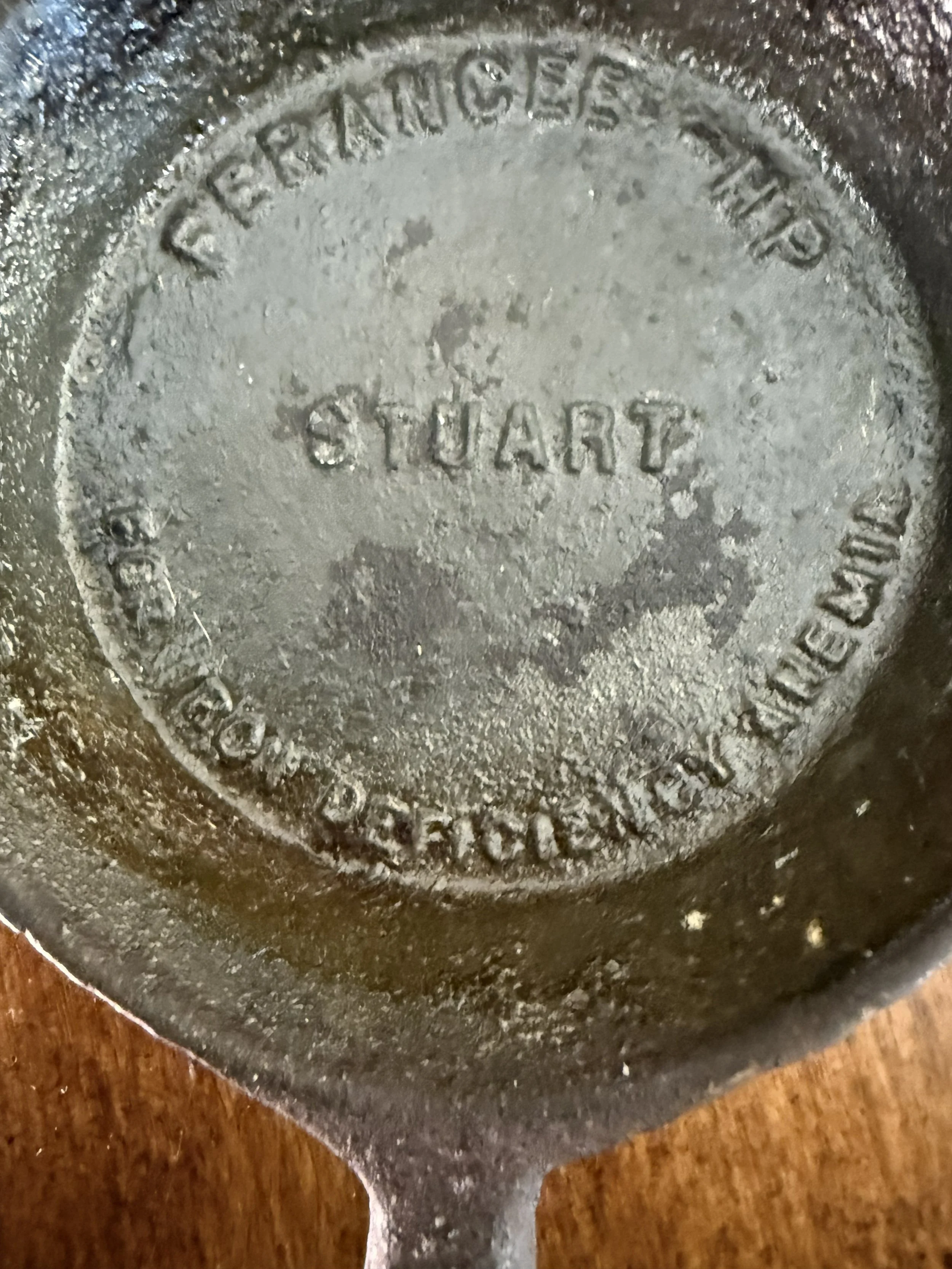
Detail top view of the Stuart Ferancee-HP miniature advertising skillet showing the interior casting text in full: FERANCEE-HP arching across the upper interior arc; STUART in large raised letters at center; FOR IRON DEFICIENCY ANEMIA arching across the lower interior arc. The text is cast as an integral part of the piece — raised letters formed in the sand mold pattern rather than stamped or engraved after casting. The circular arrangement of the advertising text fills the interior bowl of the skillet completely, using every available surface for the message. The letter definition is legible across all elements despite the piece's age and the surface patina of decades.
Manufacturer
The Stuart Company (pharmaceutical manufacturer); cast iron foundry of manufacture unidentified — advertising novelties of this type were typically commissioned from specialty foundries or novelty casting houses rather than produced in-house by the pharmaceutical company
Advertised Product
Ferancee-HP — iron supplement for iron deficiency anemia; manufactured and marketed by The Stuart Company; HP designation consistent with High Potency formulation designation common in pharmaceutical marketing of the period
Advertising Text
Interior cast text in circular arrangement: FERANCEE-HP arching across upper interior arc; STUART in large raised letters at center; FOR IRON DEFICIENCY ANEMIA arching across lower interior arc; full intended reading: STUART FERANCEE-HP FOR IRON DEFICIENCY ANEMIA
Piece Type
Miniature advertising skillet — pharmaceutical detail piece / promotional novelty; not a functional cooking vessel and not a scaled-down sample of a production skillet; purpose-made advertising item intended for placement in physicians' offices
Advertising Concept
Visual pun: a cast iron skillet — made of iron — advertising an iron supplement for iron deficiency anemia; the material of the object and the message of the object are identical; one of the most conceptually effective pharmaceutical advertising novelties documented in the SSC collection
Intended Use
Physician's desk or office display piece; pharmaceutical detail man leave-behind; designed to maintain brand and product name visibility in the physician's office between sales calls; teardrop hang-hole allows wall or hook display in waiting room or examination room
Base Configuration
Flat, smooth, entirely unmarked base; no heat ring; no maker's mark; no advertising text on base; all identification and advertising carried on interior cooking surface
Handle
Short flat handle terminating in a teardrop open-center hang-hole; standard configuration for advertising novelty cast iron pieces intended for display hanging
Interior Text Casting Method
Raised letters formed as part of the sand mold pattern; cast integral to the piece rather than stamped or engraved after casting; text is a permanent element of the casting itself
Condition
Very Good — all three advertising text elements legible: FERANCEE-HP, STUART, and FOR IRON DEFICIENCY ANEMIA all present and readable; surface shows period patina and age-appropriate oxidation consistent with early-to-mid 20th century manufacture and use; no cracks or structural damage; handle and hang-hole intact; display ready
Date of Manufacture
c. 1920s–1940s — consistent with The Stuart Company's active pharmaceutical marketing period for the Ferancee iron supplement line and with collector dating of this advertising novelty type; collector market sources reference 1890–1919 and 1930s depending on the specific piece variant
Acquisition Date
February 5, 2026
Acquisition Source
eBay — Seller: kansasauctionfinds
eBay Item Number
177823974883
Order Number
22-14182-91991
Purchase Price
$20.00 item + $9.45 shipping (USPS Ground Advantage) + $2.50 tax = $31.95 total
SSC Catalog Number
SSC-ADV-MINI-SKL-STUARTFHP-001
The Visual Pun: Iron for Iron Deficiency
The advertising logic of this piece operates on a single, elegant insight: the word iron means two completely different things in the context of this object. Iron is the material of the skillet — cast iron, the gray iron alloy that American foundries had been pouring into sand molds for a century before this piece was made. Iron is also the mineral whose deficiency causes anemia — the dietary iron that the human body requires to produce hemoglobin, and whose absence produces the fatigue, pallor, and weakness that define iron deficiency anemia. Ferancee-HP supplies the second kind of iron. The skillet embodies the first. The advertisement collapses both meanings into a single object.
This is not an accidental convergence. Whoever designed this advertising campaign understood that a physician seeing a cast iron skillet on their desk would immediately connect the material object to the medical condition, and would remember the product name that mediated between the two. The connection is strong enough that it does not require explanation — the physician does not need to read the text to understand the joke. But the text reinforces it: FOR IRON DEFICIENCY ANEMIA, cast directly into the surface of a piece of iron. The medium is the message in the most literal possible sense.
What makes this piece particularly valuable for the SSC collection is precisely that duality. It is cast iron — it belongs in a cast iron museum. But it is also a pharmaceutical artifact, a marketing history document, and a small piece of the history of American medicine in the period when iron deficiency anemia was first being systematically understood, treated, and commercialized. The SSC Salesman Samples and Promotional Miniatures collection exists to document pieces exactly like this one: cast iron objects whose significance extends well beyond the foundry that made them.
Ferancee-HP and The Stuart Company: Pharmaceutical Context
The Stuart Company was an American pharmaceutical manufacturer that produced a line of iron supplement products under the Ferancee brand name, of which Ferancee-HP was one variant. The HP designation in pharmaceutical product naming of the early-to-mid 20th century typically indicated a High Potency formulation — a higher concentration of active ingredient intended for patients with more significant deficiency or for cases where standard formulations had proven insufficient. The Ferancee product line targeted iron deficiency anemia, a condition that was increasingly understood as a clinical entity distinct from other forms of anemia during the 1920s and 1930s.
Iron deficiency anemia had a long medical history before pharmaceutical companies began marketing dedicated iron supplements in the modern sense. Iron-based remedies for the condition described variously as chlorosis, green sickness, or anemia had been in use since at least the 17th century, when Thomas Sydenham documented the use of iron preparations to treat the pallor and fatigue that characterized the condition. The development of hematology in the 19th and early 20th centuries brought increasingly precise understanding of the relationship between iron, hemoglobin, and the red blood cell populations affected in iron deficiency states. By the 1920s and 1930s, oral iron supplementation with standardized pharmaceutical preparations was the emerging standard of care, and companies like Stuart were competing to establish their products in physicians' prescription habits.
The pharmaceutical detail man — the sales representative calling on physicians' offices — was the primary distribution channel for this kind of prescription product in an era before direct-to-consumer pharmaceutical advertising. The detail man's job was to establish the product in the physician's awareness and to differentiate it from competing iron supplements in a market where multiple companies were offering chemically similar formulations. An advertising novelty like this miniature skillet was a tool in that effort: a memorable, durable, purpose-made object that would remain in the physician's office long after the detail man's visit had ended and the conversation had been forgotten.

Side view of the Stuart Ferancee-HP miniature advertising skillet showing the full proportions: compact round body with short sidewall, flat base with no heat ring, short handle extending to the teardrop hang-hole. The miniature scale is apparent in the overall dimensions — this is a desk piece, not a functional cooking vessel. The sidewall shows some original carbon residue and surface oxidation consistent with age and period handling. The casting quality is adequate for the advertising purpose — the form reads unmistakably as a skillet at display distance, and the interior text is legible under normal viewing conditions.
The Pharmaceutical Advertising Novelty: A Collector Context
Cast iron pharmaceutical advertising novelties of the early-to-mid 20th century occupy a small but distinctive niche at the intersection of three collector communities: cast iron collectors, pharmaceutical advertising collectors, and general advertising memorabilia collectors. Each community has a different reason to value a piece like this Ferancee-HP skillet, and each brings a different interpretive framework to its documentation.
For cast iron collectors, the piece documents a use of the cast iron form — the skillet specifically — as an advertising medium that leverages the material's cultural associations. The skillet was not chosen arbitrarily for this advertisement; it was chosen because it is made of iron, because every American household in the 1920s and 1930s had one, and because the connection between the cooking vessel and the dietary mineral was immediate and obvious to any physician who received it. The foundry that cast these pieces — unknown by name but working in the tradition of American novelty casting — was producing objects that would outlast the pharmaceutical campaign they served by a century.
For pharmaceutical advertising collectors, pieces like this are documentation of the pre-FDA, pre-television, pre-direct-to-consumer era of pharmaceutical marketing — when a detail man with a leave-behind was the state of the art in physician outreach. The Stuart Ferancee-HP miniature skillet survives as physical evidence of how pharmaceutical companies competed for physician attention and prescription habits in the interwar period, using wit and craft rather than broadcast media and celebrity endorsements. The collection of such pieces is a form of medical marketing history preservation that the academic literature rarely addresses and the general collector market incompletely documents.
The SSC Salesman Samples and Promotional Miniatures collection positions itself squarely in this intersection. These pieces belong in a cast iron museum precisely because the cast iron form was chosen deliberately and meaningfully by the marketers who commissioned them. The iron skillet is not incidental to the Ferancee-HP advertisement — it is the advertisement. Documenting it here, with the same rigor applied to a Wapak Indian Head skillet or a Favorite Piqua Ware Dutch oven, honors both the object and the tradition it represents.
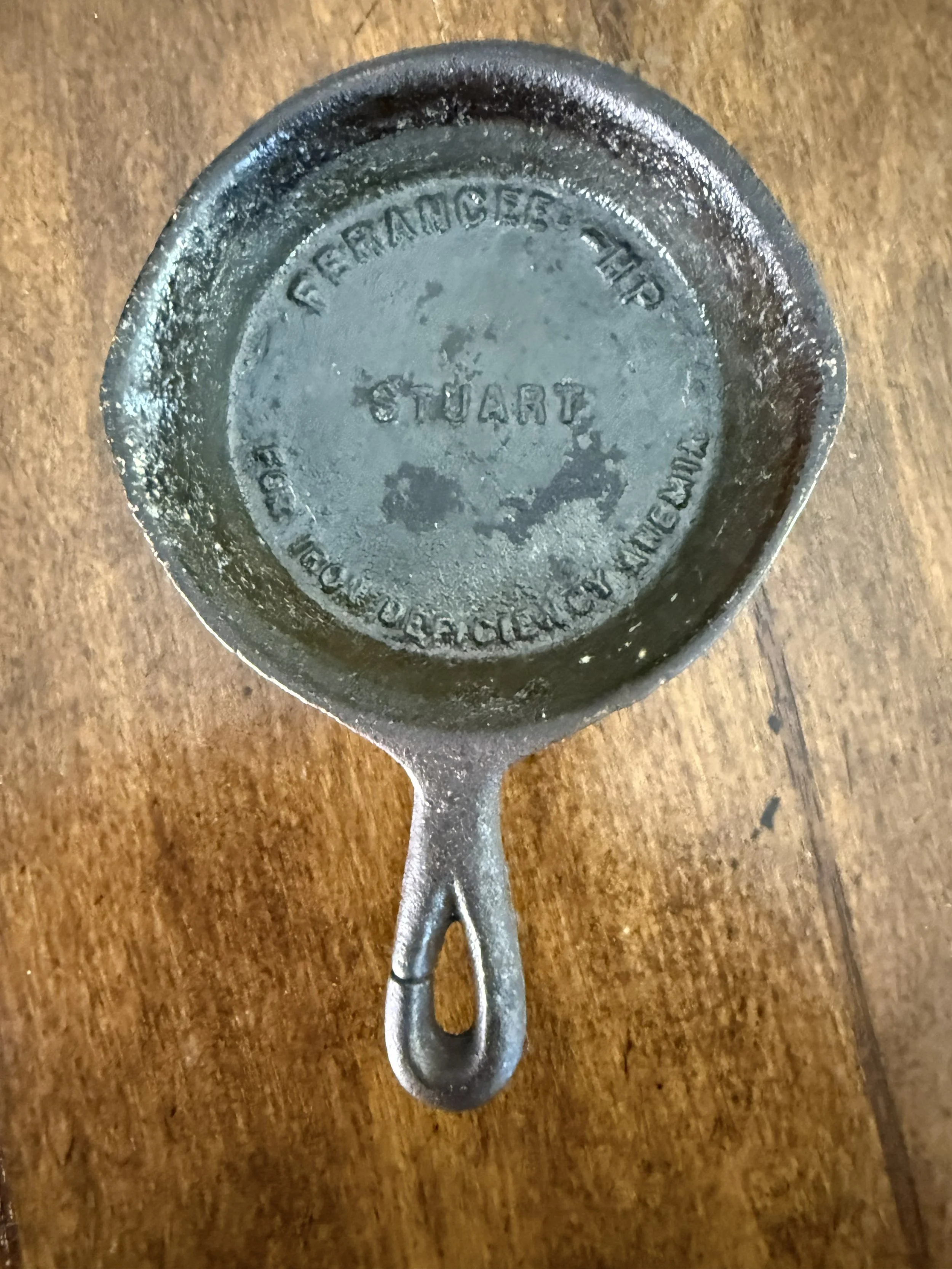
Top view of the Stuart Ferancee-HP miniature advertising skillet showing the complete interior text layout: FERANCEE-HP in raised letters arching across the upper interior arc, STUART in large raised letters at the center of the bowl, and FOR IRON DEFICIENCY ANEMIA arching across the lower interior arc. The circular arrangement of the text fills the interior cooking surface completely. The teardrop hang-hole at the handle end is visible in this view. The casting of the text is integral to the piece — these are not stamped or engraved letters but raised forms from the original sand mold pattern. The piece reads clearly and immediately as an advertising object: a cast iron skillet advertising an iron supplement.
Why This Piece Matters
The Stuart Ferancee-HP miniature advertising skillet matters for three reasons that reach beyond its modest acquisition cost and compact dimensions. First, it is one of the most conceptually brilliant pieces in the SSC collection — an object whose material and message are identical, whose advertising logic is elegant and immediate, and whose survival for nearly a century is a testament to the durability of cast iron as both a cooking medium and a documentary artifact. A ceramic advertising piece from the same era would likely have been broken decades ago. This iron skillet is exactly as it was when the detail man left it on the physician's desk.
Second, it extends the SSC Salesman Samples and Promotional Miniatures collection into the pharmaceutical advertising category — a category that is underrepresented in cast iron collector literature and deserves museum-quality documentation precisely because it is so rarely examined with the seriousness it warrants. These pieces are not novelties in the dismissive sense. They are artifacts of American commercial and medical history, cast in the same material and using the same sand mold techniques as the production hollow ware that anchors the main SSC collection.
Third, it is a reminder that the cast iron skillet meant something to Americans of the early 20th century that it no longer means in quite the same way. When The Stuart Company commissioned a miniature cast iron skillet as its Ferancee-HP advertising vehicle, they were relying on every physician who received it to immediately understand the connection between the object and the mineral. That connection was obvious because cast iron cookware was daily life — not a collector's item, not a nostalgic artifact, but the pan on the stove in every kitchen in America. The SSC collection preserves that understanding, and this small piece is one of its most eloquent expressions.
The iron endures. The markings tell the truth. The story deserves to be told.
Sources & Further Reading
WorthPoint.com — Historical auction records for Stuart Ferancee-HP miniature cast iron advertising pieces including anvil and skillet variants; collector dating and condition documentation.
eBay historical listings — Stuart Ferancee-HP miniature cast iron advertising pieces; comparative condition and dating reference.
Wikipedia — Iron supplement: history of pharmaceutical iron supplementation from Blaud's pills through the 20th century standardization of oral iron therapy.
American Society of Hematology — Iron Supplementation historical overview: development of parenteral and oral iron therapy for anemia in the 1930s–1940s.
JAMA Network — Historical Aspects of Iron Therapy in Anemia: clinical history of iron as a therapeutic agent from pre-modern through early 20th century pharmaceutical use.
PubMed — Anemia management historical perspective: documentation of oral iron supplementation practice in the late 1920s through mid-20th century.
SSC Internal Collection Records — Salesman Samples and Promotional Miniatures collection overview; Ohio Foundry Corridor and Other Makers collection documentation.
About Steve's Seasoned Classics
Steve's Seasoned Classics is an online museum dedicated to preserving and documenting the heritage of American cast iron cookware, with a focus on Ohio foundry pieces from the 19th and early 20th centuries. The SSC collection features over 60 pieces with detailed provenance, historical research, and photography for each item.
