Fanner Mfg. Co. Cast Iron Glue Melting Pot
SSC MUSEUM COLLECTION
Catalog No. SSC-FANNER-GLUEPOT-c1900-001
Fanner Mfg. Co. Cast Iron Glue Melting Pot
Complete with Original Bail, Hinged Ornate Lid & Water Jacket | Cleveland, Ohio
Circa 1891–1920 • Fanner Mfg. Co. • Cleveland, Ohio

The complete glue melting pot with lid closed, showing the ornate circular relief face of the hinged lid with its original D-ring loop handle, and the cylindrical outer water-jacket vessel with three-point feet below. All components are original and intact. The surface carries uniform age patina with no cleaning or restoration.
Hide glue was the adhesive that built the 19th-century American interior. Furniture makers, cabinet makers, carriage builders, bookbinders, musical instrument craftsmen, and the workshops that supplied them all depended on animal hide glue—the strongest reversible adhesive available before the chemical age. Hide glue melts at approximately 140–150 degrees Fahrenheit and must be maintained at that temperature to remain workable; allowed to cool, it congeals; raised too high, it scorches and loses strength. The glue melting pot solved that problem with an elegant engineering principle borrowed from the kitchen: the double boiler. An outer vessel of water, maintained just below boiling, surrounded the inner glue pot and held the glue at a stable working temperature indefinitely. The craftsman never touched the flame, never scorched the glue, and could work continuously as long as the water held heat.
This glue pot—catalog number SSC-FANNER-GLUEPOT-c1900-001—was manufactured by the Fanner Mfg. Co. of Cleveland, Ohio, and entered the SSC collection on February 11, 2026. It is a complete, intact, unrestored example: the inner cylindrical pot, the outer water-jacket vessel, the original hinged lid with its ornate cast relief face, the original D-ring loop handle on the lid, and the original bail hinge mechanism are all present and accounted for. Nothing has been replaced, cleaned with abrasives, or stripped. The patina is entirely original to the piece—decades of workshop use, storage, and age layered into a surface that no restoration can replicate and that, once removed, is gone permanently.
The completeness of this pot deserves emphasis. Glue melting pots are not rare; cast iron shops of the late 19th and early 20th centuries produced them by the thousand. Complete glue melting pots—with the original lid, original hinge, original bail, and matching outer vessel all surviving together—are another matter entirely. Lids were easily separated and lost when pots were emptied, cleaned, or repurposed. Hinges corrode and fail. Bail handles go missing. Finding all components original and together is the exception, not the rule. This pot is the exception.
Piece Details
Manufacturer
Fanner Mfg. Co.
Location
Cleveland, Cuyahoga County, Ohio
Object Type
Cast Iron Glue Melting Pot — Double-Walled (Water Jacket) Construction
Founded
1891 (waffle iron production confirmed; stove hardware documented from same period)
Product Line
Stove hardware, stove trimmings, waffle irons, keg taps, wrenches, and trade tools
Completeness
COMPLETE — Original hinged lid with ornate relief face, intact original bail handle, original outer water-jacket vessel, all components present
Lid
Hinged, cast iron, ornate circular relief face with concentric ring decoration and raised lettering; D-ring loop handle; original hinge bail intact
Body
Cylindrical inner pot, double-walled outer vessel (water jacket); three-point feet; original patina throughout
Approximate Date
c. 1891–1920 (consistent with early Fanner production; pre-Textron acquisition of 1958)
Condition
Good — complete and intact with original patina; surface oxidation and age-consistent rust throughout; no cracks, no breaks, no replaced components; original bail and hinge mechanically functional
SSC Catalog No.
SSC-FANNER-GLUEPOT-c1900-001
Acquisition
eBay, seller 1961dwayne — February 11, 2026 — $39.99 + $9.85 shipping + $4.22 tax = $54.06 total

Top-down view with lid open, showing the full ornate cast relief face of the hinged lid. The circular face features concentric ring borders, a decorative sunburst or radiating petal pattern surrounding the central boss, and raised lettering around the outer ring identifying the manufacturer. The D-ring handle and hinge bail are visible at right. Below, the open inner pot reveals the cylindrical cavity.
Form and Construction: A Complete Double-Boiler Glue Pot
The pot is constructed in two concentric cylindrical vessels. The inner pot—the glue chamber—is a straight-sided cylinder with a rolled lip at the top. It fits concentrically into the outer vessel, which is slightly larger in diameter and serves as the water jacket. The gap between the two walls is the functional heart of the design: water filled into that annular space absorbs heat from the fire below and transmits it gently to the inner glue chamber without direct contact. The three-point feet on the outer vessel raise the assembly above the stove or brazier surface and allow air circulation beneath.
The lid is the most visually distinguished component of this pot. It is cast iron, circular, and its face carries a high-quality ornate relief pattern: a raised outer ring border, a band of concentric ring detailing, and within that a radiating decorative design centered on a raised boss. The outer border of the lid face carries raised lettering identifying Fanner Mfg. Co. and Cleveland, O. as manufacturer and city of origin. The lid is attached to the pot via an original bail hinge mechanism—a cast eye on one side of the outer vessel, a corresponding cast eye on the opposite side, and a wire bail that connects them with the lid riding on the wire. This hinge allows the lid to swing open completely and rest against the side of the pot while the craftsman works, then swing closed again to retain heat. The D-ring loop handle on the lid face allows the lid to be lifted and repositioned with one finger while the other hand works with the glue.
The original bail handle—the wire loop that allows the entire pot assembly to be lifted and carried—is intact. It rides on the same cast eyes that support the lid hinge, looping over the top of the pot when in use and dropping to the sides when the lid is open. The presence of the original bail is significant both functionally and for completeness: a pot without its original bail is a pot missing a structural component. This pot has it.
The surface patina across all components is consistent, unified, and entirely unmodified. There is surface oxidation throughout, ranging from dark iron gray to areas of red-brown surface rust, with no polishing, no wire brushing, no electrolysis, no coating. The interior of the inner pot shows the mineral residue and oxidation of long-term storage following its working life. The exterior of both vessels shows the natural color and texture variation that accumulates on cast iron over generations of workshop use. This is Archival Black in its most literal form: the original surface, untouched.
Fanner Mfg. Co.: Cleveland, Ohio, 1891–1958
Fanner Manufacturing Company was a Cleveland, Ohio foundry established in 1891 and operating for nearly seven decades before its acquisition by Textron in 1958. Cleveland in the 1890s was one of the great industrial cities of the American Midwest, with iron foundries, machine shops, and hardware manufacturers concentrated along the Cuyahoga River and the lakefront rail corridors that connected the city to the ore boats of Lake Erie. Fanner operated within that industrial matrix, producing a wide range of cast iron goods that served both household and commercial markets.
The company is perhaps best known in collector circles for its "Crescent" line of waffle irons—cast iron waffle makers marked with Fanner’s name and the crescent moon motif, sold with both wood and wire handles and available in multiple sizes. The Crescent waffle iron is documented from the company’s founding in 1891 through at least the 1920s and possibly the 1930s, and examples survive in sufficient numbers to be actively collected today. But Fanner’s catalog was far broader than waffle irons. The Smithsonian Institution holds Fanner trade catalogs documenting the company’s full product line, which included stove trimmings, stove cover lifters, stove pokers, towel rods, shaker cranks, grate shakers and lifters, handle turn keys, key latches, closet handles, stove knobs, draft register screws, stove pipe drafts, tea pot shelves and hinges, stove legs, gas mixers and caps, pipe collars, keg taps, wrenches, and trade tools. A 1954 annual report in the Smithsonian’s collection documents the company still actively operating more than sixty years after its founding.
The glue pot fits squarely within the Fanner product philosophy: a practical cast iron tool, precisely executed, built to outlast the workshop it served. That Fanner put an ornate decorative relief face on the lid of a glue pot—an industrial tool, not a parlor object—is characteristic of late-Victorian foundry culture, in which the skill of the pattern-maker was a source of pride that extended even to utilitarian wares. The relief pattern on this lid is not decorative in the modern sense; it is a demonstration of craft, a signature in iron.
Why This Piece Matters
The Fanner glue pot matters first because it is complete. In the SSC collection and in any serious collection of Ohio industrial cast iron, completeness at this level—every original component present, original patina entirely intact, nothing replaced or restored—is the highest standard. A restored pot with a replacement lid is a different object. A pot with a missing bail is an incomplete object. This pot is neither. It is exactly what it was when it left a craftsman’s workshop: a working double-boiler glue pot from a documented Cleveland manufacturer, with all its parts and all its age.
It matters for the Ohio Foundry Heritage Collection because Fanner Mfg. Co. is a documented, Smithsonian-catalogued Cleveland manufacturer with a production record spanning 1891 to 1958—six decades of continuous operation in one of Ohio’s great industrial cities. The Fanner waffle iron already appears in the Cast Iron Collector foundry index. Adding a Fanner glue pot extends the SSC’s Fanner representation beyond cookware into the industrial hardware that constituted the majority of the company’s output.
It matters as an object because it documents a trade practice—the use of hide glue in woodworking and craft manufacture—that shaped American material culture for a century and a half. The furniture, the carriages, the musical instruments, the boxes, the books built in American workshops from the 1840s through the early 20th century were largely assembled with hide glue maintained at working temperature in vessels exactly like this one. The pot is not just a Fanner artifact. It is a document of how things were made.
Sources & Further Reading
Smithsonian Institution Libraries — SILNMAHTL_14326: Trade catalogs from Fanner Mfg. Co., Cleveland, Ohio, including 1954 annual report; product line documentation covering stove trimmings, cover lifters, keg taps, wrenches, and tools.
Banterings.com — Master List of Cast Iron Waffle Irons: Documents Fanner waffle iron production beginning 1891 with wood and wire handles; notes company acquired by Textron in 1958.
WAG Society Cast Iron Foundry Index — FANNER MFG. CO., Cleveland, Ohio: waffle iron, square waffle iron; confirms Cleveland, Ohio location.
CastIronCollector.com — Foundry Database: Fanner Mfg. Co. listed among documented American cast iron hollow ware and hardware producers.
WorthPoint.com — Fanner Mfg. Co. Cleveland Ohio trivet listing (early 1900s); confirmed cast iron hardware production in addition to waffle irons.
SSC Internal Collection Records — Ohio Foundry Heritage Collection: SSC-TOLEDO-001 (Union Mfg. Co. of Toledo), SSC-HL-LADLE-1871-001 (M. Hose & Lyon, Dayton), SSC-BRAND-PLATE-c1890-001 (Brand’s Famous Furnaces), SSC-SCHILL-EMBLEM-c1900-001 (Schill Brothers Co., Crestline, Ohio).

Side-angle view with lid open showing the interior of the inner glue pot and the underside of the hinged lid. The original bail hinge wire and the cast eye mount are visible at the hinge point. The ornate relief of the lid face can be seen in partial profile. The patina of the interior cylindrical wall is consistent with long-term storage following working use.
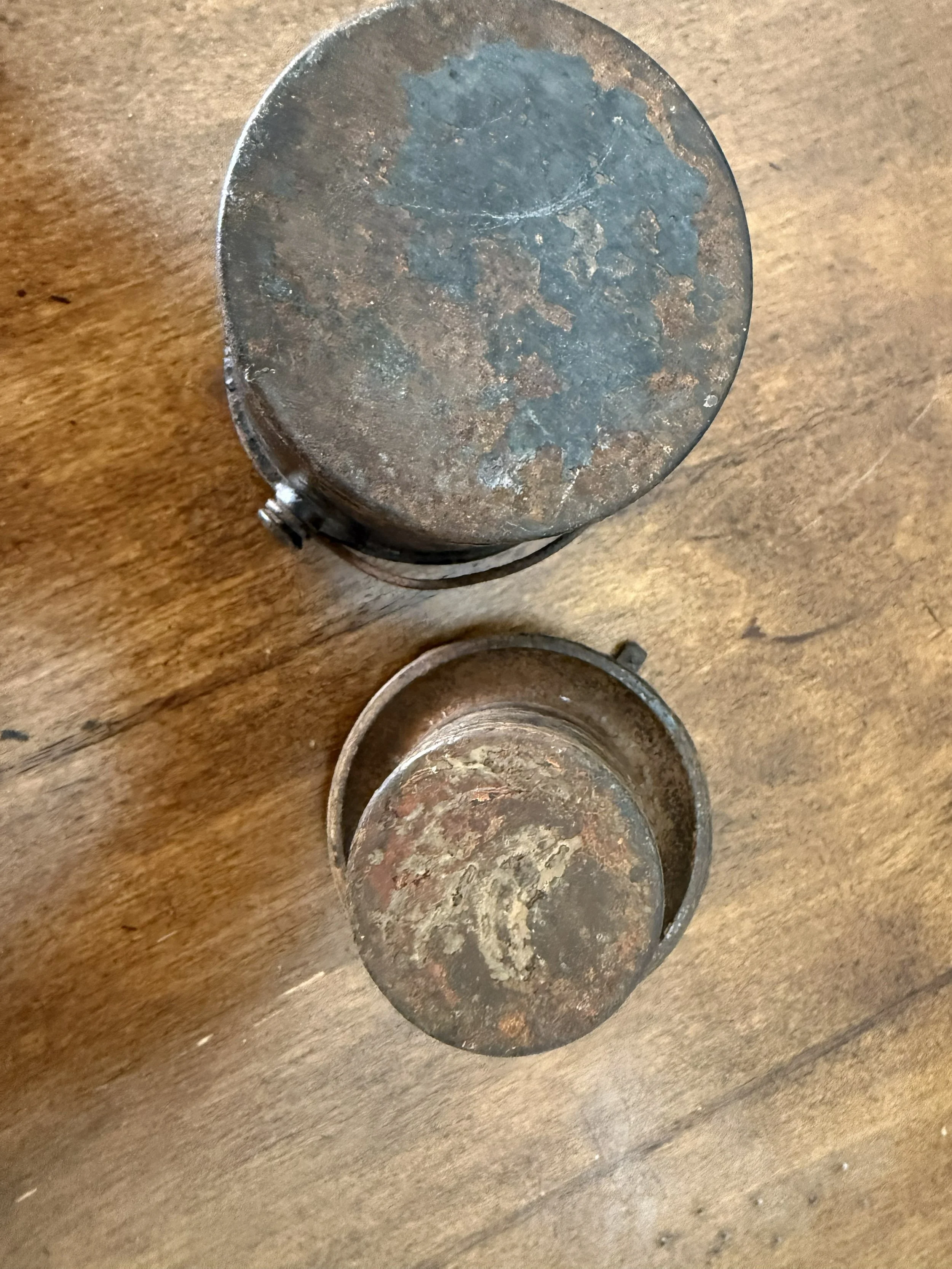
Overhead view of both vessels separated: the covered pot (upper) with the ornate lid closed and its D-ring handle visible, and the outer water-jacket vessel (lower) shown from above with its interior exposed. The consistent oxidation across both vessels confirms they have remained together as a matched set throughout their working life and subsequent storage. The circular lip of the outer vessel is visible, designed to receive the inner pot concentrically.
About Steve’s Seasoned Classics
Steve’s Seasoned Classics is an online museum dedicated to preserving and documenting the heritage of American cast iron, with a focus on Ohio foundry pieces from the 19th and early 20th centuries. The SSC collection features over 60 pieces with detailed provenance, historical research, and photography for each item.
