Ahrens & Arnold No. 3 Skillet — Wapakoneta Mark
STEVE'S SEASONED CLASSICS
An Online Museum of American Cast Iron Heritage
stevesseasonedclassics.com
Ohio Foundry Corridor · Other Makers · Cast Iron Skillets · Museum Collection
Ahrens & Arnold No. 3 Skillet — Wapakoneta Mark
Wapakoneta, Auglaize County, Ohio · c. Late 1920s
SSC MUSEUM COLLECTION · Catalog No. SSC-AA-SKL-03-LOGO-001
AA Arrow Mark | No. 3 Size | Wapakoneta, Ohio
Circa Late 1920s • Ahrens & Arnold
★ EXTREMELY RARE — One of the Most Obscure American Cast Iron Makers ★
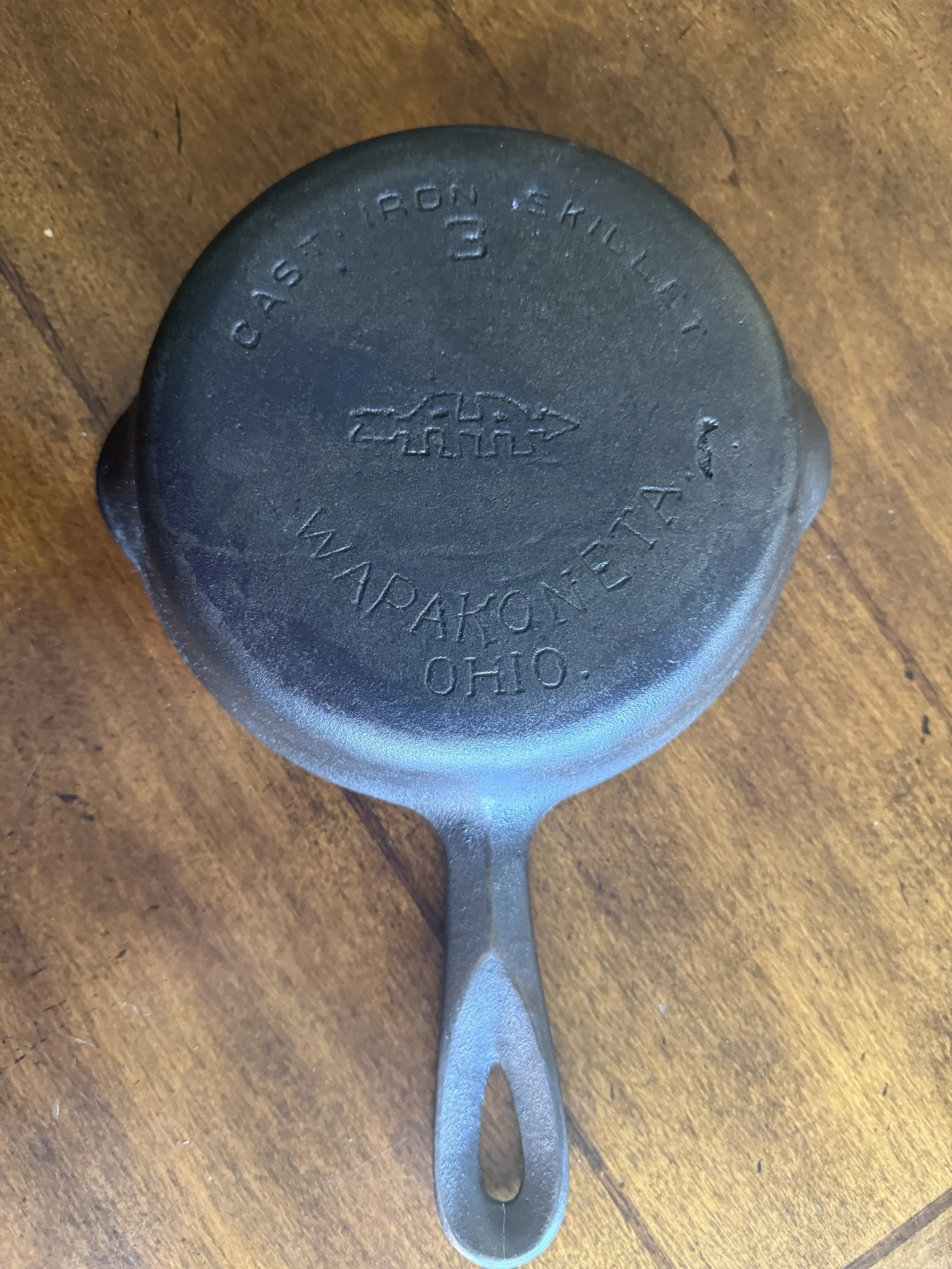
Bottom view of the Ahrens & Arnold No. 3: the full base marking layout — CAST · IRON · SKILLET arching across the upper field with raised dot separators between each word, the size numeral 3 at center, the AA arrow emblem below it — a horizontal arrow pointing right with fletching at left, arrowhead at right, and the letters AA centered in the arrow body — and WAPAKONETA / OHIO. in two lines at the base. A small mold cavity mark is present to the upper right of WAPAKONETA, a casting artifact from the sand mold process. The dot word separators in the arc text and the terminal period after OHIO. are authentication markers specific to confirmed Ahrens & Arnold production. Pieces of this maker are among the rarest in the entire American cast iron corpus — documented examples can be counted in the dozens, not the hundreds.
The Wapak Hollow Ware Company closed around 1926. The foundry was gone, the patterns were silent, and Wapakoneta's two decades as an Ohio cast iron production center were over. What Ahrens & Arnold represents is what happened next — the refusal, by at least two men, to accept that ending. Their names survive only in iron. No foundry registration has been confirmed. No period advertisement has been located. No business directory entry has been verified. What exists is this: a small number of cast iron skillets marked WAPAKONETA / OHIO., bearing an arrow device with AA centered in the arrow body — a mark no reference work had occasion to document in depth before so few examples existed to study — produced by craftsmen who learned their trade in the same Auglaize County foundry tradition that produced the Indian Head medallion, and who kept casting after the company that trained them had ceased to exist.
This No. 3 is one of those pieces. The base markings are fully present and clearly legible: the CAST · IRON · SKILLET arc with dot separators, the size numeral, the AA arrow emblem, the two-line WAPAKONETA / OHIO. origin text with its characteristic terminal period. The teardrop hang-hole handle carries the size numeral 3 on its upper face. The cooking surface is smooth and properly seasoned. The overall casting presents with the compact, well-proportioned geometry of a small Ohio foundry skillet from the late 1920s — nothing about this piece announces itself as exceptional from a distance. The exception is the marking, and the marking is everything. An Ahrens & Arnold No. 3 in this condition, with this legibility, is not a piece that appears with frequency. It is a piece that collectors search for, sometimes for years, before finding.
Ahrens & Arnold is not a Wapak piece and not a Favorite Stove & Range piece. It does not fit the corporate genealogy that organizes most Ohio foundry collecting. It is a post-closure operation — a scrappy, brief, poorly-documented effort by former foundry workers who set up a small casting operation in the same city where their training had been and made a limited run of cookware that nearly the entire historical record has ignored. The SSC collection has documented Wapak at its peak in SSC-WAP-SKL-03-IH-001. This piece documents what Wapakoneta cast iron looked like after the peak — and why that postscript is worth preserving.
Piece Details
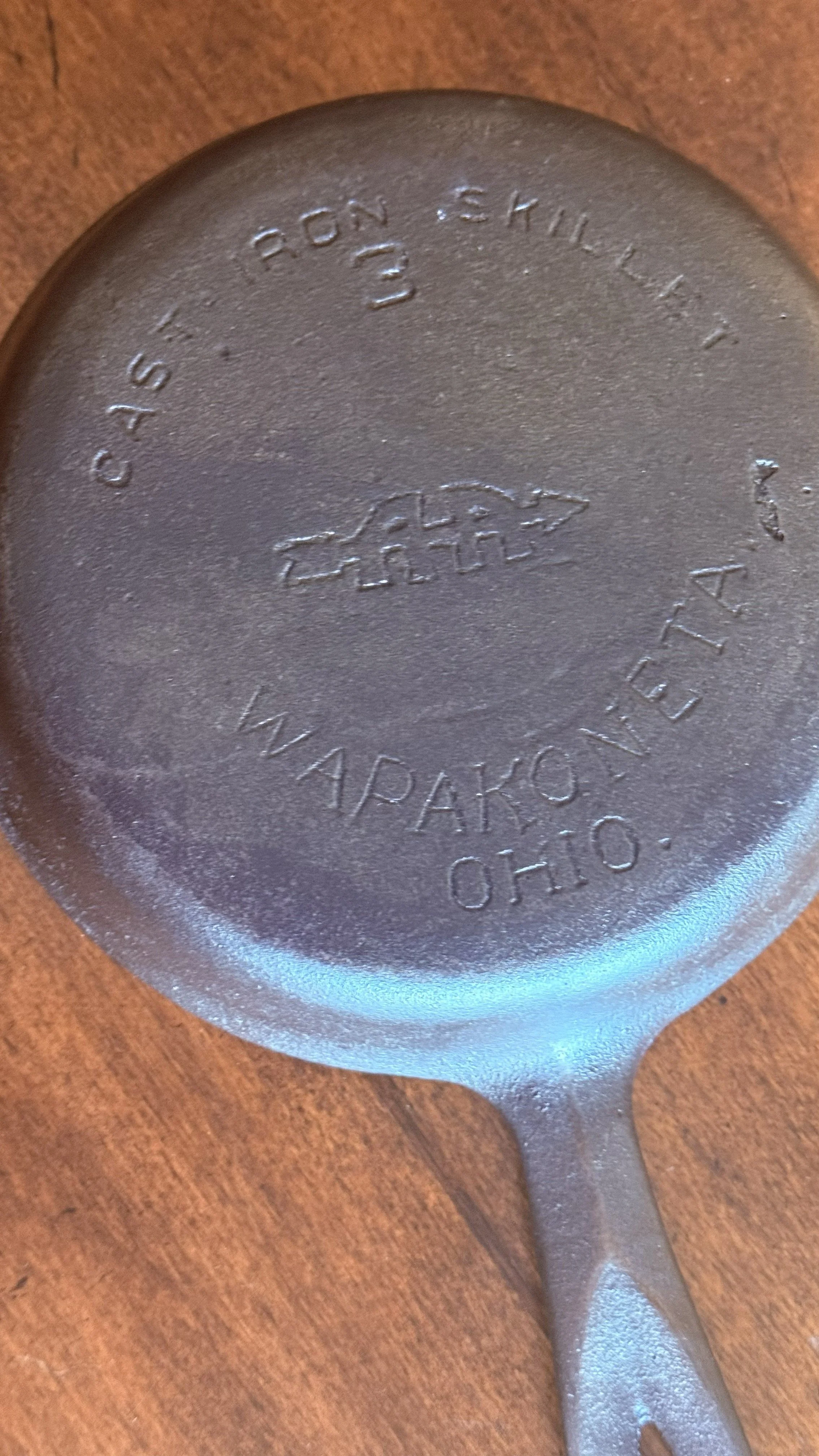
Close-up of the Ahrens & Arnold No. 3 base markings: the CAST · IRON · SKILLET arc at top with raised dot word separators — a specific pattern design choice distinctive to A&A production — size numeral 3 at center, the AA arrow emblem below — a horizontal arrow pointing right with fletching at left terminus, arrowhead at right, and letters AA centered in the arrow body — and the two-line WAPAKONETA / OHIO. origin text with its distinctive terminal period. A small mold cavity mark is visible to the upper right of WAPAKONETA, a casting artifact from the sand mold process consistent with small foundry production of the period. The legibility of these markings on a confirmed Ahrens & Arnold piece is the primary determinant of collector value — worn or partially obliterated marks reduce both documentary and market significance substantially. The markings on this specimen are among the most clearly defined recorded on a No. 3 in the collector literature.
Manufacturer
Ahrens & Arnold
Brand Mark
AA arrow emblem — horizontal arrow pointing right with fletching at left terminus and arrowhead at right; letters AA centered in arrow body; cast as raised element on base between size numeral and origin text; confirmed on physical examination: no secondary element below the arrow
Piece Type
Skillet
Size Number
No. 3
Base Marking
CAST · IRON · SKILLET (arc, upper field; raised dot separators between each word — distinctive A&A pattern convention); size numeral 3 (center); AA arrow emblem (center below numeral); WAPAKONETA (lower field); OHIO. (two-line origin text; terminal period present and clearly defined)
Bottom Configuration
No heat ring; smooth flat base; AA arrow emblem and full origin text centered on base interior; sand casting surface texture consistent with small-shop production
Mold Cavity Mark
Small raised mold cavity mark present to upper right of WAPAKONETA text; casting artifact from the sand mold process; consistent with small foundry production practice of the period
Pattern Characteristics
Dot word separators in arc text (CAST · IRON · SKILLET); terminal period after OHIO.; hand-cut pattern lettering evidenced by slight letter spacing irregularities in WAPAKONETA — all consistent with small-shop pattern fabrication rather than machined typeset characters
Handle Style
Flat handle with teardrop open-center hang-hole; size numeral "3" cast on upper face of handle near hang-hole; characteristic late 1920s small Ohio foundry handle configuration
Pour Spouts
None — consistent with No. 3 small-size production of the period
Date of Manufacture
Circa Late 1920s (post-Wapak closure; c. 1927–early 1930s)
Place of Manufacture
Wapakoneta, Auglaize County, Ohio
Condition
Very Good — base markings fully legible with strong definition; AA arrow emblem clearly present; origin text complete with terminal period intact; no cracks, chips, or active rust; interior smooth with well-developed seasoning; display ready without conservation
Acquisition Date
November 28, 2025
Acquisition Source
Etsy — Seller: EarlyBirdRustyRelics
Etsy Transaction Number
4850231091
Purchase Price
$295.98 item + $0.00 shipping + $25.08 tax = $321.06 total
SSC Catalog Number
SSC-AA-SKL-03-LOGO-001
The AA Arrow Emblem: Design, Construction, and Authentication
The collector literature on American cast iron is reasonably comprehensive on the major foundry marks. Griswold's spider, Wagner's arc, the Columbus Hollow Ware THE FAVORITE inscription, the Favorite Piqua Ware Smiley cartouche, the Wapak Indian Head medallion — each of these marks has been cataloged, dated, and contextualized in the reference literature with precision. The Ahrens & Arnold arrow emblem occupies a different category entirely: not underdocumented because it is complex or ambiguous, but underdocumented because so few pieces exist to study and so little collector literature has been devoted to a maker this obscure.
Close examination of the base on this No. 3 allows a definitive description of the emblem. The mark is a horizontal arrow pointing right, with clearly defined fletching — the feathered vanes at the back of the arrow shaft — at the left terminus, and a clearly defined arrowhead at the right terminus. The letters AA are centered within the arrow body. Physical examination confirms no secondary element below the arrow. The emblem is complete as described: arrow with AA. Clean, direct, unambiguous.
The choice of an arrow as the primary emblem element is consistent with the industrial trade mark vocabulary of American small manufacturing in the 1920s. Arrows in trade marks of this period signified forward motion, precision, and reliability — values that a small foundry operation trying to establish itself in a regional market would have had strong reason to claim. The arrow is also practically well-suited to sand casting: it produces a clear, directional shape in modest relief that reads unambiguously even on a small casting where fine detail may be lost to surface texture.
The surrounding arc text contains a detail that elevates the pattern analysis: the word separators in CAST · IRON · SKILLET are not spaces but raised dots — a deliberate pattern design choice that required the pattern maker to individually cut small raised elements between each word. This is not a standard convention in Ohio foundry arc text. Its presence on this No. 3 is an authentication marker that distinguishes genuine A&A pieces from misattributed examples at a level of detail that would be difficult to replicate in a forgery.
The contrast with the Wapak Indian Head is instructive. Wapak invested in a complex figurative medallion because it was competing for market share against Wagner and Griswold and needed a premium visual signal. Ahrens & Arnold was operating in a fundamentally different register: a small post-closure operation marking their work not to capture a brand position but to identify their output as theirs. The arrow with AA is a maker's signature, not a marketing instrument. In its directness, it is as historically honest a mark as the Indian Head is visually ambitious.
Ghost Marks: A Documented Absence
Ahrens & Arnold is documented in collector research as having used existing skillets — most often Griswold pieces — as pattern sources rather than commissioning new patterns from scratch. In sand casting, a pattern pressed into the sand creates not just the mold cavity for the skillet's geometry but also captures any raised markings on the pattern piece's surface: the original maker's name, size numeral, logo, or heat ring detail. The resulting casting carries both the new maker's markings and, on some examples, faint ghost impressions of the original pattern piece's markings — visible under raking sidelight as faint raised or recessed traces inconsistent with the primary marking layout.
This No. 3 has been examined under raking light. No ghost marks are present. The base interior shows only the Ahrens & Arnold primary markings — the CAST · IRON · SKILLET arc with dot separators, size numeral, arrow emblem, and WAPAKONETA / OHIO. origin text — without any faint impressions of underlying Griswold or other maker's markings.
The absence is itself a documented finding. It suggests one of three possibilities: that the pattern used for this No. 3 had been sufficiently worked and smoothed over multiple casting cycles to eliminate the source piece's markings from the mold cavity; that the sand preparation for this particular pour was clean enough to suppress shallow impression transfer; or that Ahrens & Arnold used a purpose-made or purpose-modified pattern for their No. 3 production rather than relying entirely on unmodified existing skillets. The absence of ghost marks does not affect the attribution confidence — the primary markings are unambiguous — but it is a definitive observation that belongs in the catalog record.
The Mold Cavity Mark: A Casting Detail Worth Documenting
The small mark visible to the upper right of the WAPAKONETA text is a mold cavity mark — a casting artifact produced by the sand mold process itself rather than an intentional design element of the pattern. In sand casting, the process of preparing, packing, and withdrawing the pattern from the sand can leave small traces in the mold cavity that carry through into the finished casting as minor raised or impressed marks on the base surface. These marks are incidental to the casting process and are not uncommon on small foundry production of this period, where mold preparation was done by hand without the standardization of larger industrial operations.
The presence of this mark is worth documenting precisely because it is a physical record of the hand process by which this skillet was made — a trace of the mold cavity preparation that no subsequent finishing step removed from the base surface. On a piece from a maker this obscure, every physical detail that can be observed and recorded contributes to a more complete understanding of the production methods Ahrens & Arnold employed. The mark is not an authentication marker and not a production control identifier; it is simply evidence of the sand casting process as practiced in a small Ohio foundry in the late 1920s, preserved in the iron for nearly a century.
Authentication Markers: A Complete Checklist for This Piece
The rarity of Ahrens & Arnold pieces creates both collector interest and the potential for misattribution — either of unmarked pieces speculatively claimed as A&A, or of authentic pieces whose significance is missed by uninformed sellers. This No. 3 presents a complete and unusually well-preserved set of authentication markers that collectively make the attribution unambiguous.
Present and confirmed on this piece:
• CAST · IRON · SKILLET arc with raised dot word separators — not spaces, but raised dots between each word — a specific A&A pattern convention not standard in Ohio foundry arc text, requiring deliberate pattern fabrication to replicate.
• AA arrow emblem — horizontal arrow pointing right, fletching at left terminus, arrowhead at right terminus, AA centered in arrow body — present and clearly legible, correctly positioned between size numeral and origin text. No secondary element below the arrow confirmed on physical examination.
• WAPAKONETA origin text — correctly spelled; slight letter spacing irregularities consistent with hand-cut pattern lettering, distinguishable from machined typeset characters on close examination.
• OHIO. with terminal period — present and clearly defined; a deliberate pattern element consistent across the confirmed A&A corpus and not a casting artifact.
• Mold cavity mark — small casting artifact present to upper right of WAPAKONETA, outside main marking layout; physical record of the hand sand casting process.
• No heat ring — confirmed; smooth base perimeter, distinguishing A&A from heat ring-equipped Wapak and other Ohio foundry production.
• Size numeral 3 on handle upper face — present and clearly cast near the hang-hole.
Any piece claimed as Ahrens & Arnold that cannot present the dot separators, the terminal period after OHIO., and the arrow emblem in correct configuration should be treated with skepticism until those elements are confirmed.
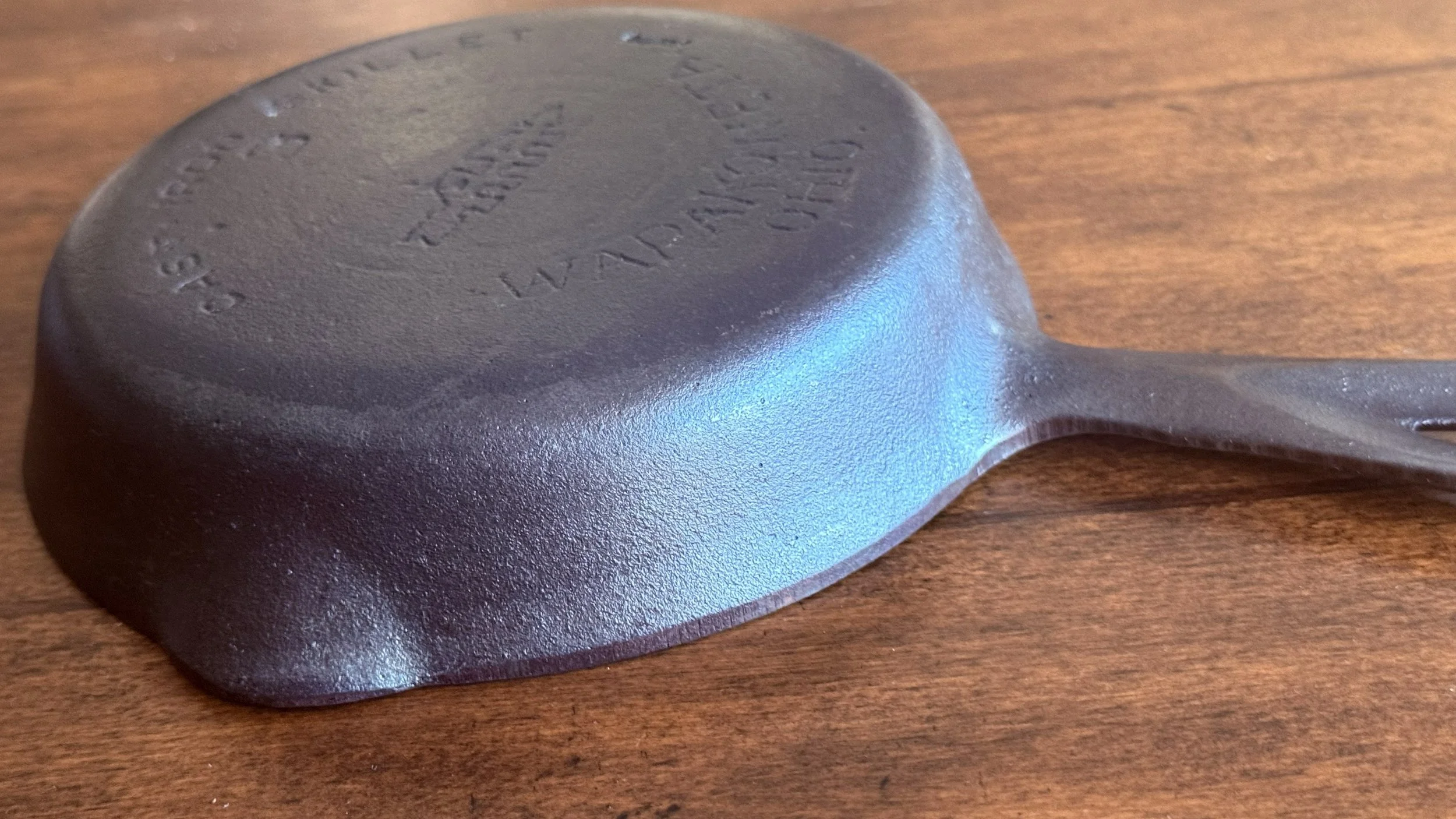
Profile view of the Ahrens & Arnold No. 3 showing the compact proportions of the small-size skillet, the smooth base perimeter without heat ring, the relatively shallow sidewall consistent with late 1920s small Ohio foundry production, and the teardrop hang-hole handle characteristic of the period. The base markings are partially visible at left. The overall casting is sound and correct for the No. 3 size, with surface characteristics consistent with hand sand casting at a small Ohio foundry operation.
The No. 3 in the Ahrens & Arnold Size Run: Scarcity and Significance
The full extent of the Ahrens & Arnold size run is not definitively established in the collector literature — one of many gaps in the documentation of this maker. Confirmed pieces have been reported in a range of sizes. The No. 3 is among the smallest confirmed sizes, and its survival rate reflects both the lower production volume typical of small sizes in any foundry's output and the higher attrition rate of the smallest skillets, which saw the heaviest daily use and the least careful treatment over decades of kitchen service.
A confirmed, marked Ahrens & Arnold No. 3 in Very Good condition is not a piece that appears in the collector market with any regularity. The base markings — particularly the AA arrow emblem and the WAPAKONETA / OHIO. origin text with terminal period — must be clearly present for a piece to be confidently attributed rather than speculatively identified. Worn, corroded, or partially legible examples are far more common than clearly marked ones. This No. 3 presents its markings with the legibility that makes confident attribution possible and that elevates the piece from an interesting find to a documentable specimen.
The $295.98 acquisition price sits at the upper end of the Ahrens & Arnold market for No. 3 pieces in this condition — a reflection of the rarity tier this maker occupies rather than the prestige tier of a Wapak Indian Head or a Griswold large block logo. Ahrens & Arnold commands collector interest not because of the visual power of its mark but because of the extreme scarcity of confirmed pieces. The market for this maker is small, knowledgeable, and specific. When a clearly marked example in this condition appears, it does not stay available.
The Wapakoneta Pairing: Two Pieces, One Complete Story
The SSC collection now holds two pieces from Wapakoneta, Auglaize County, Ohio — and the pairing is not incidental. The Wapak Indian Head No. 3, documented as SSC-WAP-SKL-03-IH-001, represents Wapakoneta cast iron at its peak: the fully established foundry, the premium brand mark, the production at scale, the market position that made the Indian Head medallion the most visually distinctive logo in the Ohio foundry corpus. This Ahrens & Arnold No. 3, documented as SSC-AA-SKL-03-LOGO-001, represents Wapakoneta cast iron in its aftermath: the closed foundry, the former employees, the improvised patterns, the brief and poorly-documented effort to keep the trade alive in the same county where it had flourished.
The two pieces are the same size — No. 3. They are from the same city — Wapakoneta. They are from adjacent periods — Wapak operating c. 1903–1926, Ahrens & Arnold operating c. 1927–early 1930s. No other private collection in the documented SSC collector network holds a confirmed matched-size pairing from both the Wapak and Ahrens & Arnold production lines. The SSC collection holds that pairing, and with it the ability to tell the complete Wapakoneta story — from the founding of one of Ohio's most admired small foundries to the scrappy persistence of the men who refused to let the Auglaize County foundry tradition end with the bankruptcy notice.
That story is, in miniature, the story of American manufacturing in the early 20th century: the rise, the disruption, the determination, and the silence. The iron survived. The story is recoverable. The SSC collection's purpose is to recover it.
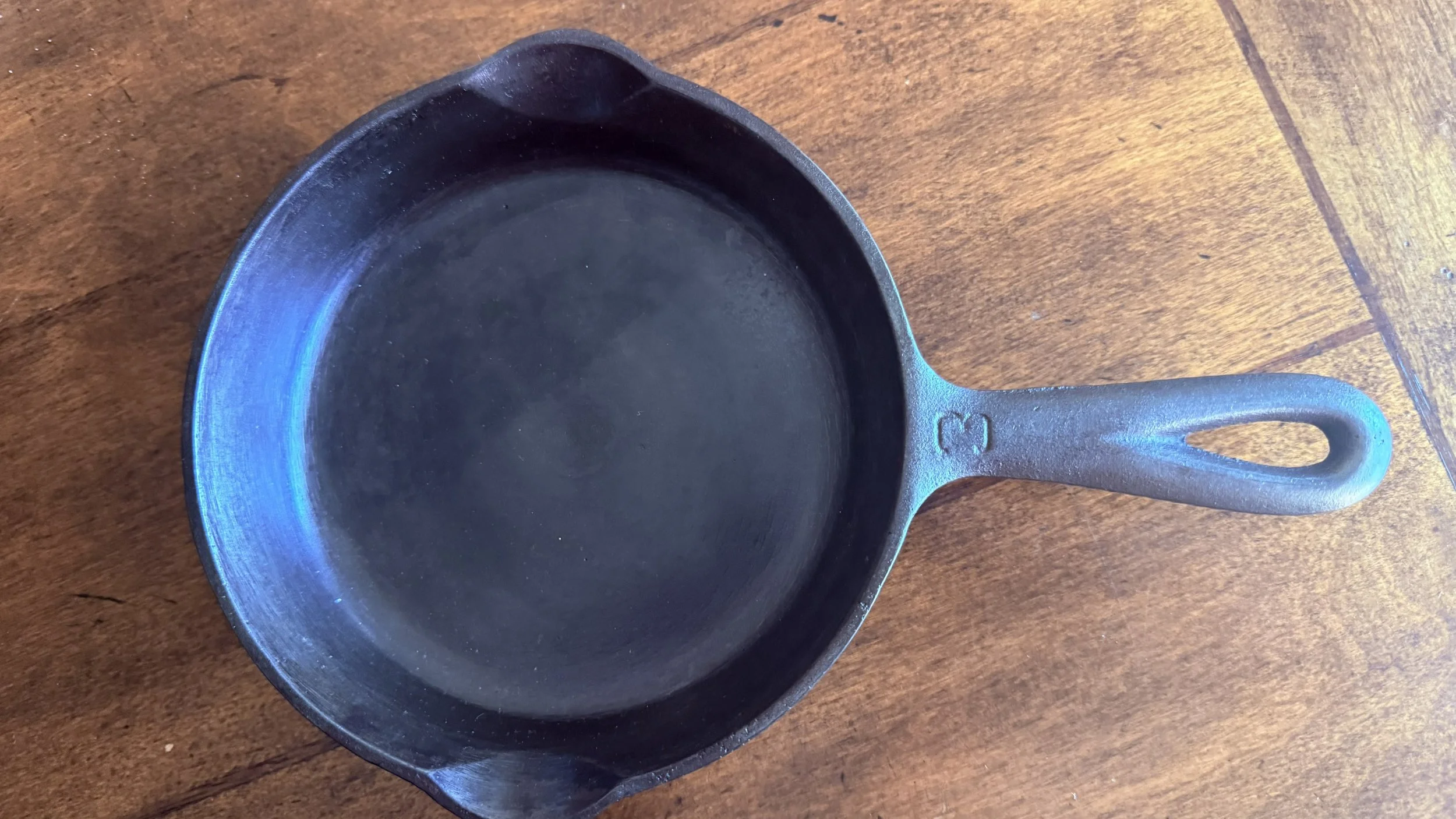
Top view of the Ahrens & Arnold No. 3 showing the clean interior with well-developed seasoning, the absence of pour spouts consistent with the small No. 3 size and the production conventions of the period, and the characteristic teardrop hang-hole handle with size numeral 3 visible on the upper face near the hang-hole. The cooking surface quality — smooth and evenly seasoned — is consistent with the Very Good condition assessment. The overall interior geometry is sound and correct for the size.
Ahrens & Arnold: Company History
Ahrens & Arnold was a small cast iron foundry operating in Wapakoneta, Auglaize County, Ohio, in the late 1920s and possibly into the early 1930s. The company is believed to have been established by two former employees of Wapak Hollow Ware Company following that firm's closure around 1926 — men whose surnames, Ahrens and Arnold, constitute nearly the entirety of the documented record of the firm's existence. No incorporation documents, no period newspaper references, no business directory listings have been confirmed in the collector research literature. The company is known through its output and through nothing else.
The production method — pattern reuse from existing skillets rather than purpose-built foundry patterns — reflects the capitalization constraints of a small post-closure operation. The equipment required to run a sand casting foundry was available and familiar to former Wapak workers; the capital required to commission professional patterns was not. The compromise was resourceful and functional: it produced cookware that was geometrically sound, properly marked with the company's own origin text and device, and saleable in the regional market. It also produced, as a documented byproduct on some examples, ghost marks — faint impressions of the source pattern's original markings that survive into the finished casting and are visible under raking light. This No. 3 does not exhibit ghost marks, a finding consistent with either a well-worked pattern or careful sand preparation on this particular pour.
The duration of the operation is unknown. The collector literature suggests a brief window — a few years at most — consistent with the very small number of pieces that have reached the modern market. No Ahrens & Arnold production has been documented after the early 1930s. Whether the company closed due to the onset of the Great Depression, the death or relocation of the principals, competition from the larger Ohio foundries, or some other cause is unrecorded. The iron simply stops appearing in the historical and collector record, and with it, whatever remained of Ahrens & Arnold as a going concern.
Corporate Timeline: Ahrens & Arnold
c. 1926
Wapak Hollow Ware Company ceases operations in Wapakoneta, Auglaize County, Ohio. Former employees Ahrens and Arnold begin planning a successor casting operation using available foundry equipment and pattern reuse methods.
c. 1927
Ahrens & Arnold begins production in Wapakoneta. The AA arrow emblem, CAST · IRON · SKILLET arc with raised dot word separators, and WAPAKONETA / OHIO. origin text with terminal period are established as the company's complete marking convention. Sand casting production methods consistent with small Ohio foundry practice of the period.
c. 1927–early 1930s
Full production period. A limited size run of skillets is produced and sold into the regional market. Ghost marks from pattern source pieces are present on some examples. Total output is a fraction of the volume produced by the major Ohio foundries.
c. Early 1930s
Ahrens & Arnold ceases operations. No closing documentation has been located. The company's brief production window leaves fewer confirmed surviving pieces than any other named maker in the Ohio foundry corpus.
2025
Steve's Seasoned Classics acquires this No. 3 from Etsy seller EarlyBirdRustyRelics. Documented as SSC-AA-SKL-03-LOGO-001, the first Ahrens & Arnold piece in the SSC collection and the rarest maker attribution in the collection to date at $321.06.
Why This Piece Matters
The Ahrens & Arnold No. 3 matters for three reasons that are distinct but compound each other. First, it introduces the rarest named maker in the Ohio foundry corpus into the SSC collection. Every previous named Ohio piece in the collection — Wapak, Columbus Hollow Ware, Favorite Piqua Ware — is from an operation that produced enough output to appear regularly in the collector market and to generate a reference literature. Ahrens & Arnold has neither. It is documented in the collector community primarily through the pieces themselves. Adding a confirmed, clearly marked example to a museum collection is a documentary act — it creates a permanent, accessible record of a maker that the broader historical record has almost entirely ignored.
Second, the physical evidence on this No. 3 advances what is known about Ahrens & Arnold as an operation. The dot separators in the CAST · IRON · SKILLET arc confirm a deliberate and specific pattern convention not shared by other Ohio foundry marks. The mold cavity mark on the base, the absence of ghost marks, and the overall casting quality together paint a picture of a small but methodical foundry operation — men who knew what they were doing and did it with care. This piece does not merely confirm what was known — it documents it at a level of physical detail the collector literature has not previously achieved for this maker.
Third, paired with the Wapak Indian Head No. 3, this piece completes a curatorial narrative that no other collection in the SSC network has assembled: the full Wapakoneta arc, from peak production to post-closure persistence, in matched size, from the same county, in the same generation. The SSC collection was built to document the Ohio foundry corridor in depth. This acquisition means that Wapakoneta — both its triumph and its aftermath — is now fully represented in that documentation.
The iron endures. The markings tell the truth. The story deserves to be told.
Sources & Further Reading
CastIronCollector.com — Ahrens & Arnold reference entry: maker documentation, known size configurations, and pattern reuse research.
BoonieHicks.com — Ohio foundry documentation including Wapakoneta-area makers and post-Wapak production research.
Griswold & Cast Iron Cookware Association (GCICA) — Collector community documentation of confirmed Ahrens & Arnold specimens and ghost mark forensics.
WorthPoint.com — Historical auction records for confirmed Ahrens & Arnold pieces in comparable condition and size.
SSC Internal Collection Records — Wapak Indian Head No. 3 entry (SSC-WAP-SKL-03-IH-001) — comparative Wapakoneta production reference; Ohio Foundry Corridor collection overview.
About Steve's Seasoned Classics
Steve's Seasoned Classics is an online museum dedicated to preserving and documenting the heritage of American cast iron cookware, with a focus on Ohio foundry pieces from the 19th and early 20th centuries. The SSC collection features over 60 pieces with detailed provenance, historical research, and photography for each item.
