Griswold “ERIE” No. 8 Skillet — Pre-Spider Era
SSC MUSEUM COLLECTION
Catalog No. SSC-GRW-SKL-08-ER-001
“ERIE” Arc Mark | No. 8 Size | Erie, Pennsylvania
Circa 1880s–1905 • Griswold Manufacturing Co.
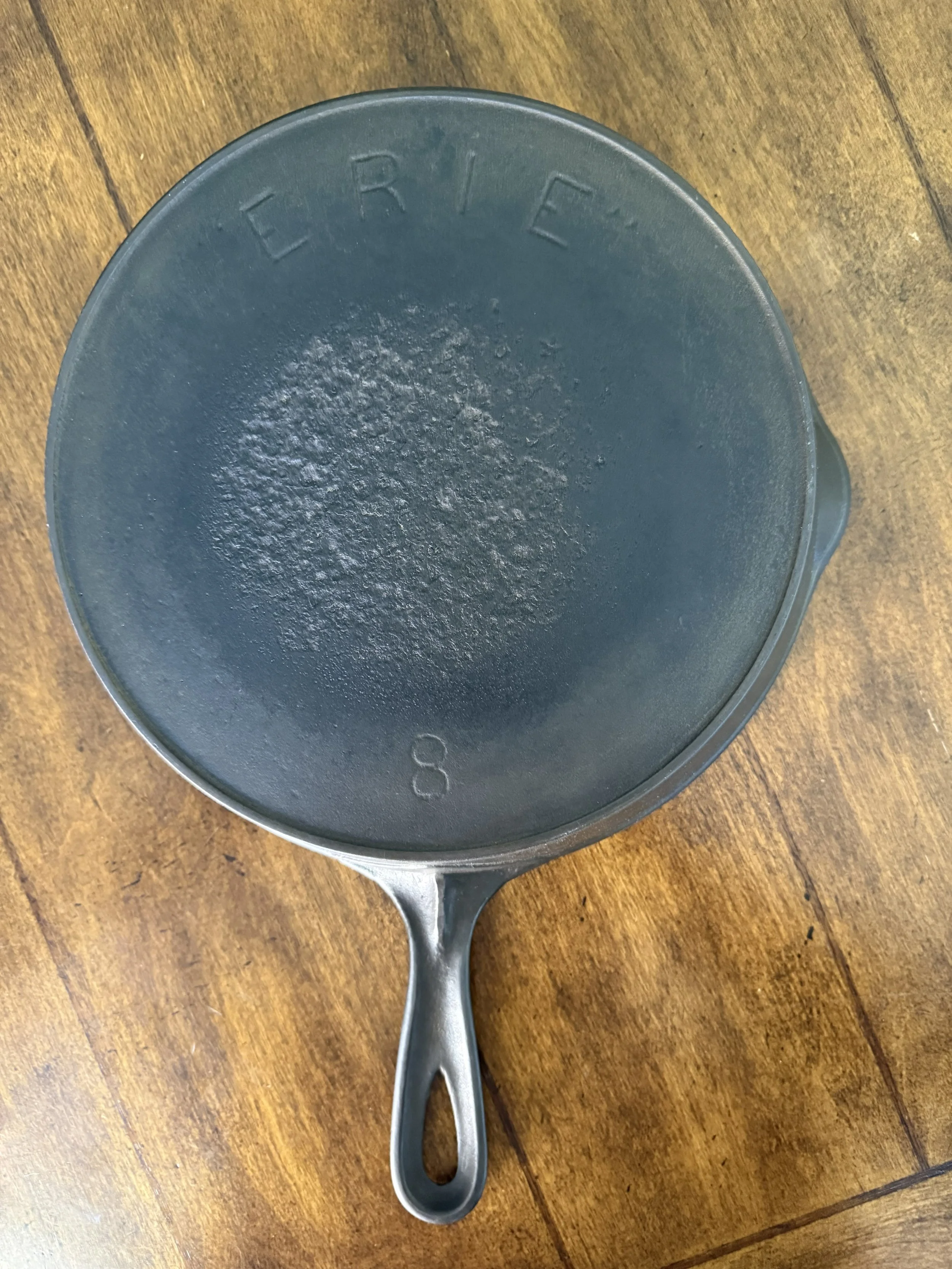
Bottom view of the Griswold “ERIE” No. 8: “ERIE” arched along the upper rim of the base, size numeral “8” near the handle junction, and the characteristic center sprue area showing the slightly textured patch where the casting gate was managed. No heat ring — the smooth flat base is the defining bottom configuration of the pre-spider Griswold Erie production period.
The SSC collection is built around Ohio iron. The Columbus Hollow Ware pieces from Franklin County, the Favorite Piqua Ware pieces from Miami County, the pre-logo era gate scar skillet from an unknown regional foundry — the core of the collection tells the story of the Ohio foundry corridor and the cast iron heritage it produced. This No. 8 is from Pennsylvania. It is the first piece in the SSC collection to come from outside Ohio, and its presence here is deliberate: the “ERIE” mark on this base is one of the most significant early brand marks in the entire history of American cast iron, and documenting it in the context of the Ohio collection places the Ohio story in its proper national frame.
Griswold Manufacturing Company operated in Erie, Pennsylvania — a city that gave its name to this skillet’s most distinctive marking feature. The “ERIE” arc that runs along the upper base of this No. 8 is the pre-spider mark: the Griswold brand configuration from the period before the company developed the cross-and-circle logo with its central spider figure that would become the most recognized mark in antique American cast iron collecting. An “ERIE” mark places the piece firmly before approximately 1905, putting it in the same broad production era as the Columbus Hollow Ware pieces at the early end of the SSC collection and contemporary with the gate scar pre-logo piece at the collection’s chronological foundation.
The “ERIE” mark also carries a specific collector significance that goes beyond dating. It represents Griswold at its earliest branded phase — the period when the company was establishing the production quality and market presence that would eventually make it the most collected American cast iron brand of the 20th century. An ERIE-marked piece is not simply an early Griswold; it is a Griswold from the era before Griswold became Griswold in the collector sense. For the SSC collection, which traces the arc of American cast iron from pre-logo anonymity through the branded era’s peak, the ERIE No. 8 is a critical comparative reference point.
Piece Details
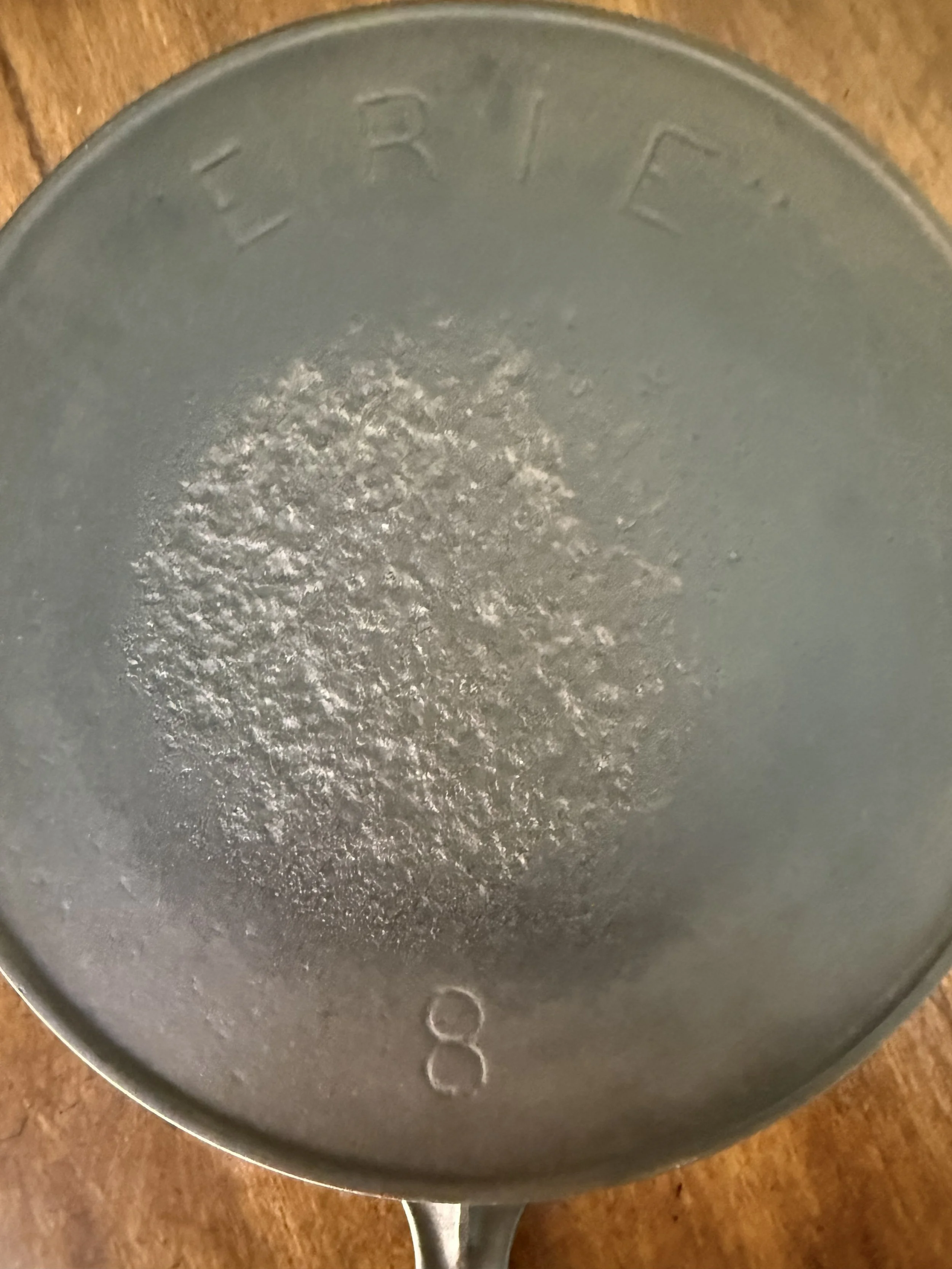
Detail view of the base markings: “ERIE” arched along the upper base rim with clean, well-defined letter impressions, and size numeral “8” near the handle junction. The center sprue area — the textured patch where the casting gate was managed during production — is visible in the base interior. This surface artifact, like the gate scar on the pre-logo piece elsewhere in the collection, is a physical record of the casting process rather than a defect.
Manufacturer
Griswold Manufacturing Co.
Brand Mark
“ERIE” — arched along upper base rim; pre-spider era mark
Piece Type
Skillet
Size Number
No. 8
Base Marking
“ERIE” arched at upper base rim; size numeral “8” near handle junction; center sprue area visible; no additional text or logo
Bottom Configuration
No heat ring — smooth flat base; characteristic of Griswold Erie production; center sprue patch in base interior
Pour Spouts
Two opposing spouts at rim
Handle Style
Flat handle with teardrop hanging loop; standard Griswold Erie handle configuration
Date of Manufacture
Circa 1880s–1905 (pre-spider era, based on ERIE mark configuration)
Place of Manufacture
Erie, Erie County, Pennsylvania
Condition
Very Good — ERIE mark crisp and fully legible; base flat with no warping; no cracks or chips; interior smooth with well-developed seasoning; sprue area present and intact; display ready
Acquisition Date
October 21, 2025
Acquisition Source
Etsy — Seller: ForgottenFoundries
Etsy Transaction
#4778900840
Order Number
#3833622972
Purchase Price
$159.95 list price − $16.00 (COMEBACK 10% discount) = $143.95 subtotal + $0.00 shipping + $12.20 tax = $156.15 total
SSC Catalog Number
SSC-GRW-SKL-08-ER-001
The “ERIE” Mark: Griswold Before the Spider
The Griswold Manufacturing Company went through several distinct marking phases across its operational history, and collectors use those phases as a primary dating and identification system. The “ERIE” mark — the company’s city of origin rendered in capital letters arched along the upper base rim — represents the earliest branded phase of Griswold production. Before the company adopted the distinctive cross-and-circle logo with the central spider figure that would define its mid-period identity, it marked its pieces simply with the city name. The iron was Erie iron, from Erie, Pennsylvania, and the mark said exactly that.
The transition from the ERIE mark to the spider/cross mark occurred gradually through the late 1890s and early 1900s, with the ERIE-only configuration generally associated with production before approximately 1905. Within the ERIE mark period, collectors distinguish between different configurations based on the presence or absence of additional text, the treatment of quotation marks around the ERIE lettering (this piece carries the quotation mark treatment visible at the right end of the arc — a variant noted in the collector reference literature), and the overall mark definition and placement. These sub-variations allow more precise dating within the ERIE period for collectors who have assembled sufficient comparative reference specimens.
The absence of a heat ring on this piece is the other major dating indicator. Griswold’s early production — the ERIE-period pieces — used a smooth flat base without the raised concentric heat ring that was standard on Ohio foundry pieces of the same era and that appears on virtually every piece in the SSC Ohio collection. The smooth base is a Griswold Erie production signature, and its presence here, combined with the ERIE arc mark, confirms the pre-spider dating with high confidence.
The Sprue Area: Erie Production and the Center Patch
The textured center patch visible in both the bottom and detail photographs is the sprue area — the location on the base interior where the casting gate was placed during production. Griswold’s ERIE-period production managed the gate differently from the Ohio foundry practice that left visible diagonal gate scars on pre-logo pieces: the sprue was placed at the base center and finished in a way that left a slightly different surface texture rather than a raised ridge. The result is the mottled, slightly granular patch visible in the base photographs — not a defect, not damage, but a physical record of where molten iron entered the mold cavity during the original casting.
This center sprue treatment connects the ERIE No. 8 to the broader SSC narrative about casting process artifacts as documentary evidence. The gate scar on the pre-logo era flat skillet is a visible raised ridge from an unmanaged gate. The center sprue patch on this ERIE No. 8 is the same phenomenon managed differently — placed centrally, finished more deliberately, but still present as evidence of the original pour. Griswold would continue to refine its gating and finishing practice through successive production periods, eventually producing the smooth, machine-finished cooking surfaces that made its later pieces the gold standard of American cast iron. The center patch on this ERIE No. 8 is an artifact of the earlier, less finished production approach that preceded that standard.
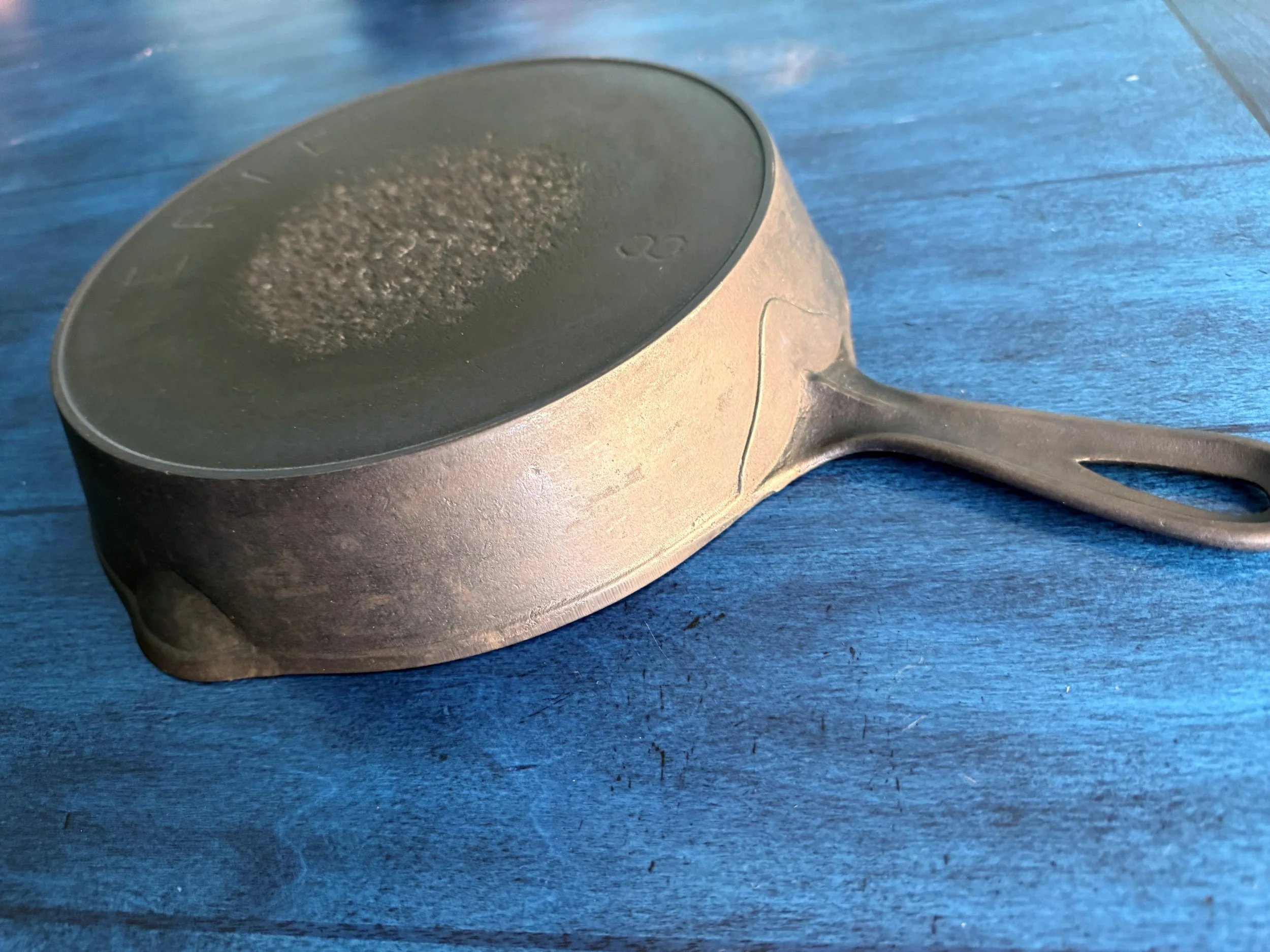
Profile view of the Griswold ERIE No. 8 showing the smooth flat base without heat ring — the defining bottom configuration of the ERIE production period and a clear contrast to the heat ring configuration of every Ohio foundry piece in the SSC collection. The substantial sidewall depth and the flat handle with teardrop loop are visible; the sprue area is partially visible on the base at left.
Griswold and Ohio: The Pennsylvania Counterpart
Understanding this ERIE No. 8’s place in the SSC collection requires understanding the relationship between Griswold and the Ohio foundry corridor. Griswold Manufacturing was not an Ohio company — it was a Pennsylvania company, operating in Erie on the southern shore of Lake Erie, drawing on the regional industrial infrastructure of northwestern Pennsylvania rather than the Miami River valley or Franklin County manufacturing base that produced the Ohio corridor pieces. Griswold and the Ohio foundries were contemporaries and competitors, producing similar products for overlapping markets through the same broad era of American cast iron’s commercial peak.
The competition was not abstract. Wagner Manufacturing in Piqua — the Ohio foundry that most directly overlapped with Griswold’s market position — produced a comparable premium consumer cast iron line at the same time Griswold was refining its ERIE-period production and developing the spider mark that would define its later identity. Both companies were making No. 8 skillets for Ohio and Pennsylvania households in the 1880s and 1890s. A consumer choosing between them was choosing between Erie iron and Piqua iron, between the ERIE arc and the Wagner arc, between two high-quality regional products that were more similar than different in their cooking performance but distinct in their marking identity.
The SSC collection documents the Ohio side of that competition in depth. This ERIE No. 8 provides the Pennsylvania reference point. It is not an Ohio foundry piece, but it is the piece that the Ohio foundry pieces were competing with, and placing it alongside the CHW and FPW entries in the SSC documentary record gives both sides of the competitive landscape a physical representation.
The No. 8 in Griswold’s Production Line
The No. 8 was as central to Griswold’s production identity as it was to the Ohio foundries’ output. At approximately 10½ inches across the cooking surface, the No. 8 was the household workhorse — the right size for daily family cooking, produced in the greatest volume, most likely to be found in any kitchen that had a Griswold skillet. Griswold’s No. 8 was also the piece through which the company’s quality standards were most visible in the market: the smooth cooking surface, the precise casting, the light weight relative to competitors — these characteristics were most apparent and most valued in the No. 8, where cooking performance could be directly compared to any other No. 8 on the market.
An ERIE No. 8 in Very Good condition with a fully legible arc mark, a flat base, and a clean well-developed interior is a reference-quality specimen of Griswold at its earliest branded phase. The SSC collection’s No. 8 documentation now extends across three distinct configurations: the Columbus Hollow Ware No. 8 (prison iron, pre-1905, Ohio), the Favorite Piqua Ware No. 8A single-logo Smiley (Piqua, Ohio, branded era), the FPW No. 8A dual Smiley + Miami (same size, dual-logo variant), and now this Griswold ERIE No. 8 (Erie, Pennsylvania, pre-spider era). Four No. 8 configurations from four distinct production contexts — each telling a different part of the American cast iron story.
Physical Characteristics & Condition Assessment
The ERIE No. 8 is a well-proportioned standard skillet with the physical characteristics associated with Griswold’s ERIE-period production. The base is smooth and flat without a heat ring — the primary visual distinction from the Ohio foundry pieces in the SSC collection, all of which carry heat rings. The ERIE arc along the upper base rim is crisp and fully legible: all four letters clearly defined, the quotation mark treatment at the right end of the arc visible in close examination. The size numeral “8” near the handle junction is clearly cast.
Two opposing pour spouts are present at the rim, consistent with standard Griswold No. 8 production. The handle is flat with a teardrop hanging loop at the terminus, following the standard Griswold Erie handle configuration. The overall proportions are correct for the No. 8 size.
Condition is assessed as Very Good. The ERIE mark is crisp. The base is flat with no warping. No cracks, chips, or cold shuts are present. The interior cooking surface carries a well-developed seasoning with the smooth, dark character of properly maintained vintage Griswold iron. The center sprue area is present as described — a casting process artifact, not a condition issue. Display ready.
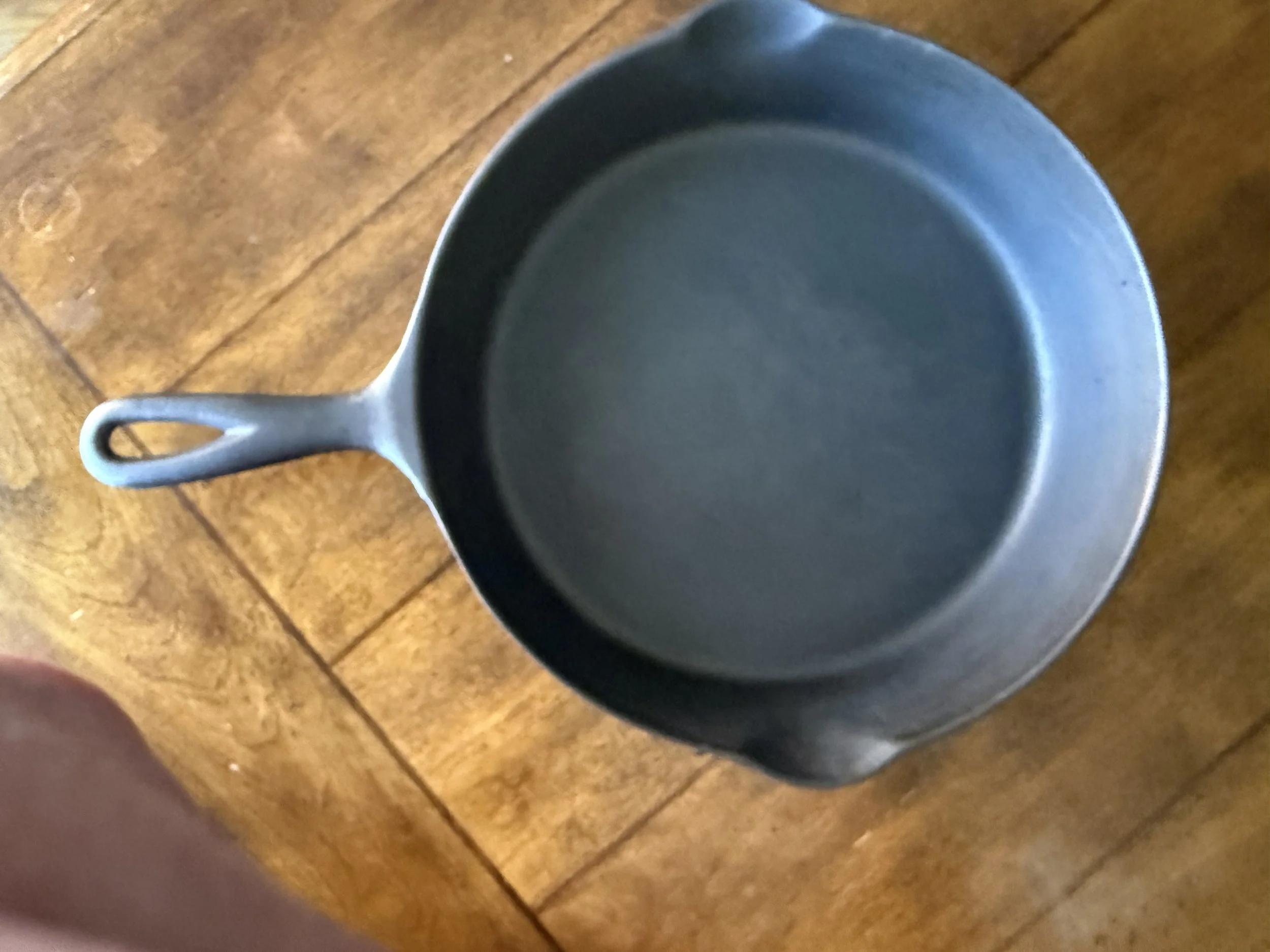
Top view showing the interior of the ERIE No. 8: a well-developed seasoning, the characteristic Griswold cooking surface with its slightly greater machine-finishing quality than comparable Ohio foundry pieces of the same era, and the two opposing pour spouts at the rim. The deep sidewall and the wide rim channel for lid seating are consistent with ERIE-period Griswold production standards.
Griswold Manufacturing Co.: Company History
Griswold Manufacturing Company was established in Erie, Pennsylvania, where it would operate for over a century as one of America’s premier cast iron cookware producers. The company’s early history is tied to the Selden family and their ironware business, with the Griswold name becoming the primary commercial identity in the 1880s. The ERIE mark — the period documented by this No. 8 — represents the company’s first branded phase, before the development of the cross-and-circle spider logo that would define its later and most widely collected period.
Through the late 19th and early 20th centuries, Griswold developed the production techniques and quality standards that eventually made its pieces the benchmark of American cast iron cookware. The light weight, smooth cooking surface, and precise casting that characterize Griswold’s best production were not fully achieved in the ERIE period — the center sprue area on this piece is evidence of that — but the direction was set. Griswold would continue refining its production through the spider mark era, the slant logo era, and the large block logo era, each successive period representing another step toward the quality standard that collectors now seek.
Griswold ceased independent operations in 1957 when it was acquired by McGlade Industries, and the brand changed hands several more times in subsequent decades. The original Erie production facility and the production quality of the pre-1957 pieces define what collectors mean when they discuss Griswold cast iron, and the ERIE-marked pieces like this No. 8 represent that tradition at its earliest documented phase.
Corporate Timeline: Griswold Manufacturing Co.
1865
Matthew Griswold and others establish Erie, Pennsylvania ironware business that will become Griswold Manufacturing Co.
1880s
Griswold Manufacturing Company fully established. “ERIE” arc mark enters production as the company’s primary brand identifier. This No. 8 is produced during this period.
c.1880s–1905
ERIE mark production period. Smooth base without heat ring is the standard bottom configuration. Center sprue treatment is characteristic of this era’s casting practice.
c.1900–05
Transition to spider/cross-and-circle mark begins. ERIE-only configuration gradually superseded by the new logo system that will define Griswold’s most collected production period.
c.1905–40s
Spider mark era: Griswold’s peak production period. The brand becomes the national premium standard for American cast iron cookware.
1957
Griswold acquired by McGlade Industries. Original Erie production ends. Pre-1957 pieces define collector-grade Griswold.
2025
Steve’s Seasoned Classics acquires this ERIE No. 8 from Etsy seller ForgottenFoundries. Documented as SSC-GRW-SKL-08-ER-001, the first Griswold and first non-Ohio piece in the SSC collection.
Why This Piece Matters
The Griswold ERIE No. 8 matters to the SSC collection for a reason that has nothing to do with Ohio and everything to do with it: it is the Pennsylvania reference point that puts the Ohio story in context. The Columbus Hollow Ware pieces, the Favorite Piqua Ware pieces, the Wagner pieces that will eventually join the collection — all of them existed in a competitive market that included Griswold. The ERIE mark on this No. 8 base is the mark of that competition, cast in iron, from the same broad production era as the earliest dated pieces in the SSC Ohio holdings.
It is also the most widely recognized mark in antique American cast iron collecting, and documenting an ERIE-period example — the earliest and rarest of the Griswold marking configurations — gives the SSC collection a reference point that most Ohio-focused collections lack. The ERIE No. 8 alongside the CHW No. 8, the FPW No. 8A, and the pre-logo gate scar piece creates a No. 8 comparative record across four distinct production contexts spanning roughly 1860s to 1930s. No other single size in the SSC collection tells as broad a story.
The iron endures. The markings tell the truth. The story deserves to be told.
Sources & Further Reading
Griswold & Cast Iron Cookware Association (GCICA) — Griswold marking period documentation: ERIE mark dating, spider mark transition, and production period identification.
CastIronCollector.com — Griswold Manufacturing Co. reference page: complete marking period chronology and physical characteristic documentation.
BoonieHicks.com — Griswold ERIE period reference including mark configuration variants and base configuration documentation.
WorthPoint.com — Historical auction records for Griswold ERIE No. 8 specimens in comparable condition.
SSC Internal Collection Records — CHW No. 8 entry (SSC-CHW-SKL-08-TF-001); FPW No. 8A dual-logo entry (SSC-FPW-SKL-08-SM-001); Pre-logo gate scar entry (SSC-UNK-SKL-08-GS-001) — comparative No. 8 reference specimens.
About Steve’s Seasoned Classics
Steve’s Seasoned Classics is an online museum dedicated to preserving and documenting the heritage of American cast iron cookware, with a focus on Ohio foundry pieces from the 19th and early 20th centuries. The SSC collection features over 60 pieces with detailed provenance, historical research, and photography for each item.
