Favorite Piqua Ware No. 5B Skillet
SSC MUSEUM COLLECTION
Catalog No. SSC-FPW-SKL-5B-Smiley-001
Smiley Face Logo | Heat Ring | Piqua, Ohio
Circa 1916–1935 • Favorite Stove & Range Co.
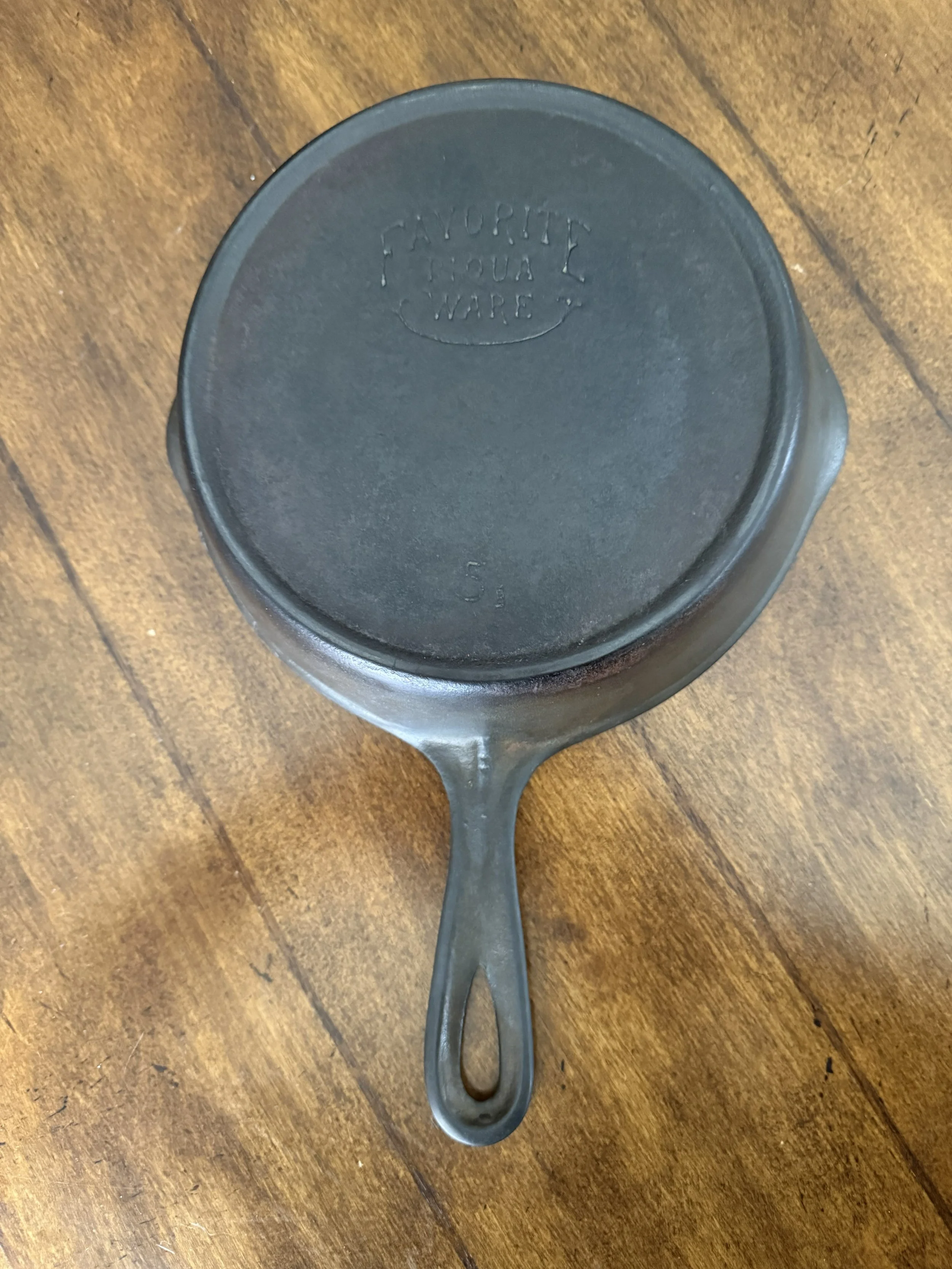
Bottom view showing the Favorite Piqua Ware Smiley logo and size marking “5B.”
This Favorite Piqua Ware No. 5B skillet represents one of the mid-range workhorses in the Favorite Stove & Range Company’s cookware lineup. Bearing the beloved “Smiley” logo—a curved flourish beneath the company name that gives the trademark its collector nickname—this piece was cast in Piqua, Ohio sometime between 1916 and 1935, during the golden age of American cast iron manufacturing.
The “B” suffix in the size designation indicates a mold variant, a common practice among foundries to track individual casting molds for quality control. The skillet features the classic Favorite Piqua Ware construction: thin walls, a smooth cooking surface, a raised heat ring on the bottom, dual pour spouts, and a teardrop-shaped hanging hole in the handle.
At approximately 8 inches across the cooking surface, the No. 5 is a versatile everyday pan—ideal for frying eggs, sautéing vegetables, or making a single portion of cornbread. It sits comfortably between the collectible smaller sizes and the more utilitarian larger skillets.
Piece Details

Close-up of the Smiley logo: “FAVORITE / PIQUA / WARE” with the distinctive curved flourish beneath, and size number “5B” below.
Manufacturer
Favorite Stove & Range Co.
Brand
Favorite Piqua Ware
Piece Type
Skillet
Size Number
No. 5B
Logo Variant
Smiley Face Logo
Approximate Dimensions
8” diameter × 12” overall length × 1¾” deep
Date of Manufacture
Circa 1916–1935
Place of Manufacture
Piqua, Miami County, Ohio
Condition
Sits flat, no cracks, no chips, heat ring intact, well-seasoned
Acquisition Date
August 27, 2025
Acquisition Source
eBay — Seller: rilke3
eBay Item Number
157251744979
Order Number
18-13493-84807
Purchase Price
$36.00 item + $12.70 shipping + $4.13 tax = $52.83 total
SSC Catalog Number
SSC-FPW-SKL-5B-Smiley-001
The Company: From Cincinnati to “The Favorite City”
The story of this skillet begins not in Piqua, but in Cincinnati. In 1848, William C. Davis founded W.C. Davis & Company, a stove and hollow ware manufacturer on the banks of the Ohio River. After the Civil War, the firm reorganized as Great Western Stove Works. In 1872, a young industrialist named William King Boal purchased partial ownership of the company, and by 1880 he had assumed full control, renaming it Favorite Stove Works.
Boal was an ambitious industrialist. When the Piqua Board of Trade came calling in 1886 with an extraordinary offer—eight free acres of land, eight new brick factory buildings, free natural gas for ten years, and tax exemptions—Boal signed on. Production began on February 25, 1889, with over 250 employees working in eight buildings on College Street.
The impact on Piqua was immediate and profound. The company became the city’s largest manufacturer. The community became known as “The Favorite City.” Workers settled on the hill west of the factory on what became known as “Stove Works Hill,” where generations of families would make their living in the foundry.
William King Boal died on January 2, 1916 at age 84. His son, William Stanhope Boal, succeeded him as president and significantly expanded the production of hollow ware—the cast iron cookware we collect today. Under his leadership, the Smiley logo became the company’s signature mark, appearing across the full range of skillets, Dutch ovens, and specialty pieces.
The Great Depression hit the company hard. William Stanhope Boal died on December 17, 1933. The firm reorganized under William C. Katker, who became the fourth company president, but it was too late. In 1935, the Favorite Stove & Range Company was liquidated. Foster Stove Company of Ironton, Ohio purchased the patents, patterns, dies, and trademarks—but the Piqua foundry never produced another piece.

Profile view showing the characteristic thin walls, heat ring, and graceful handle proportions of Favorite Piqua Ware.
The Smiley Logo: Favorite’s Most Beloved Mark
Favorite Stove & Range used approximately eight different logos on its cookware over the years. The earliest pieces bear a simple block letter trademark, and the consensus among collectors and researchers places the Smiley logo in the later period of production—roughly 1916 through 1935—making it a product of the William Stanhope Boal era.
The Smiley logo features “FAVORITE” arched across the top in an elegant serif font, with “PIQUA” centered below it, and “WARE” beneath that. What gives the logo its nickname is the graceful curved line beneath “WARE” that resembles a subtle smile. The overall impression is warm and inviting—a piece of early 20th-century brand identity that still charms collectors a century later.
On this No. 5B skillet, the Smiley logo is positioned at the 12 o’clock position on the bottom of the pan, with the size number “5” and mold letter “B” cast below at approximately the 6 o’clock position. The casting is crisp and well-defined, indicating a mold in good condition at the time of manufacture.
The Favorite Family: Four Brands, One Foundry
What many casual collectors do not realize is that Favorite Piqua Ware was only one of several brand names produced under the Favorite Stove & Range umbrella. The complete family includes four distinct brands:
Favorite Piqua Ware — The flagship brand. Premium quality hollow ware bearing the company’s own name, produced under various logos including the block letter, stylized, and Smiley variants.
Columbus Hollow Ware (“The Favorite”) — A subsidiary operation producing skillets marked “The Favorite” in Columbus, Ohio from approximately 1882 to 1902.
Miami — The budget-friendly brand, marked with a distinctive diamond logo containing the word “MIAMI.” Named after Miami County, where Piqua is located.
Puritan — A private-label brand manufactured for Sears, Roebuck & Co. These pieces were sold through the Sears catalog, bringing Favorite’s casting quality to a nationwide retail audience.
The Steve’s Seasoned Classics museum collection includes documented pieces from all four of these brands—a distinction we believe makes SSC the first and only online resource to present the complete Favorite family under one roof.
Physical Characteristics & Construction
Favorite Piqua Ware skillets are consistently praised by collectors for their light weight, thin walls, and smooth cooking surfaces—qualities that place them in the same conversation as Griswold and Wagner. The No. 5B exemplifies these traits.
The cooking surface is glassy smooth, the result of careful finishing at the foundry. Unlike modern cast iron, which is often left with a rough, pebbly texture from the casting sand, Favorite’s pieces were ground and polished to create a surface that develops a superb non-stick seasoning with use.
The bottom of the skillet features a raised heat ring around the outer edge, designed to sit securely on the flat cooking eyes of wood- and coal-burning stoves. This heat ring is one of the telltale signs of pre-1935 manufacture, as the shift to gas and electric ranges eventually eliminated the need for this feature.
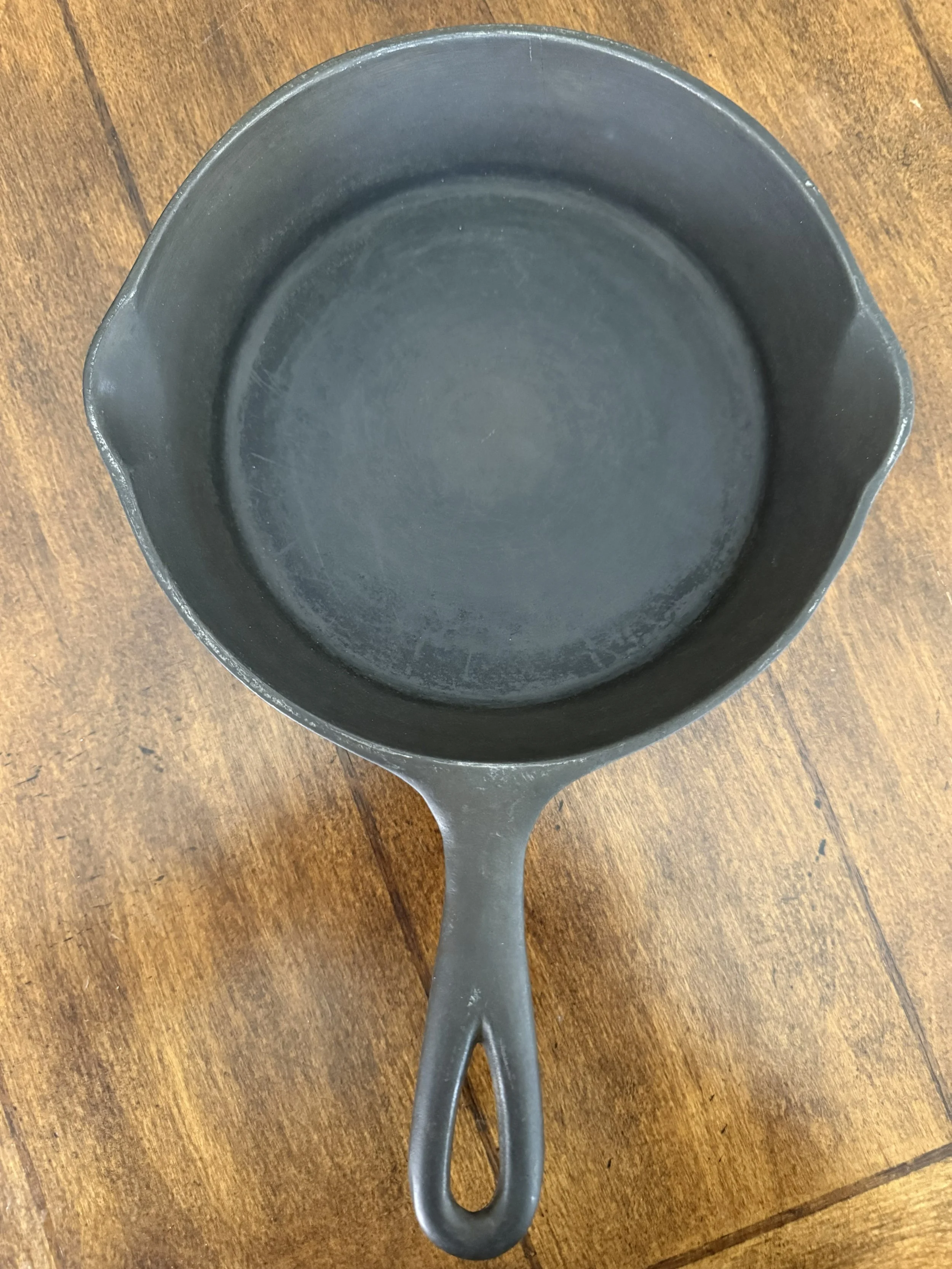
Top view showing the smooth, well-seasoned cooking surface with dual pour spouts and teardrop hanging hole.
Collector’s Context
The No. 5 is a solid mid-range size in the Favorite Piqua Ware lineup. Large enough to be a practical everyday cooker, yet still affordable compared to the scarcer larger sizes. The “B” mold letter adds a minor distinction for completists tracking mold variants.
For a collector building a Favorite Piqua Ware Smiley set, the No. 5 is typically acquired early in the journey alongside the common No. 3, No. 5, and No. 8 sizes. In the Steve’s Seasoned Classics collection, it joins Smiley-logo siblings across multiple sizes, contributing to what we believe is one of the most comprehensive documented Favorite Piqua Ware collections available online.
Pricing for Favorite Piqua Ware has historically been favorable compared to equivalent Griswold or Wagner pieces. A No. 5 Smiley in good condition typically trades in the $35–$65 range, making it an excellent entry point for new collectors discovering the brand.
Provenance & Acquisition
This No. 5B skillet was acquired on August 27, 2025, via eBay from seller rilke3, under eBay item number 157251744979 (order 18-13493-84807). The listing described it as a “Favorite Piqua Ware 5B Smiley Vintage Cast Iron Heat Ring Skillet — Rare Model.” The total acquisition cost was $52.83, comprising $36.00 for the item, $12.70 for USPS Ground Advantage shipping, and $4.13 in sales tax. The piece arrived well-packed and in the condition described: no cracks, no chips, sits flat on all surfaces, heat ring intact, with a well-established seasoning.
Corporate Timeline: From W.C. Davis to Liquidation
1848
William C. Davis founds W.C. Davis & Company in Cincinnati, Ohio, manufacturing stoves and hollow ware.
1865
After the Civil War, the firm reorganizes as Great Western Stove Works.
1872
William King Boal purchases partial ownership of Great Western Stove Works.
1880
Boal assumes full control after Davis’s retirement, renames the company Favorite Stove Works.
1881
The Favorite Stove Works Company is formally organized with Boal as President and Samuel P. Cheseldine as Secretary and Treasurer.
1882
Columbus Hollow Ware Company begins operations, producing skillets marked “The Favorite.”
1886
Boal signs contract with the Piqua Board of Trade to relocate the foundry.
1889
Favorite Stove & Range Company of Piqua, Ohio begins production on February 25 with 250+ employees in eight brick buildings on College Street.
1893
Stanhope Boal registers the “Favorite” trademark.
1896
Workforce exceeds 300; annual production surpasses 50,000 stoves.
1902
Columbus Hollow Ware Company ceases operations.
1916
William King Boal dies January 2 at age 84. His son William Stanhope Boal succeeds him and expands hollow ware production significantly.
1919
A labor strike lasting eleven days hits the plant, with workers demanding a 25% wage increase.
1923
William Stanhope Boal becomes Chairman of the Board.
1928
William C. Katker becomes the fourth company president.
1933
William Stanhope Boal dies December 17. The Great Depression devastates sales.
1935
Favorite Stove & Range is liquidated. Foster Stove Company of Ironton, Ohio purchases patents, patterns, dies, and trademarks.
Why This Piece Matters
A No. 5B Favorite Piqua Ware skillet is not the rarest piece of American cast iron, nor the most expensive. What it is, however, is a beautifully made, historically significant artifact from a foundry that helped define an entire Ohio community—a foundry whose products rivaled the best in the country, even if its name never achieved the same collector recognition as Griswold or Wagner.
Every piece in the Steve’s Seasoned Classics collection tells a story. This one tells the story of William King Boal, a Cincinnati foundry man who bet everything on a small Ohio town and built an empire that employed generations. It tells the story of Piqua, a community that proudly called itself “The Favorite City.” And it tells the story of American manufacturing at its finest—when skilled workers poured molten iron into sand molds and created objects so well-made that they endure, fully functional, more than a century later.
The Smiley logo smiles back at us across roughly a hundred years. The iron endures. The story deserves to be told.
Sources & Further Reading
CastIronCollector.com — Favorite Stove & Range Co. reference page and collector forums.
BoonieHicks.com — “Guide to Favorite Piqua Ware: Favorite Stove and Range Co.”
CastIronCanada.com — “Favorite Stove and Range History” — primary source research on W.C. Davis lineage.
Piqua Public Library Local History Department — “Favorite Stove” historical article, including Lois J. Fair contributions.
1909 History of Miami County, Ohio — Troy Historical Society biography entry for the Favorite Stove & Range Co.
Wikipedia — “Favorite Stove” article with community impact details.
About Steve’s Seasoned Classics
Steve’s Seasoned Classics is an online museum dedicated to preserving and documenting the heritage of American cast iron cookware, with a focus on Ohio foundry pieces from the 19th and early 20th centuries. The SSC collection features over 140 pieces with detailed provenance, historical research, and photography for each item.
