Ahrens & Arnold | Skillet | No. 3 | AA Logo | Griswold Ghost
Ahrens & Arnold No. 3 Cast Iron Skillet | Wapakoneta, Ohio | c. Late 1920s | SSC Museum Restoration
★ EXTREMELY RARE — ONE OF THE MOST OBSCURE AMERICAN CAST IRON MAKERS ★
Overview
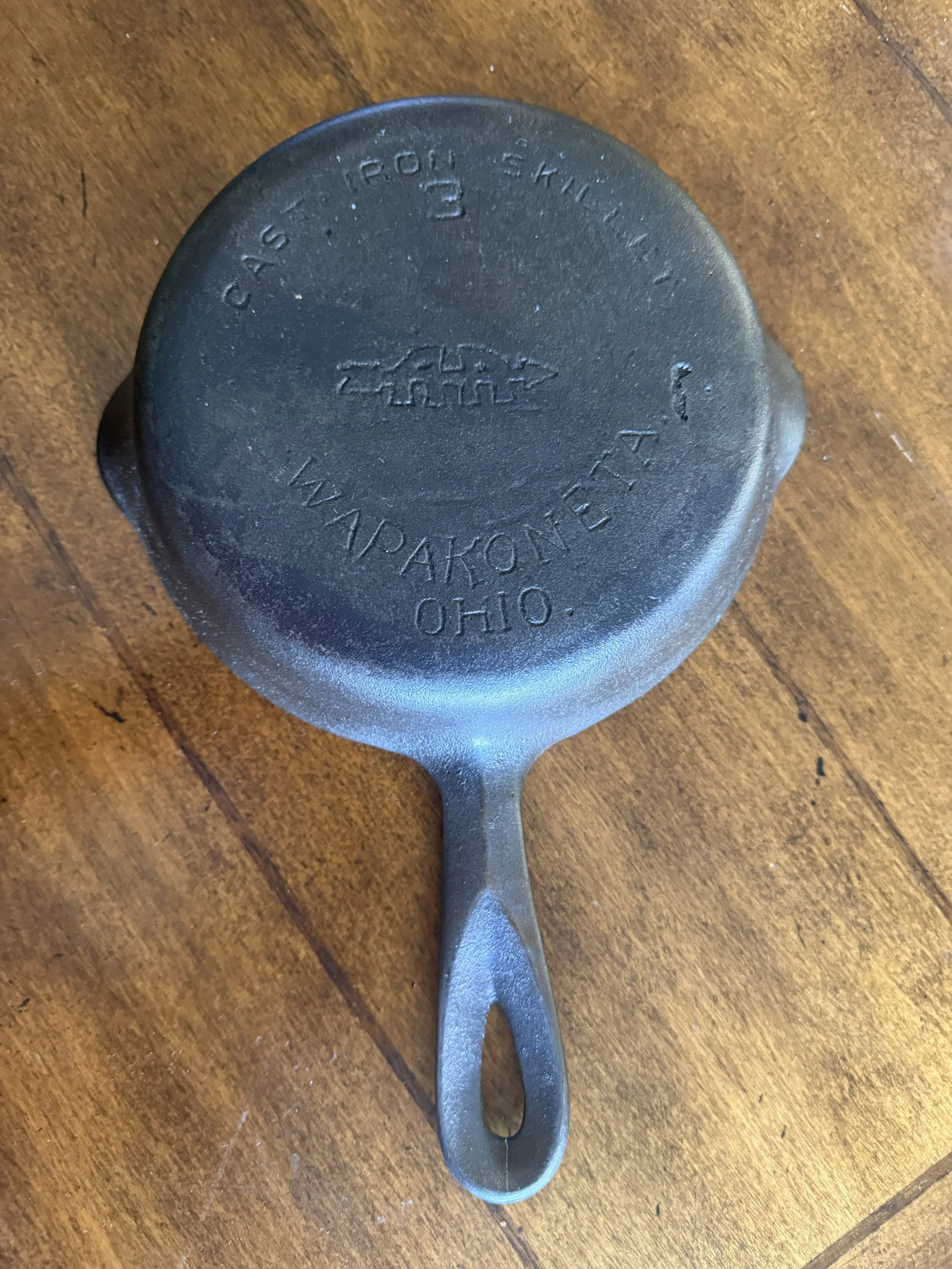
This is an Ahrens & Arnold No. 3 cast iron skillet — an exceptionally rare piece from one of the most obscure American cast iron makers known to exist. Ahrens & Arnold was a short-lived operation in Wapakoneta, Ohio, believed to have been founded by two former employees of the Wapak Hollow Ware Company after that foundry closed in 1926. Very few examples of their work have survived, making any Ahrens & Arnold piece a significant find for serious collectors.
The company is known to have used existing skillets (often Griswold) as patterns to create their molds, resulting in pieces that may exhibit "ghost marks" — faint impressions of the original manufacturer's markings visible beneath the Ahrens & Arnold branding. This practice, while producing pans with less precision than true pattern-made pieces, creates fascinating artifacts that document the scrappy determination of small foundry operations in the late 1920s.
This piece has been fully restored and seasoned to Steve's Seasoned Classics museum standards, preserved using the exclusive SSC Museum Process, and documented as part of the permanent SSC archive.
Identification & Markings
Maker: Ahrens & Arnold (Wapakoneta, Ohio)
Item Type: Skillet
Size: No. 3
Logo: "AA" (Ahrens & Arnold) centered on bottom
Era: c. Late 1920s (post-Wapak closure, 1926+)
Origin: Wapakoneta, Auglaize County, Ohio
Form/Features:
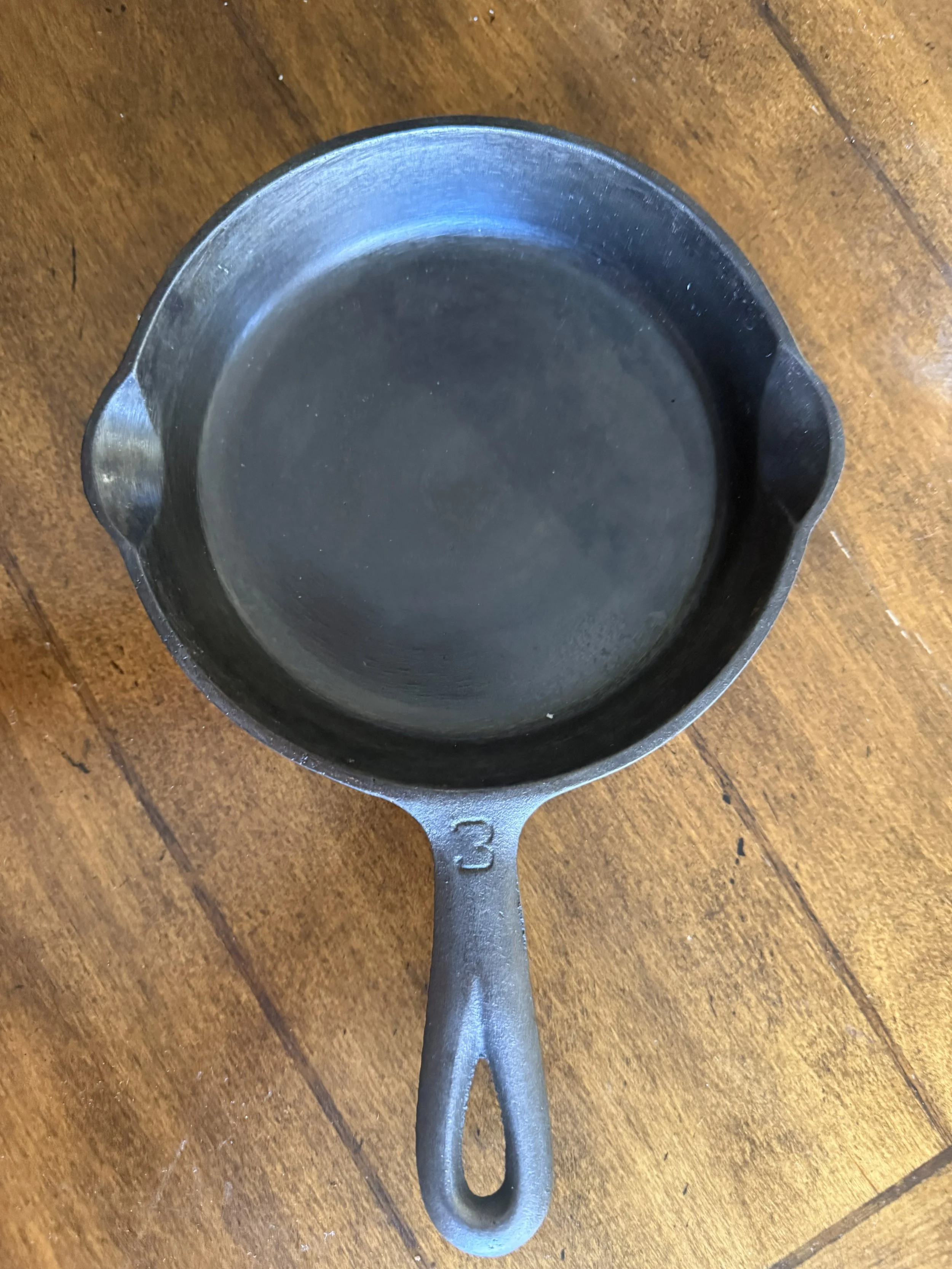
• Classic skillet profile derived from Griswold pattern
• "AA" logo marking (Ahrens & Arnold)
• Possible Griswold ghost marks (faint original markings)
• Dual pour spouts
• Heat ring (stove-era design)
Measurements & Weight (Typical Range for No. 3)
• Top Rim Diameter: ~6 1/2" – 6 3/4"
• Cooking Surface Diameter: ~5" – 5 1/2"
• Overall Length (handle tip to rim): ~10" – 11"
• Depth: ~1 1/2" – 1 3/4"
• Weight: ~2 – 2.5 lbs
Historical Context
The Wapak Hollow Ware Company was founded in 1903 in Wapakoneta, Ohio by five entrepreneurs: Milton and Harry Bennett, Charles and Marion Stephenson, and S.P. Hick. Starting with approximately $20,000 in assets, Wapak produced a full line of cast iron cookware including skillets, bean pots, kettles, Dutch ovens, griddles, sad irons, and waffle irons. The company became known for its distinctive "Indian Head" logo featuring a Native American chief in full headdress, which remains highly prized by collectors today.
Like many smaller foundries of the era, Wapak sometimes used existing cookware from competitors as patterns for their molds — a practice evidenced by "Erie" and "Griswold" ghost marks occasionally found on Wapak pieces. Despite producing quality lightweight "thin wall" cast iron, Wapak filed for bankruptcy and closed in 1926 after just 23 years of operation.
The Ahrens & Arnold Story: According to cast iron collector lore and limited documentation, Ahrens & Arnold was established by two former Wapak employees who attempted to continue producing cast iron cookware after the foundry's closure. Operating in the late 1920s from Wapakoneta, they produced a small number of pieces — primarily skillets — using other manufacturers' pans (often Griswold) as patterns rather than creating proper foundry patterns from scratch.
This "pattern from pan" approach resulted in several characteristics unique to Ahrens & Arnold pieces: ghost marks from the original pan's markings, slightly crude casting quality compared to major foundries, and pieces that often do not sit perfectly flat. These "flaws" are actually authentication markers — they confirm the piece's origin and the resourceful methods of this tiny operation.
Virtually nothing is documented about how long Ahrens & Arnold operated or how many pieces they produced. What is certain is that surviving examples are extraordinarily rare. Most serious cast iron collectors have never seen one in person, and they appear in the marketplace only a handful of times per decade.
Rarity & Collector Significance
Ahrens & Arnold pieces represent the outer frontier of American cast iron collecting — the point where documented history fades and artifacts become the primary evidence of a company's existence. Their extreme rarity stems from:
• Microscopic Production Volume: Believed to be one of the smallest cast iron operations ever documented
• Very Short Lifespan: Operated for only a brief period in the late 1920s
• Limited Documentation: Almost no historical records survive; knowledge comes primarily from surviving pieces
• Regional Distribution: Pieces likely sold only in and around Wapakoneta, Ohio
• Survival Rate: After nearly 100 years, very few examples are known to exist
For collectors who specialize in rare and obscure makers, an Ahrens & Arnold piece is a holy grail item — tangible proof of a foundry that most collectors have only read about. Owning one places a collection in elite company.
Condition Summary (SSC Museum Grade)
This skillet has been assessed and preserved in museum-grade condition:
✅ No cracks (confirmed)
✅ No repairs (confirmed)
✅ AA logo visible and authentic
✅ Griswold ghost marks present (typical for maker)
✅ Casting characteristics consistent with Ahrens & Arnold production methods
✅ Fully restored and seasoned to SSC museum standards
✅ Preserved using the SSC Exclusive Museum Process
✅ Excellent archive candidate for long-term preservation
Note on Geometry: Ahrens & Arnold pieces are known for sometimes not sitting perfectly flat due to the crude pattern-from-pan production method. This is not a defect but rather an authentication marker consistent with the maker's known production techniques.
Cooking & Collector Value
The Ahrens & Arnold No. 3 is primarily a collector's piece — its extreme rarity and historical significance make it far more valuable as a preserved artifact than as a cooking implement. The No. 3 size is functional for:
• Single egg cooking
• Small side dishes
• Individual portions
• Display and historical preservation
However, given its extraordinary rarity, this piece is strongly recommended for display/archive status only. Using it for regular cooking would be akin to using a rare historical artifact as an everyday tool — technically possible, but inadvisable given what would be at risk.
Restoration Plan (SSC Process)
This piece is already complete and preserved under the Steve's Seasoned Classics Museum Process:
• Museum-grade strip and iron neutralization
• Complete stabilization and surface conditioning
• SSC seasoning applied for durable archival finish
• Final inspection for markings, ghost marks, and authenticity
• Documentation preserved for SSC archive record
• Museum-grade storage prep and handling protocol
Care & Use Notes
• STRONGLY RECOMMEND display/archive status given extreme rarity
• Handle with care — this is an irreplaceable artifact
• If displayed, keep in climate-controlled environment
• Maintain light oil coating to prevent oxidation
• Document any changes in condition for archive records
• Never soak, dishwasher, or subject to harsh cleaning
Why This Piece Matters in the SSC Collection
The Ahrens & Arnold No. 3 Skillet represents the absolute edge of American cast iron collecting — a piece from a maker so obscure that most collectors have never encountered one. It tells the story of two workers who, after their foundry closed, refused to abandon their trade and struck out on their own with nothing but determination and borrowed patterns.
This is exactly the kind of piece that defines a museum-quality collection. While Wagner and Griswold pieces demonstrate the heights of American cast iron manufacturing, an Ahrens & Arnold piece documents its margins — the small operators, the brief experiments, the human stories that left only a handful of artifacts behind.
Preserved with museum-quality restoration and thorough documentation, this skillet stands as one of the most significant pieces in the Steve's Seasoned Classics collection — a rare window into the last gasps of Ohio's cast iron industry in the late 1920s.
Catalog & Naming (SSC Standards)
Catalog Number
SSC-AA-SKL-03-LOGO-GG-001
Inventory Name
Ahrens & Arnold | Skillet | No. 3 | AA Logo | Griswold Ghost | Wapakoneta
Collection Reference
This piece is part of the Steve's Seasoned Classics Rare & Obscure Makers Collection, documenting the lesser-known foundries and small operators of American cast iron history.
Research Notes & Sources
Documentation on Ahrens & Arnold is extremely limited. The following sources were consulted to authenticate and contextualize this piece:
• Cast Iron Collector (castironcollector.com) — Foundry Database
• Boonie Hicks — Wapak Hollow Ware historical documentation
• WorthPoint auction archives — Confirmed examples of A&A pieces
• Collector oral history — Connection to Wapak former employees
• Physical examination — Consistent with documented A&A characteristics
Preservation Statement
Preserved as a museum-quality specimen of extraordinary rarity, this Ahrens & Arnold No. 3 Skillet stands as one of the few surviving artifacts from one of America's most obscure cast iron makers. Dating to the late 1920s and produced by former Wapak employees in Wapakoneta, Ohio, it represents the determination of craftsmen who refused to let their trade die — and the remarkable survival of their work nearly a century later. Steve's Seasoned Classics is honored to preserve this exceptional piece.